
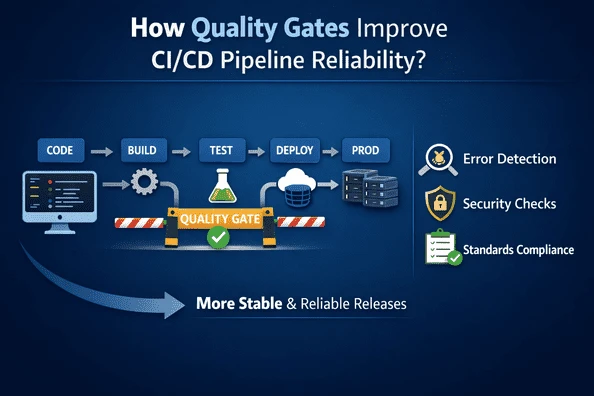
Modern software teams rely on CI/CD pipelines to release features quickly and consistently. However, rapid deployments can introduce risks if code changes are not properly validated before reaching production. This is where quality gates play a critical role.
Quality gates act as automated checkpoints in the CI/CD pipeline that verify whether a build meets predefined standards before it can move to the next stage. By enforcing testing, code quality checks, and performance validations, quality gates help teams maintain stable and reliable releases.
What Are Software Quality Gates in CI/CD?
Quality gates are conditions or rules that must be satisfied before code progresses through a pipeline stage. These conditions are typically based on metrics such as code coverage, test results, security scans, or static code analysis.
If the build fails to meet the required criteria, the pipeline stops automatically. This prevents unstable code from moving forward and ensures that only verified changes are deployed.
Why CI/CD Pipelines Need Quality Gates
Continuous integration and continuous delivery accelerate development cycles, but speed without validation can lead to production failures. Quality gates help balance speed and reliability by introducing automated validation steps.
For example, if a new feature introduces a failing test or reduces code coverage below the acceptable threshold, the pipeline blocks deployment until the issue is resolved.
Key Ways Quality Gates Improve Pipeline Reliability
1. Preventing Faulty Builds from Reaching Production
One of the primary benefits of quality gates is that they stop faulty builds early in the pipeline. Instead of discovering issues after deployment, teams detect problems during the integration stage.
This early detection significantly reduces the risk of system outages or broken functionality in production environments.
2. Enforcing Consistent Code Quality Standards
Quality gates ensure that all code changes follow predefined quality standards. These rules may include requirements for code coverage, linting results, and successful test execution.
By enforcing consistent standards across every commit, quality gates help maintain long-term code health and reduce technical debt.
3. Supporting Automated Testing Workflows
Quality gates work closely with automated testing processes. When tests run as part of the pipeline, the results determine whether the code passes the quality gate.
This integration ensures that automated validation becomes a core part of the development workflow. In many pipelines, test automation provides the verification layer that feeds directly into quality gate decisions.
4. Improving Developer Accountability
When quality gates are implemented effectively, developers receive immediate feedback about the impact of their changes. If a build fails, the pipeline clearly indicates which rule was violated.
This transparency encourages developers to fix issues early and maintain higher quality standards during development.
5. Reducing Deployment Failures
Deployments can fail when untested or unstable code is introduced into production. Quality gates reduce this risk by validating every change before deployment occurs.
By ensuring that each stage of the pipeline meets strict requirements, teams can release updates with greater confidence.
Best Practices for Implementing Quality Gates
To maximize the effectiveness of quality gates in CI/CD pipelines, teams should follow a few key practices:
- Define measurable quality metrics such as test coverage, build success rate, and static analysis results
- Integrate automated testing into every pipeline stage
- Set realistic thresholds that encourage quality without slowing development
- Continuously review and adjust quality gate criteria as the project evolves
A well-designed quality gate strategy balances speed with reliability, enabling teams to maintain efficient delivery pipelines while protecting software quality.
Conclusion
Quality gates are essential for improving the reliability of CI/CD pipelines. By enforcing automated validation, preventing faulty builds from progressing, and maintaining consistent code standards, quality gates help teams release software safely and efficiently.
When integrated with automated testing and continuous integration practices, quality gates provide a powerful safeguard against deployment risks. As development cycles become faster, these checkpoints become increasingly important for maintaining stable and reliable software delivery.