Introduction
Technology is rapidly transforming every industry, creating a growing demand for developers who can build complete web applications from scratch.
Because of this, Python Full Stack Development has become one of the most sought-after career paths in 2026.
However, beginners often ask:
- What does it take to become a Python Full Stack Developer in 2026?
- Can I learn Full Stack Python without a Computer Science degree?
- How long does it take to become job-ready?
- In what order should I learn the required technologies?
Fortunately, with the right roadmap, practical projects, and consistent learning, anyone can build a successful career as a Python Full Stack Developer.
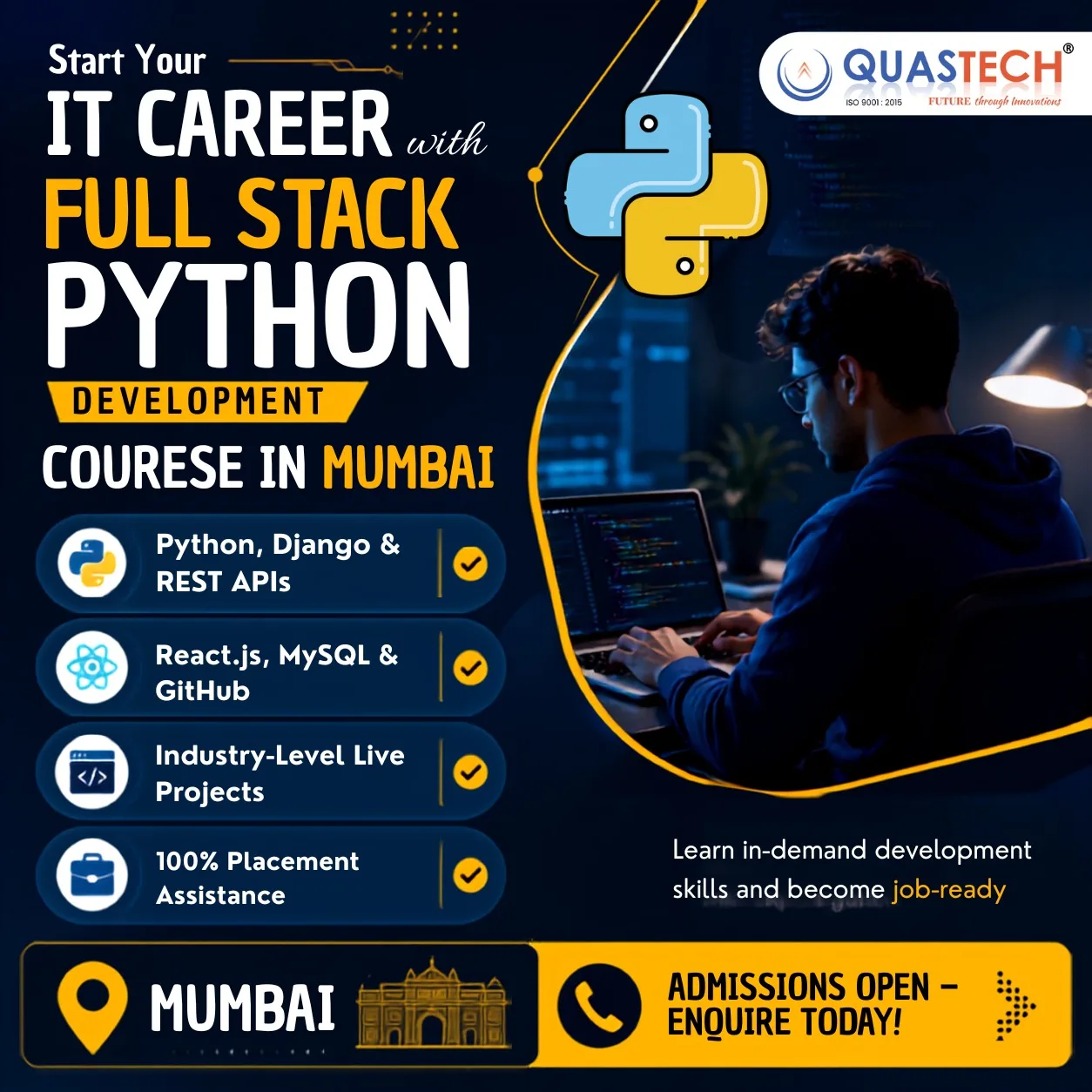
Many students begin with a Python Full Stack Developer Course in Mumbai, where they receive structured training, hands-on projects, and industry-focused guidance.
What is a Python Full Stack Developer?
A Python Full Stack Developer builds complete web applications by working on both the frontend and backend.
Unlike developers who specialize in only one area, Full Stack Developers understand the complete application lifecycle.
Their responsibilities include:
- Designing user interfaces
- Writing backend logic
- Managing databases
- Developing REST APIs
- Testing applications
- Deploying websites
This versatility makes Full Stack Developers valuable in startups, IT companies, and product-based organizations.
Step 1: Learn Programming Fundamentals
Every successful developer begins by learning programming basics.
Start with Python fundamentals:
- Variables
- Data Types
- Operators
- Loops
- Functions
- Object-Oriented Programming (OOP)
- Exception Handling
- File Handling
Python is one of the easiest programming languages for beginners because of its clean and readable syntax.
Step 2: Learn Frontend Development
Frontend development focuses on everything users see and interact with.
HTML
Learn:
- Forms
- Tables
- Semantic HTML
- Accessibility
CSS
Understand:
- Flexbox
- Grid
- Responsive Design
- Animations
JavaScript
Master:
- Variables
- Functions
- DOM Manipulation
- Events
- ES6 Features
- Async Programming
Once you're comfortable with HTML, CSS, and JavaScript, frontend development becomes much easier.
Step 3: Learn a Frontend Framework
Modern web applications are rarely built using only HTML and JavaScript.
One of the most popular frontend frameworks is React.js.
Topics include:
- Components
- Props
- State
- Hooks
- Routing
- API Integration
React helps developers build fast, scalable, and interactive web applications.
Step 4: Master Backend Development with Python
The backend handles business logic and server-side operations.
Popular Python frameworks include:
- Django
- Flask
- FastAPI
Important backend concepts:
- Authentication
- Authorization
- Session Management
- REST APIs
- File Uploads
- Email Integration
Backend development is a major part of a quality Full Stack Python Course in Mumbai.
Step 5: Learn Database Management
Every web application stores and manages data.
SQL Databases
Learn:
- MySQL
- PostgreSQL
Topics include:
- CRUD Operations
- Joins
- Normalization
- Stored Procedures
NoSQL Database
Learn the basics of:
- MongoDB
Understanding both SQL and NoSQL databases increases career flexibility.
Step 6: Learn Git and GitHub
Version control is an essential skill for modern developers.
Important concepts include:
- Git Repositories
- Branching
- Commits
- Pull Requests
- GitHub Collaboration
Version control enables developers to work efficiently in teams.
Step 7: Build Real-World Projects
Projects showcase your practical skills to employers.
Examples include:
- E-commerce Website
- Student Management System
- Hospital Management System
- Food Delivery Platform
- Job Portal
- CRM Dashboard
Your projects should include:
- Authentication
- Database Integration
- REST APIs
- Responsive UI
Strong projects significantly improve interview opportunities.
Step 8: Learn Deployment Basics
Building an application is only part of the development process.
Developers should also understand deployment.
Topics include:
- Hosting
- Domain Configuration
- Cloud Basics
- Linux Commands
Deployment knowledge helps developers understand the complete application lifecycle.
Step 9: Prepare for Technical Interviews
Interview preparation should include:
Programming Questions
- Python
- OOP
- Data Structures
Frontend Questions
- HTML
- CSS
- JavaScript
- React
Backend Questions
- Django
- REST APIs
- Authentication
Database Questions
- SQL Queries
- Joins
- Query Optimization
Regular coding practice and mock interviews improve confidence.
Skills Companies Expect in 2026
Employers typically expect Full Stack Developers to know:
- Python
- HTML
- CSS
- JavaScript
- React.js
- Django
- SQL
- Git
- REST APIs
- Debugging
- Problem Solving
Strong communication and teamwork skills are equally valuable.
How Long Does It Take to Become a Python Full Stack Developer?
The learning timeline depends on your background and consistency.
A typical roadmap:
Months 1–2
- Python Fundamentals
- Programming Basics
Months 3–4
- HTML
- CSS
- JavaScript
Months 5–6
- React
- Django
- SQL
- REST APIs
- Git
Month 7 Onwards
- Real-world Projects
- Deployment
- Interview Preparation
- Portfolio Development
Remember, employers value practical projects more than learning speed.
Is Certification Enough to Get a Job?
Certification strengthens your profile, but employers primarily evaluate practical skills.
A quality Certification Course with Placement should include:
- Live Projects
- Portfolio Development
- Mock Interviews
- Resume Building
- Coding Practice
- Career Guidance
Similarly, a Job-Oriented IT Course focuses on preparing students for real workplace requirements rather than only completing the syllabus.
Career Opportunities After Learning Full Stack Python
Python Full Stack Developers can work across various industries.
Common career paths include:
- Python Full Stack Developer
- Backend Developer
- Web Application Developer
- Django Developer
- Software Engineer
- API Developer
- Full Stack Software Engineer
With experience, professionals can also transition into:
- Cloud Computing
- DevOps
- Artificial Intelligence
- Software Architecture
Python Full Stack Career Opportunities in Mumbai
Mumbai remains one of India's leading technology and startup hubs.
Skilled Python developers are in demand across:
- IT Companies
- FinTech Firms
- Software Product Companies
- Healthcare Technology Companies
- Digital Agencies
Students interested in software development often enroll in a Python Full Stack Developer Course in Mumbai to learn frontend technologies, Python programming, Django, SQL, REST APIs, and build industry-level projects.
QUASTECH follows a practical learning approach where students build live applications, complete industry-relevant assignments, strengthen coding skills, and receive interview preparation to become industry-ready.
Conclusion
Python Full Stack Development continues to be one of the best career choices in 2026.
The journey starts with programming fundamentals and gradually progresses through frontend development, backend frameworks, databases, APIs, deployment, and real-world projects.
Rather than trying to learn everything at once, focus on mastering one technology at a time, building practical applications, and continuously improving your skills.
With consistent practice, project development, and a strong portfolio, beginners can build a rewarding career as a Python Full Stack Developer.
Frequently Asked Questions (FAQs)
1. How do I become a Python Full Stack Developer?
Start by learning Python, HTML, CSS, JavaScript, React, Django, SQL, Git, and build real-world projects.
2. Can beginners learn Python Full Stack Development?
Yes. Python is considered one of the most beginner-friendly programming languages.
3. How long does it take to become job-ready?
The timeline depends on learning consistency, practical projects, and interview preparation.
4. Is Python enough for Full Stack Development?
No. You also need frontend technologies, databases, APIs, and version control tools.
5. Which framework is best for Python Full Stack?
Django is one of the most widely used frameworks, while Flask and FastAPI are also popular.
6. Is React necessary for Python Full Stack?
Yes. React is widely used for frontend development and is commonly expected by employers.
7. What projects should I build before applying for jobs?
Build projects like e-commerce websites, management systems, dashboards, job portals, and CRUD applications.
8. Is SQL required for Full Stack Development?
Yes. SQL is essential for storing, retrieving, and managing application data.
9. Can non-IT students become Python Full Stack Developers?
Yes. Many successful developers come from commerce, science, arts, and other non-technical backgrounds.
10. Is Python Full Stack Development a good career in 2026?
Yes. Demand for Full Stack Developers continues to grow because companies prefer professionals who can manage complete web application development.
Author Bio – About QUASTECH
QUASTECH is a leading IT training and placement institute dedicated to helping students and professionals build industry-ready technical skills through practical learning. The institute offers career-oriented programs in Full Stack Python Development, Data Science, Data Analytics, Software Testing, Full Stack Java, Artificial Intelligence, Digital Marketing, and other emerging technologies. Through live projects, hands-on assignments, interview preparation, and placement assistance, QUASTECH helps learners prepare for successful careers in today's technology industry.