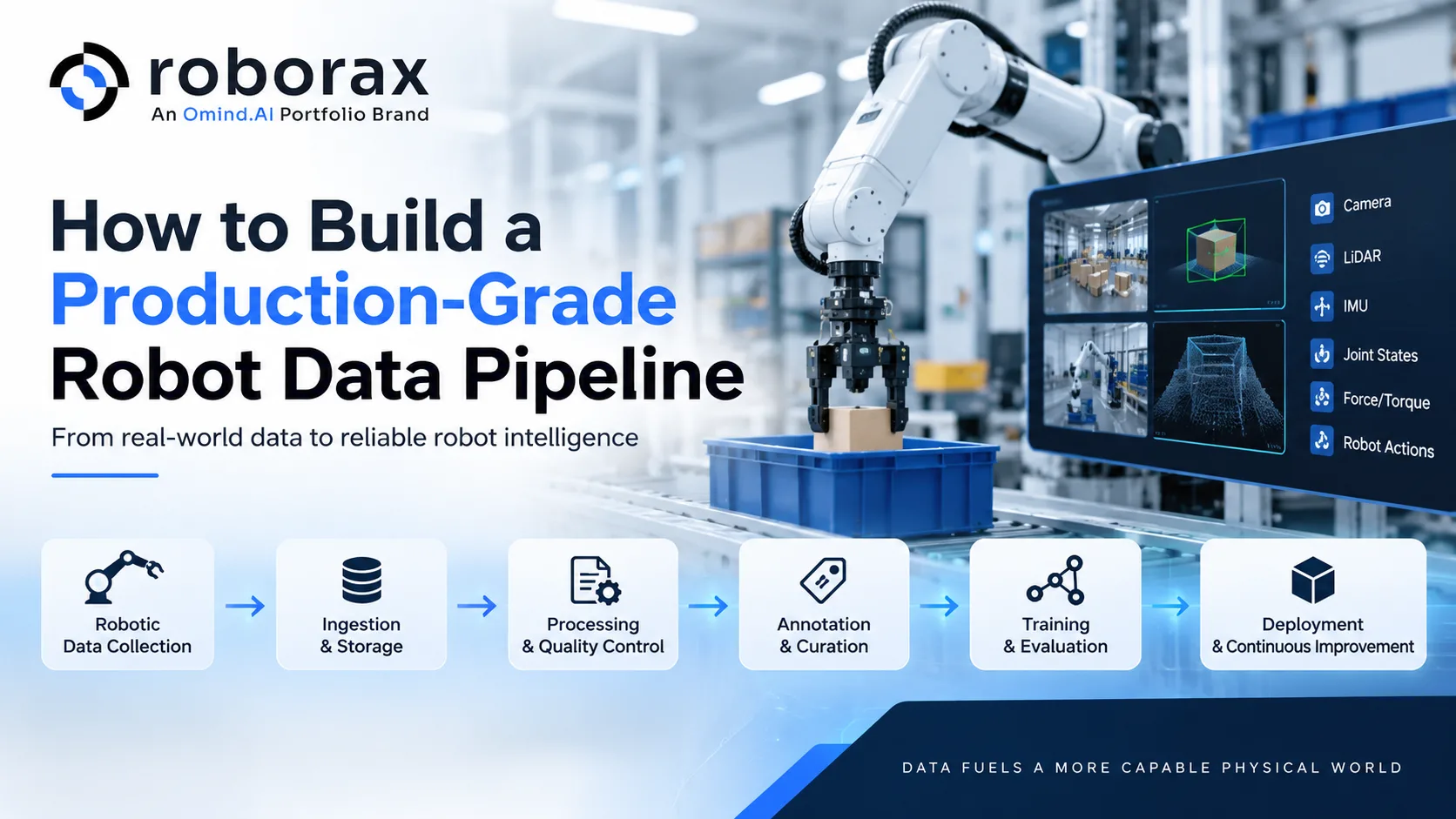
Robots are becoming increasingly capable of operating in warehouses, factories, laboratories, hospitals, and other dynamic environments. But behind every reliable autonomous system is a dependable data pipeline. Robots need large volumes of high-quality data to perceive their surroundings, understand tasks, make decisions, and improve through machine learning.
Building that infrastructure is more complicated than simply collecting sensor recordings. A production-grade pipeline must move data reliably from physical robots to storage, processing, annotation, validation, training, evaluation, and deployment. It must also preserve context, maintain data quality, and scale as robot fleets and datasets grow.
For teams developing embodied AI systems, a well-designed pipeline can turn raw robot experiences into valuable robotic training data while reducing operational bottlenecks. Here is how to build one.
1. Define the Data Requirements First
Before selecting tools or designing infrastructure, establish what the robot learning system actually needs.
Different applications require different data modalities. A mobile robot may depend heavily on cameras, LiDAR, GPS, and inertial measurements, while a manipulation robot may require RGB-D cameras, force-torque sensors, joint positions, velocities, and gripper states.
Define:
- Required sensor modalities
- Sampling frequencies
- Data formats
- Synchronization requirements
- Task and environment metadata
- Annotation requirements
- Quality thresholds
- Retention and storage policies
This initial specification prevents teams from collecting massive amounts of data that ultimately provide little training value.
2. Build Reliable Robotic Data Collection
The foundation of the pipeline is robotic data collection. Data should be captured consistently across robots, environments, tasks, and operating conditions.
A useful collection system records more than sensor streams. Each episode should ideally include contextual information such as robot ID, hardware configuration, software version, task type, environment, operator information where applicable, timestamps, and success or failure outcomes.
Synchronization is particularly important. A camera frame, joint state, and control command that appear to occur simultaneously but actually have different timestamps can introduce errors into downstream learning.
Production systems should therefore use robust timestamping and synchronization mechanisms. Every observation and action should be traceable to a common temporal reference.
3. Establish a Scalable Data Ingestion Layer
Once data leaves the robot, the pipeline needs a reliable ingestion mechanism.
Robot fleets can generate substantial amounts of multimodal data, and network connectivity may vary considerably between environments. A resilient architecture should support local buffering, resumable uploads, data validation, and asynchronous processing.
Edge devices can temporarily store recordings when connectivity is unavailable and upload them once a reliable connection is restored. This prevents valuable demonstrations from being lost because of network interruptions.
The ingestion layer should also validate files before they enter the main dataset. Checks can identify corrupted recordings, missing sensor streams, invalid timestamps, or incomplete episodes.
4. Use Structured Storage and Metadata
Raw robot data quickly becomes difficult to manage without consistent organization.
Instead of treating recordings as independent files, production pipelines should maintain structured metadata describing every episode. Useful fields can include:
- Dataset and episode identifiers
- Robot model and configuration
- Sensor configuration
- Environment information
- Task category
- Collection date
- Software and firmware versions
- Annotation status
- Quality score
- Training or evaluation designation
Object storage can handle large sensor files efficiently, while databases or metadata catalogs can make those files searchable.
This combination allows teams to answer questions such as: Which demonstrations were collected with a particular robot configuration? Which episodes contain failed grasps? Which recordings were generated after a specific software update?
5. Add Data Cleaning and Quality Control
Not every robot experience belongs in a training dataset.
A production-grade pipeline should automatically identify low-quality samples before expensive annotation or model training occurs. Automated checks can detect missing frames, excessive sensor noise, duplicate recordings, timestamp inconsistencies, abnormal trajectories, and incomplete demonstrations.
Quality scoring can also prioritize human review. Instead of manually inspecting every episode, teams can route questionable samples to reviewers while automatically accepting recordings that meet established criteria.
This approach improves the consistency of robotic training data and reduces the amount of unusable information entering the training workflow.
6. Create an Annotation and Dataset Curation Layer
Raw sensor recordings often need additional labels before they can support supervised or multimodal learning.
Depending on the application, annotations may identify objects, actions, manipulation phases, task states, failures, environmental conditions, or temporal events.
The annotation layer should be connected to the original episode rather than creating disconnected copies of the data. This maintains traceability between a label and the exact observation from which it was generated.
Dataset curation is equally important. Teams should be able to create subsets based on task, environment, robot configuration, difficulty, or quality. This makes it easier to build targeted training and evaluation datasets.
7. Introduce Versioning and Governance
Robot datasets change continuously. New demonstrations are added, labels are corrected, poor samples are removed, and collection procedures evolve.
Without version control, it becomes difficult to determine exactly which data produced a particular model.
Every meaningful dataset change should therefore generate a traceable version. Teams should record additions, removals, annotation changes, filtering rules, and preprocessing configurations.
Governance should also define who can collect, modify, approve, and release datasets. Clear ownership reduces accidental changes and makes experimental results easier to reproduce.
8. Connect the Pipeline to Model Training
A production pipeline should not end at storage. It needs a controlled path into model development.
Training jobs should be able to retrieve specific dataset versions and preprocessing configurations automatically. This enables reproducible experiments and reduces manual preparation.
The pipeline should also separate training, validation, and test data carefully. Splitting data based solely on random samples can create leakage when multiple recordings originate from the same environment, task, or robot session.
More robust evaluation may require separating environments, objects, operators, or task conditions to determine whether a model can generalize beyond its training experiences.
9. Monitor the Pipeline Continuously
Production infrastructure requires observability.
Teams should monitor metrics such as data ingestion rates, storage growth, failed uploads, missing sensor streams, annotation throughput, dataset quality, and training pipeline failures.
Data drift should also be monitored. If robots begin operating in new environments or collecting different types of demonstrations, the distribution of incoming data may change significantly.
Monitoring these changes helps teams identify gaps before they negatively affect model performance.
10. Design for Scale From the Beginning
A pipeline that works for one robot may fail when deployed across hundreds of machines.
Scalability should therefore be considered at every stage—from edge collection and data transfer to storage, annotation, search, and training.
Use modular components and standardized interfaces so individual services can scale independently. Automated processing and metadata-driven workflows can prevent human operations from becoming the bottleneck as data volume increases.
Building the Data Foundation for Embodied AI
A production-grade robot data pipeline is ultimately an infrastructure problem as much as a machine learning problem. Reliable robotic data collection, structured storage, quality control, annotation, versioning, governance, and model integration must work together.
For teams developing physical AI and autonomous robotics, the objective is not simply to gather more data. It is to create a dependable system that transforms robot experiences into consistent, traceable, high-value robotic training data.
At Roborax, we understand that the quality of a robot learning system depends heavily on the data foundation behind it. By building pipelines around reliability, scalability, and data quality, robotics teams can move more efficiently from real-world experiences to models that perform effectively in the physical world.