If your business operations are scattered across different tools and your team is struggling with fragmented data, an Enterprise Resource Planning (ERP) software can help bring everything together. However, choosing the right ERP software is tricky, as the market offers countless options. And of course, the wrong choice comes with consequences, including disconnected workflows, expensive customizations, poor user adoption, and so on. The right ERP system, on the other hand, helps businesses unify internal operations and keep every department connected through shared data.
With so many ERP development companies offering similar features and quick implementations, knowing what to look for is overwhelming. So, here’s a detailed guide to help you understand how to choose an ERP software development company that fits your company. Read on and find out how you can choose the right ERP provider.
What is an ERP Software?
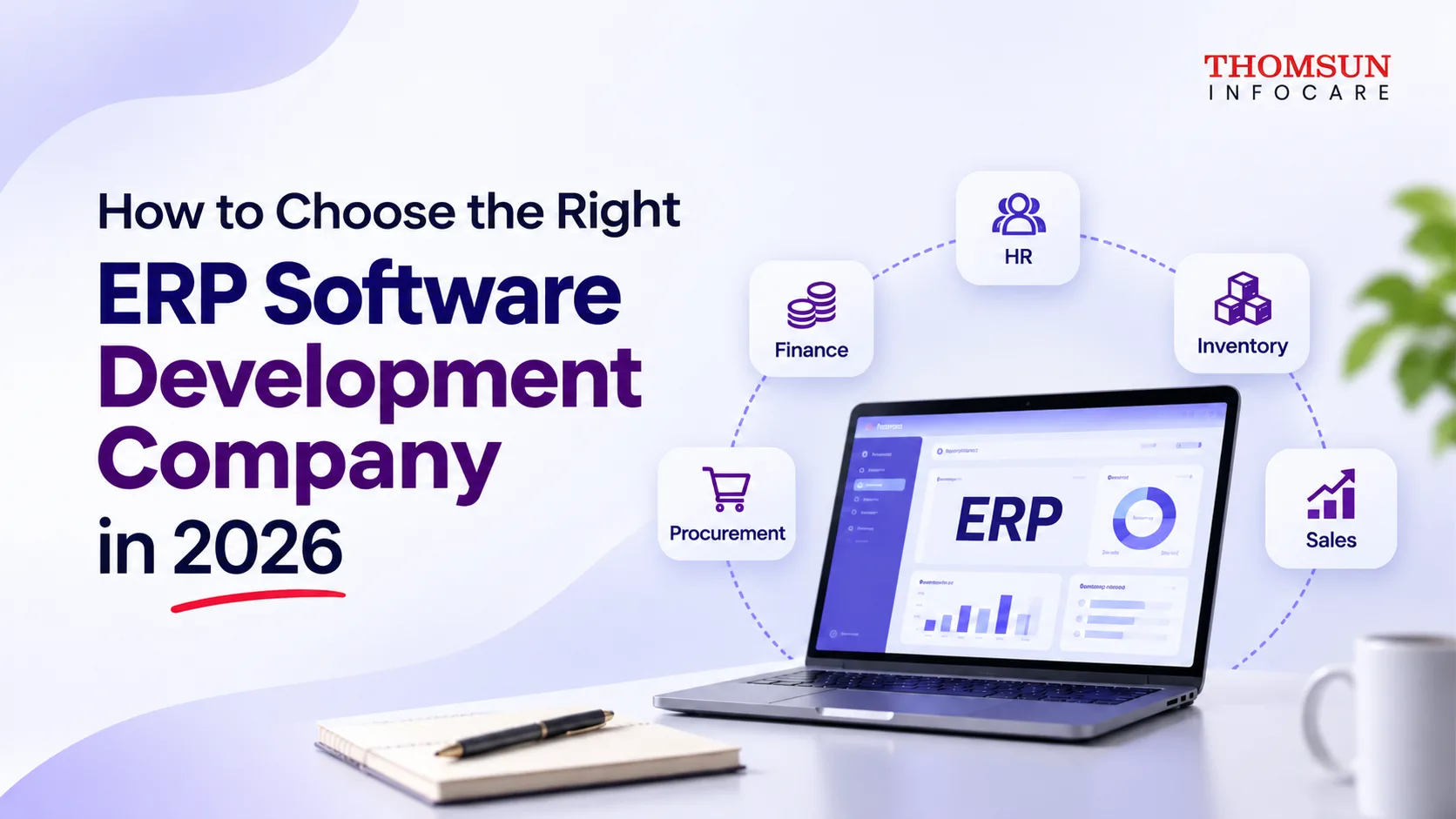
Enterprise resource planning (ERP) software is built to unify multiple business functions within a centralized platform. Instead of working on disconnected applications and spreadsheets, different teams can work with shared data across finance, inventory, procurement, sales, human resources, and other operational processes.
A well-built ERP system helps businesses minimize manual work, improve data visibility across departments, and automate repetitive tasks. However, depending on the type of organization, ERP requirements vary. For example, a commercial food manufacturer with a wide range of products may need Finance, inventory, and trading capabilities, while a service-based business may prioritize project management, billing, CRM, and HRMS. This is particularly why you should be aware of how to choose the right ERP software development company.
ERP Software Development Company Checklist
- Proven ERP Expertise
Compared to standard software development, ERP development requires a different level of knowledge and expertise. A company might have solid expertise with software applications, but limited experience in building and implementing ERP solutions. So, look for a reliable ERP development company with proven experience and a relevant portfolio.
Review their previous work, development capabilities, implementation experience, and case studies to understand the complexity and types of projects they have handled. Moreover, an ERP partner with established expertise will understand interconnected business processes, module integrations, and the challenges involved in implementing such a tool.
2. Industry Experience
Industry experience is a significant factor in how well an ERP tool fits a business. Organizations from different industries have different workflows, compliance requirements, and operational challenges. So, while thinking about how to choose the right ERP development company, check whether it has worked with businesses in your industry or handled similar requirements.
Additionally, relevant industry experience can reduce the learning curve and let the team contribute from day one.
3. Technical Knowledge & Integration Capabilities
An ERP system can give you functions including finance, inventory, HRMS, sales, and procurement in a unified platform. However, many businesses require specialized external tools or may have to retain existing tools for their operations. Therefore, integration capabilities are an important factor when choosing an ERP software development company.
The ERP partner should be able to integrate third party systems such as ecommerce platforms, payment gateways, or any other business software when required. Additionally, look for a technically adept partner who can handle any ERP requirements on the go. The goal is not to add more software to the technology ecosystem but to ensure that the systems your business needs can communicate effectively and share data seamlessly.
4. Proper Understanding of Your Business Requirements
A great ERP partner should understand the business requirements before suggesting a solution. The partner should have a clear understanding of your existing workflow, the challenges your business faces, the software you are currently using, and the areas where automation can bring efficiency. This discovery process is important because ERP implementation should not replicate inefficient processes in a new system.
The right partner focuses on simplifying workflows and creating solutions that support business growth. Additionally, you should define your business requirements clearly and identify solutions before approaching any vendor.
5. Data Migration & Security
Proper data migration and security are extremely important, as any data loss or breach can affect the newly implemented system. Moving data to a new system requires solid planning, as information can be spread across spreadsheets, legacy applications, databases, and different departments. Ensure that your ERP partner has the expertise and follow a structured process to transmit it to the new system.
Data security is equally important. ERP systems can contain sensitive business data. Before finalizing an ERP development partner, check how they handle access controls, backups, encryption, permissions, and other security measures.
The bottom line is that data migration and security should be treated with great importance from the very beginning rather than considering it a technical detail on the go.
6. Implementation Process & Timeline
ERP implementation is much more than software development and deployment. Everything, including requirement gathering, configuration, customization, data migration, testing, training, and deployment, should be planned and executed accordingly.
Ask the partner to explain their implementation process and provide a realistic timeline for each stage based on the scope of your project. Simultaneously, be cautious of companies offering extremely fast implementations without conducting a detailed discovery process. Rushed implementations can result in inefficient system functioning.
For complex organizations, a phased implementation can be suitable. This allows you to introduce modules with respect to the immediacy and critical nature of the requirement.
7. Post-Launch Support & Scalability
Going live is not the end of an ERP project. Employees may need additional training, technical issues may arise, and business requirements change. So, before choosing an ERP development company, be clear about what post-launch support they provide, how they handle issues, and whether ongoing maintenance and development are available.
The option to scale is another important factor to look for in an ERP partner. Your ERP system should accommodate the evolving changes in your organization. Only that way can it support your organizational growth.
8. Customization and Flexibility
Customization is paramount when choosing an ERP development company. Every business has different processes, and some may not fit perfectly into an ERP system. This is where customization features can help you.
Ask how the partner can customize or configure the software, accommodating your specific workflows. At the same time, excessive customization can result in high development costs and make upgrades complicated. In this case, a reliable and capable partner can help you sort out which requirements are genuinely needed.
Here, the goal is to build a flexible ERP system that can adapt and evolve according to your business changes without complexities.
Ensure that your partner meets the key criteria we discussed in this ERP software development company checklist.
TERO ERP: The New Age ERP System for Unified Business Operations
If you are wondering how to choose an ERP software development company for your business, look no further, TERO ERP is the smartest choice. Regardless of the business type, our ERP system is built to align with your workflow, operational requirements, and growth plans. Unlike traditional ERPs that are limited to specific requirements, TERO is customizable, scalable, and unifies your complex operations under one roof. Moreover, TERO ERP has already been adopted by businesses looking for a more connected experience, and the growing user adoption reflects its fitness in the competitive ERP landscape.
Conclusion
Choosing an ERP software development company requires more than feature and price comparison. As discussed in our ERP software development company checklist above, you should always examine the expertise, experience, technical capabilities, integration, scalability, flexibility, implementation, and data security.
As ERP technology is evolving, businesses should also consider capabilities such as cloud and deployment flexibility, AI and automation, mobile accessibility, API integration, analytics, and reporting. Take the time to evaluate vendors against your requirements and look beyond sales presentations.
If you are still confused about how to choose an ERP software development company, reach out to us, and our team will guide you through every question. Thomsun Infocare is one of the best custom ERP software development companies in the UAE. We deliver tailored ERP software solutions for UAE businesses and support long term growth.