
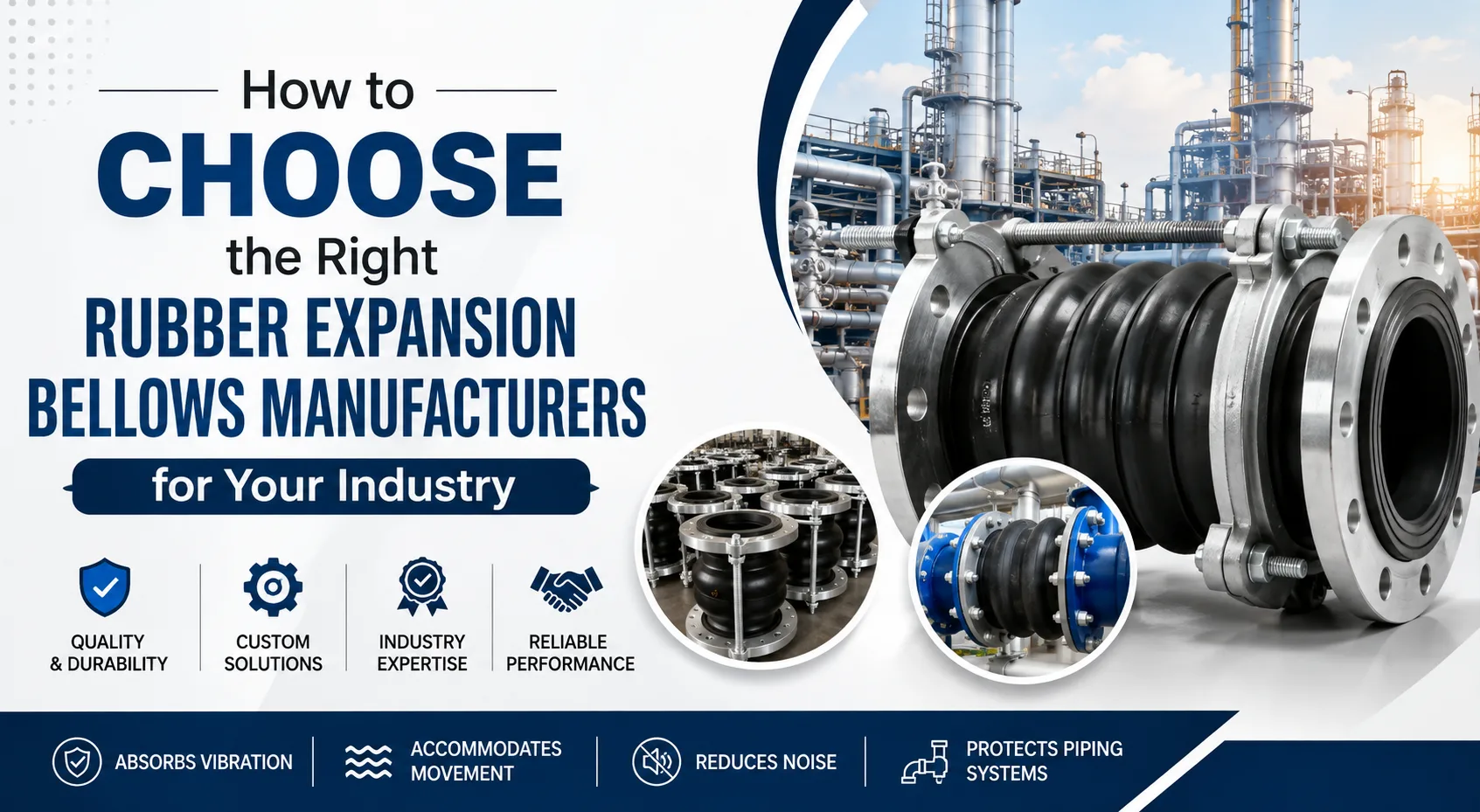
Choosing the right supplier for critical piping components can make a noticeable difference in system performance, maintenance, and operating costs. How to Choose the Right Rubber Expansion Bellows Manufacturers for Your Industry is an important question for industries that depend on reliable piping systems, pumps, HVAC equipment, water treatment plants, and industrial machinery. A well-made rubber expansion bellow can absorb vibration, accommodate thermal movement, reduce noise, and protect connected equipment from mechanical stress.
However, not every manufacturer offers the same level of quality, customization, or technical support. Before placing an order, it is worth looking beyond price and comparing several factors that affect long-term performance.
What Are Rubber Expansion Bellows?
Rubber expansion bellows are flexible components installed between sections of piping or equipment. Their flexible construction allows them to absorb movement caused by temperature changes, vibration, pressure fluctuations, and minor alignment issues.
They are commonly manufactured using elastomers such as EPDM, neoprene, nitrile, natural rubber, or other specialized compounds. The suitable material depends on the fluid, temperature, pressure, and operating conditions of the application.
These components are frequently used in:
- Water and wastewater treatment systems
- HVAC and air-conditioning systems
- Chemical processing plants
- Pumping systems
- Power plants
- Industrial piping networks
- Food and beverage processing
- Marine applications
- Manufacturing facilities
Selecting the correct bellows is important because the wrong material or design can result in premature wear, leakage, or equipment damage.
Why Manufacturer Selection Matters
A rubber expansion bellow may look like a relatively simple component, but its performance depends on material formulation, reinforcement, molding quality, dimensions, and testing.
An experienced manufacturer understands these factors and can recommend a product based on the actual operating environment rather than simply supplying a standard size.
A dependable manufacturer should be able to provide consistent products, accurate dimensions, suitable materials, and technical information. This becomes especially important when bellows are used in high-temperature, high-pressure, corrosive, or continuous-duty applications.
1. Check the Manufacturer's Industry Experience
Start by looking at the manufacturer's experience.
A company that has supplied rubber expansion bellows for several years is more likely to understand the practical challenges associated with different piping systems. Experience across multiple industries can also indicate that the manufacturer knows how different elastomers behave under various operating conditions.
Ask questions such as:
- How long has the manufacturer been producing expansion bellows?
- Which industries do they serve?
- Do they manufacture standard and customized designs?
- Can they recommend materials for specific fluids?
- Have they supplied products for applications similar to yours?
Industry experience does not automatically guarantee quality, but it is a useful factor when comparing potential suppliers.
2. Evaluate the Quality of Raw Materials
The rubber compound used in a bellow directly affects its durability.
Different applications require different elastomers. For example, EPDM may be suitable for many water and hot-water applications, while nitrile rubber is often selected where resistance to oils and petroleum-based fluids is important.
When comparing manufacturers, ask about:
- Rubber compound specifications
- Reinforcement materials
- Temperature resistance
- Chemical compatibility
- Pressure rating
- Aging and weather resistance
A manufacturer should be able to explain why a particular rubber compound is suitable for your operating conditions.
3. Look at Manufacturing Capabilities
Good manufacturing capabilities are essential for producing expansion bellows with consistent dimensions and performance.
Check whether the manufacturer has suitable equipment for molding, reinforcement, finishing, and quality inspection. Advanced manufacturing processes can help maintain uniform wall thickness, accurate dimensions, and proper reinforcement.
It is also useful to determine whether the manufacturer can produce different configurations, sizes, and connection arrangements.
If your piping system has unusual dimensions, a supplier capable of producing customized bellows can be a better choice than one offering only standard products.
4. Ask About Customization Options
Industrial piping systems are not always designed around standard dimensions. You may require a specific length, flange arrangement, rubber compound, pressure rating, or movement capacity.
A capable manufacturer should be able to discuss customization requirements before production.
Depending on the application, customization may include:
- Different diameters
- Custom face-to-face dimensions
- Flange drilling patterns
- Special rubber compounds
- Higher temperature resistance
- Different pressure ratings
- Multiple arch designs
- Special reinforcement
Provide the manufacturer with accurate technical information. This allows them to recommend a bellow that matches the application instead of relying on assumptions.
5. Check Pressure and Temperature Ratings
Pressure and temperature are two of the most important specifications when selecting an expansion bellow.
Every rubber compound has operating limits. Excessive temperature can accelerate rubber degradation, while pressure beyond the design rating can cause deformation or failure.
Before ordering, identify:
- Normal operating pressure
- Maximum operating pressure
- Normal operating temperature
- Maximum temperature
- Fluid or gas being transported
- Expected movement
- Installation environment
Share these details with the manufacturer and confirm that the proposed product is suitable for the complete operating range.
6. Consider Chemical Compatibility
The fluid flowing through a pipeline can have a major effect on rubber performance.
Water, oils, chemicals, acids, solvents, and other fluids interact differently with elastomeric materials. A rubber compound that performs well with water may not be appropriate for an oil-based or chemically aggressive application.
This is why selecting a bellow based only on size is not enough.
A reliable manufacturer should help identify an appropriate material according to the chemical characteristics of the medium. If your application involves aggressive chemicals, provide the manufacturer with detailed information about concentration and operating temperature as well.
7. Review Testing and Quality Control
Quality control should be part of the manufacturing process, not something considered only after a problem occurs.
Ask potential suppliers about their inspection and testing procedures. Depending on the product and application, these may include dimensional inspection, pressure testing, material checks, and visual examination.
You can also ask whether the manufacturer provides product documentation such as:
- Technical datasheets
- Material information
- Test certificates
- Dimensional drawings
- Quality certificates
- Inspection reports
Clear documentation makes it easier for engineering and maintenance teams to verify that the supplied component meets project requirements.
8. Compare Product Design and Construction
Not all rubber expansion bellows have the same construction.
Some designs are intended primarily to absorb vibration, while others are designed to accommodate axial, lateral, or angular movement. Reinforcement and arch configuration can also affect performance.
When comparing manufacturers, examine the construction details rather than comparing products only by price.
A suitable design should match the movement requirements and installation conditions of your piping system. Incorrect installation or excessive movement can shorten service life even when the bellow itself is manufactured correctly.
9. Check Certifications and Standards
Depending on your industry, specific standards or certifications may be required.
Ask the manufacturer which quality management systems, product standards, or industry requirements their products comply with. This is particularly important for regulated industries and large engineering projects.
Do not assume that a certificate automatically means the product is suitable for every application. Verify that the certification or standard is relevant to your specific requirement.
10. Consider Technical Support
Technical support can be extremely valuable when selecting and installing expansion bellows.
A knowledgeable manufacturer should be willing to discuss installation conditions, movement requirements, operating temperatures, pressure, and material compatibility.
Good support can help prevent common problems such as:
- Incorrect sizing
- Excessive movement
- Improper alignment
- Incorrect flange installation
- Unsupported piping
- Material incompatibility
The relationship should not end when the product is delivered. Responsive technical assistance can be useful during installation and future maintenance.
11. Compare Lead Times and Production Capacity
Delivery time matters when expansion bellows are required for a new project, plant shutdown, or replacement job.
Ask about standard production lead times and whether the manufacturer can handle larger quantities. If customized products are required, confirm the expected production schedule before placing the order.
A supplier with adequate production capacity can be particularly valuable for projects involving multiple sizes or repeated orders.
12. Don't Choose Based on Price Alone
Price is important, but the cheapest product may not always be the most economical option.
A low-cost bellow that fails early can result in replacement expenses, production downtime, labor costs, and possible damage to connected equipment.
Instead, consider the overall value, including:
- Product quality
- Expected service life
- Material suitability
- Manufacturing consistency
- Technical support
- Warranty terms
- Delivery reliability
- Customization capability
A slightly higher initial investment may provide better value when the component is expected to operate continuously for years.
Questions to Ask Before Placing an Order
Before selecting a manufacturer, prepare a basic technical checklist. Important questions include:
- What rubber compound is recommended for my application?
- What are the maximum pressure and temperature ratings?
- What movements can the bellow accommodate?
- Can the product be customized?
- What testing is performed before dispatch?
- Are technical drawings and datasheets available?
- What certifications or standards does the product meet?
- What is the expected production and delivery time?
- Is installation guidance available?
- What after-sales support is provided?
Having these answers makes supplier comparison much easier.
Final Thoughts
Finding the right manufacturer requires more than comparing product prices. Material quality, manufacturing experience, customization, pressure and temperature ratings, chemical compatibility, testing, certifications, and technical support all deserve attention.
When you evaluate rubber expansion bellows manufacturers in India, focus on the supplier's ability to provide a product that matches your actual operating conditions and long-term requirements. A reliable manufacturer should be able to discuss your application, recommend the appropriate construction, provide clear specifications, and maintain consistent quality from one order to the next.