For local businesses, online visibility is no longer optional. Whether you run a law firm, restaurant, dental practice, home service company, auto repair shop, real estate business, or another local service, potential customers are searching online before deciding which business to choose.
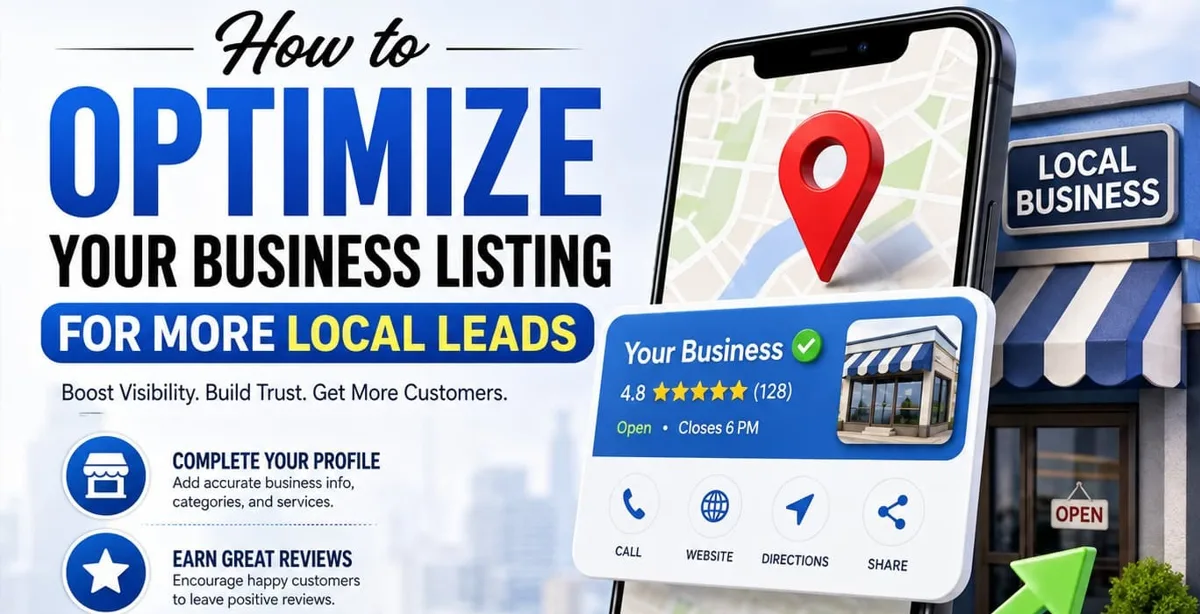
A well-optimized business listing can become one of your most valuable digital marketing assets. It can help people discover your company, understand your services, compare you with competitors, read reviews, visit your website, request directions, and ultimately become leads or customers.
However, simply creating a business listing is not enough.
To generate more local leads, your listing needs accurate information, relevant categories, compelling content, consistent business details, strong reviews, quality images, and clear conversion opportunities. It should also support your broader local SEO strategy across your website, business profiles, local directories, social platforms, and industry-specific websites.
In this guide, we'll explain how to optimize your business listing for more local leads and build a stronger presence in local and organic search results.
Why Business Listing Optimization Matters for Local Lead Generation
When someone searches for a local service, they often have strong purchase or contact intent.
They may search for:
- Personal injury lawyer near me
- Best plumber in [city]
- Family dentist in [location]
- Auto repair shop near me
- Local roofing company
- Restaurant near [neighborhood]
- Real estate agent in [city]
These searches can lead directly to website visits, appointment requests, direction requests, and other customer actions.
Your business listing acts as a digital introduction to your company. If the information is incomplete, outdated, or inconsistent, potential customers may choose a competitor instead.
A well-optimized listing helps answer important questions before the customer even contacts you:
- What does this business do?
- Where is it located?
- What services does it provide?
- What areas does it serve?
- How can I contact the business?
- What do other customers say?
- Is the business open?
- Does the business appear trustworthy?
- Does the website provide more information?
The easier you make it for customers to find and understand your business, the more opportunities you create for local leads.
Start With Accurate and Consistent Business Information
The foundation of every successful business listing is accurate information.
Your core business details should remain consistent across your website and important online profiles.
Include Complete NAP Information
NAP traditionally stands for:
- Name
- Address
- Phone number
These details should accurately represent your real business.
Avoid using one business name on your website and a significantly different version across directories. Likewise, make sure your address and other contact details are correct and current wherever they appear.
Additional Information to Include
A complete business listing should also include:
- Website URL
- Business category
- Business description
- Opening hours
- Special holiday hours
- Email address when appropriate
- Service areas
- Appointment or booking information
- Social media profiles
- Products or services
- Business attributes
Why Consistency Matters
Customers may discover your business through many different sources, including search engines, local directories, industry websites, social platforms, or a business listing platform.
If different profiles contain conflicting information, customers can become confused.
For example, a potential customer might find:
- Different business names across platforms
- Incorrect operating hours
- An outdated address
- Inconsistent website information
- Old service details
That confusion can reduce trust and cost your business potential leads.
Create a master record of your official business information and use it whenever you create or update online listings.
Choose the Most Relevant Business Categories
Business categories help search engines, directories, and potential customers understand what your company does.
Choosing the right primary category can make your listing more relevant to the searches that matter most to your business.
Be Specific Whenever Possible
If your business is a personal injury law firm, a broad category such as "Legal Services" may provide less context than a more specific available category.
The same principle applies to other industries.
Look for categories that accurately describe your primary business activity, such as:
- Personal Injury Attorney
- Roofing Contractor
- Family Dentist
- Auto Repair Shop
- HVAC Contractor
- Real Estate Agency
- Italian Restaurant
Your primary category should reflect your main business activity.
Add Relevant Secondary Categories
If the platform allows additional categories, include services that genuinely represent your business.
Do not select unrelated categories simply because they appear to have high search volume. Relevance and accuracy are more valuable than filling your profile with unrelated terms.
Write a Business Description That Attracts Local Customers
Your business description should clearly explain:
- Who you are
- What you offer
- Who you serve
- Where you operate
- Why customers should choose your business
A strong description combines useful information with natural local relevance.
Example Business Description Structure
You can structure your description like this:
[Business Name] provides [primary service] for customers in [primary city] and surrounding communities. Our team helps [target audience] with [important services]. We are committed to providing [key benefit or differentiator]. Visit our website to learn more or schedule a consultation.
This format is simple, clear, and customer-focused.
Avoid Keyword Stuffing
You do not need to repeat the same keyword over and over.
For example, this type of description can appear unnatural:
Best plumber in Dallas, Dallas plumber, plumbing Dallas, emergency plumber Dallas, affordable Dallas plumber.
Instead, write naturally:
Our experienced plumbing team provides residential and commercial plumbing services throughout Dallas and nearby communities, including repairs, installations, inspections, and emergency plumbing assistance.
The second example gives customers and search engines useful context without sacrificing readability.
Add Every Important Service You Offer
Many businesses lose potential leads because their listings only describe the company broadly.
A customer searching for a specific service may never realize that your business offers it.
Create clear service information for your most important offerings.
For Example, a Law Firm Could Include
- Car accident representation
- Truck accident claims
- Motorcycle accident cases
- Wrongful death claims
- Dog bite injuries
- Slip and fall accidents
A Home Service Business Could Include
- Emergency repairs
- Installation services
- Maintenance
- Inspections
- Residential services
- Commercial services
The goal is to create a clear connection between what customers search for and what your business actually provides.
Optimize Your Business Listing for Local Search Intent
Local customers often include geographic terms in their searches.
Examples include:
- Divorce lawyer in Mesa
- Dentist in Phoenix
- Roofer in Salt Lake City
- Car repair in Austin
- HVAC company near downtown
Your listing should clearly communicate your primary location and legitimate service area.
Add Your Primary Location
Include your correct business address when your business has a physical location that customers can visit.
Define Your Service Area Carefully
If you travel to customers, clearly identify the cities, neighborhoods, or regions you actually serve.
Avoid claiming an unrealistically large number of locations simply to target more keywords. Instead, focus on areas where your business genuinely operates.
Build Location Relevance Across Your Website
Your business listing should not work alone.
Support it with useful location-focused content on your website, such as:
- City service pages
- Location pages
- Area-specific FAQs
- Case studies
- Local guides
- Service pages
- Customer testimonials
For example, a roofing company serving Mesa and nearby communities could create useful pages about roofing services in those areas.
The key is to create genuinely useful content rather than publishing thin pages that simply replace one city name with another.
Add High-Quality Photos and Visual Content
People want to know what a business looks like before contacting or visiting it.
Photos can demonstrate professionalism, experience, services, products, team members, and business personality.
Consider adding:
- Exterior photos
- Interior photos
- Team photos
- Service photos
- Product photos
- Before-and-after images
- Completed projects
- Office or storefront images
- Branded images
Keep Images Current
Old images can create the wrong impression.
If your office has moved, your branding has changed, or your business has added new services, update your visuals accordingly.
Authentic images can often provide more value than generic stock photography because they show customers what they can actually expect.
Build and Manage Customer Reviews
Reviews can strongly influence whether someone chooses to contact your business.
Customers comparing several local companies may consider:
- Overall rating
- Number of reviews
- Recent feedback
- Quality of responses
- Common themes in customer experiences
Develop a consistent process for requesting honest reviews from real customers.
A Simple Review Strategy
After completing a successful service:
- Thank the customer.
- Ask for honest feedback.
- Provide a simple review process.
- Never pressure the customer to leave only positive feedback.
- Respond professionally when appropriate.
Respond to Reviews
Positive reviews deserve appreciation, while negative reviews should be handled calmly and professionally.
Avoid arguing publicly with customers. Instead, demonstrate that your business takes feedback seriously.
A thoughtful response can help protect your reputation and show future customers that your company is responsive and professional.
Add a Strong Call to Action
Visibility alone does not guarantee leads.
Your listing should tell potential customers what to do next.
Examples include:
- Request a free estimate
- Schedule a consultation
- Book an appointment
- Visit your website
- Get directions
- Contact your team
- Request more information
Make the Next Step Easy
Do not force users to search through multiple pages to find important information.
Your website should make conversion easy with visible:
- Contact information
- Contact forms
- Appointment forms
- Consultation requests
- Email information
- Service inquiry forms
The fewer obstacles between discovery and contact, the better your chances of converting local visitors into customers.
Build Consistent Listings Across Trusted Directories
Do not rely on a single online profile.
A strong local presence can include listings across relevant and trustworthy platforms, including:
- Major search platforms
- Business directories
- Industry-specific directories
- Local business directories
- Chamber of commerce websites
- Professional associations
- Local community websites
- Social media platforms
For example, a business directory profile on Yelp Circle can provide another place for potential customers to discover and learn about a local business.
Focus on Quality and Relevance
You do not need to submit your business to every directory on the internet.
Focus on platforms that are:
- Relevant to your industry
- Useful for local customers
- Trusted by users
- Appropriate for your location
- Capable of providing accurate business information
Quality, accuracy, and consistency should be more important than simply accumulating a large number of listings.
Connect Your Business Listing With Your Website
Your listing and website should support each other.
The website link in your listing should lead users to the most relevant page whenever possible.
For example:
- A general business listing can link to the homepage.
- A location-specific listing may link to a relevant location page.
- A service-focused profile can direct users to an appropriate service page when the platform permits it.
Make Landing Pages Convert
A local lead may arrive from a directory or search result and immediately decide whether to stay or leave.
Your landing page should clearly include:
- A strong headline
- Your primary service
- Your location or service area
- Trust signals
- Customer reviews or testimonials
- Clear contact information
- A visible call to action
Do not send potential customers to a page that provides little information or makes contacting your business difficult.
Use Local Business Schema on Your Website
Structured data can provide additional context about your business to search engines.
Depending on your business type, relevant markup may include:
- Business name
- Address
- Contact information
- Website URL
- Opening hours
- Geographic information
- Business type
Use the most appropriate business type for your organization and ensure that the information in your structured data matches the visible information on your website.
Structured data should support accurate information rather than attempt to manipulate search results.
Monitor Your Listing Performance
Optimization is not a one-time project.
Businesses change. Services expand. Hours change. Customers leave reviews. Competitors update their profiles.
Review your listings regularly.
Monitor Important Performance Signals
Track metrics such as:
- Website clicks
- Customer actions
- Direction requests
- Contact form submissions
- Appointment requests
- Keyword visibility
- Organic traffic
- Local search visibility
- Conversion rates
- New customer inquiries
The goal is not simply to increase impressions.
The real goal is to generate qualified leads.
How Business Listings Can Support Google 3-Pack Visibility
Many local business owners want to appear prominently when customers search for services in their area.
A complete and well-maintained business presence can support stronger local visibility by making it easier for search engines and customers to understand:
- What your business does
- Where it operates
- How customers can contact you
- What services you provide
- How customers experience your business
However, no single tactic guarantees placement in Google's local results.
Local visibility is influenced by multiple factors, including relevance to the search, the searcher's location, and the overall prominence and trust associated with the business.
The best long-term strategy is to build a complete local presence rather than chase shortcuts.
A Simple Business Listing Optimization Checklist
Before publishing or updating your listing, review the following:
Business Information
- Accurate business name
- Correct address
- Consistent contact information
- Updated website URL
- Correct opening hours
- Special hours when applicable
SEO and Relevance
- Accurate primary category
- Relevant secondary categories
- Complete business description
- Important services listed
- Legitimate service areas included
Trust and Conversion
- High-quality photos
- Clear call to action
- Easy contact options
- Recent customer reviews
- Professional review responses
Website Support
- Relevant landing page
- Accurate business information
- Location and service pages
- Mobile-friendly experience
- Appropriate LocalBusiness structured data
- Internal links to important services and locations
Final Thoughts: Turn Your Business Listing Into a Local Lead Generation Asset
An optimized business listing is more than an online directory profile. It can become an important part of your local marketing strategy.
Businesses that generate more value from local search usually focus on the fundamentals consistently. They keep information accurate, clearly describe their services, choose relevant categories, add useful photos, earn authentic reviews, maintain a strong website, and make it easy for customers to take the next step.
Start by auditing your existing listings.
Check whether your business name, address, contact information, website, hours, categories, services, and descriptions are accurate. Identify duplicate or outdated profiles. Improve your most important listings first, then continue building a consistent presence across relevant local and industry platforms.
Ready to Improve Your Local Visibility?
If you want to help more potential customers discover your business, start by creating or optimizing your business profile and making sure your online information accurately represents your company.
A complete listing can help customers understand who you are, what you offer, and how to take the next step.
Visit Yelp Circle to explore local business listings, strengthen your online presence, and create a more discoverable profile for your business.
Then connect your listing with a strong website, helpful local content, consistent citations, and an ongoing local SEO strategy designed to turn visibility into real leads.
For additional local SEO resources and citation services, visit Local SEO Citation.
WhatsApp: +8801323-325922