White label website development has become a practical way for agencies, freelancers, and consulting companies to expand their services without building a large in-house development team. Instead of hiring developers for every technology or project, an agency can partner with a specialized development company and sell the completed service under its own brand.
The basic relationship is simple:
Client → Agency → White Label Development Partner
The agency manages the client relationship, strategy, sales, and branding, while the white label development partner handles the agreed technical work behind the scenes.
As demand for websites grows and projects become more technically complex, this model can help businesses improve capacity, meet deadlines, access specialized skills, and focus more heavily on sales and client relationships. AI-assisted development is also changing how development teams work, although human expertise remains essential for architecture, security, integrations, quality control, and complex business requirements.
What Is White Label Website Development?
White label website development is a business model where a development provider creates websites or performs development services for another agency, allowing that agency to sell the work under its own brand.
For example, suppose an SEO agency wins a $3,000 website project but does not have developers on staff. Instead of rejecting the project or hiring a permanent developer, it can work with a white label website development company.
The agency communicates with the client, manages expectations, and presents the final website under its own brand. The development partner works behind the scenes according to the agency's requirements.
This arrangement can be used for:
- Website design and development
- WordPress development
- Shopify development
- Webflow and Framer development
- Custom website development
- E-commerce development
- Website redesigns
- Landing pages
- Website maintenance
- Technical SEO implementation
The important point is that white label development is more than simply outsourcing coding. A successful partnership requires clear processes, communication, quality control, confidentiality, and defined responsibilities.
How Does White Label Website Development Work?
A typical white label website development process follows several stages.
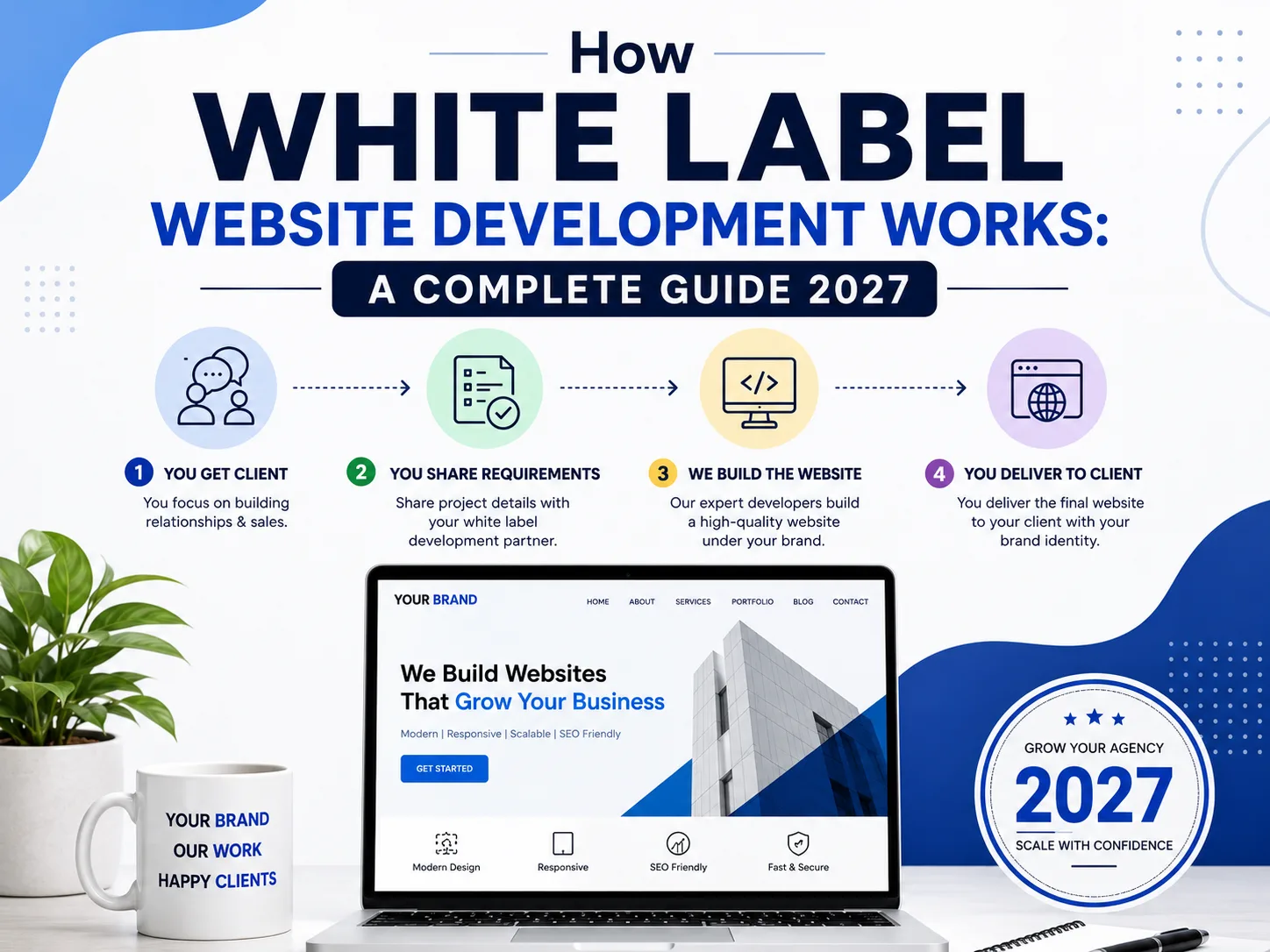
Step 1: The Agency Gets the Client
The agency first markets website development services and signs a client.
The agency may already provide SEO, branding, advertising, social media, or other digital services. Website development becomes an additional service that can increase the value of its overall offering.
Step 2: The Agency Collects Requirements
Before sending the project to a development partner, the agency should create a detailed project brief.
Important information can include:
- Business information
- Website objectives
- Target audience
- Design preferences
- Sitemap
- Required features
- Content requirements
- Technology preferences
- Integrations
- Budget
- Timeline
- SEO requirements
A detailed brief reduces misunderstandings and helps the development team estimate the project accurately.
Step 3: The Agency Sends the Project to the White Label Partner
The agency provides the development partner with the required documents and assets.
These may include designs, wireframes, content, technical specifications, brand guidelines, access credentials, and project requirements.
The partner then reviews the scope and confirms the development approach, timeline, and cost.
Step 4: Development Begins
The white label development team performs the agreed technical work.
Depending on the project, technologies may include:
- WordPress
- Shopify
- Webflow
- Framer
- Laravel
- React
- Next.js
- WooCommerce
- Custom CMS
- Headless CMS
The right technology depends on the client's business requirements rather than simply choosing the most popular platform.
Step 5: Quality Assurance
Before delivery, the website should go through a structured QA process.
Testing may include:
- Responsive design
- Browser compatibility
- Website speed
- Forms
- Navigation
- Functionality
- Security
- Basic SEO implementation
- Mobile usability
Quality assurance is particularly important in a white label relationship because the agency's reputation is ultimately connected to the final product.
Step 6: Agency Review
The agency receives the completed website and reviews it against the original requirements.
If changes are required, the agency sends consolidated feedback to the development partner.
Step 7: Client Approval
Once the agency is satisfied, it presents the completed website to its client under its own brand.
The client may request additional revisions before giving final approval.
Step 8: Launch and Support
After approval, the website is deployed.
Depending on the agreement, the agency or development partner may then provide:
- Hosting support
- Maintenance
- Security updates
- Bug fixes
- Performance optimization
- Content updates
- Technical support
A simple overview of the process is:
Client Acquisition → Requirements → White Label Partner → Design/Development → QA → Agency Review → Client Approval → Launch → Maintenance
Who Uses White Label Website Development?
White label development can be useful for many types of businesses.
Digital Marketing Agencies
Digital marketing agencies can add website development to SEO, PPC, social media, and marketing packages without building a full development department.
SEO Agencies
An SEO agency can provide technically optimized websites while continuing to focus its internal resources on search strategy, content, and optimization.
Branding Agencies
Branding agencies can turn visual identities and brand guidelines into complete websites through a development partner.
Advertising Agencies
Advertising agencies may need landing pages, campaign websites, and promotional pages. White label development can provide additional technical capacity when campaigns move quickly.
Freelancers
Freelancers can manage more website projects without becoming responsible for every technical task themselves.
IT Consulting Companies
IT consulting companies can use external development specialists when they need additional capacity or expertise in a particular technology.
White Label Website Development vs. In-House Development
The decision between an in-house team and a white label partner depends on business requirements.
FactorWhite Label DevelopmentIn-House DevelopmentHiring costGenerally lower initial overheadRequires recruitment and salariesScalabilityEasier to add project capacityDepends on team sizeTechnical expertiseCan access specialized teamsLimited to internal capabilitiesManagementPartner management requiredDirect employee managementProject flexibilityUseful for fluctuating demandBest with consistent workloadTime to startCan be relatively quickRecruitment may take timeMaintenanceCan be included in agreementManaged internallyControlRequires clear processesDirect control over developersLong-term costDepends on project volumeIncludes ongoing employee costsWhite labeling does not necessarily replace an in-house team. An agency with internal developers can also use a white label development Agencies when it has excess workload, needs specialized expertise, or has a tight deadline.
Benefits of White Label Website Development
1. Lower Development Overhead
An agency does not necessarily need to maintain a large technical department to sell development services.
2. Faster Project Delivery
An experienced development partner can provide additional resources when projects need to move quickly.
3. Easier Business Scaling
Agencies can accept more projects without immediately hiring permanent employees.
4. Access to Specialized Developers
A good partner may have specialists across multiple platforms and technologies.
5. No Need for a Large Technical Team
Businesses can concentrate internal resources on their strongest capabilities while outsourcing specialized development work.
6. Ability to Offer More Services
An SEO, branding, or marketing agency can expand its service portfolio with development services.
7. Better Resource Management
Internal teams can focus on strategy, sales, client management, and high-value activities.
8. Increased Revenue Opportunities
Website development can become an additional revenue stream alongside SEO, maintenance, hosting, analytics, and marketing.
9. More Focus on Client Relationships
The agency can spend more time acquiring clients and developing long-term relationships instead of managing every line of code.
10. Multiple Projects at Once
With a reliable partner, agencies can potentially manage several projects simultaneously without building a large permanent team.
How Agencies Make Money With White Label Development
The economics are straightforward.
For example:
- Agency charges the client: $3,000
- White label development cost: $1,800
- Agency gross margin: $1,200
This is only an example. Actual margins vary depending on technology, project complexity, geography, scope, revisions, maintenance requirements, and the development partner.
Agencies can also increase the overall value of a website project by offering related services such as:
- SEO
- Hosting
- Maintenance
- Website security
- Content
- Conversion rate optimization
- Local SEO
- Analytics
- Paid advertising
- Website redesigns
The strongest model is often not based on a single website project but on building recurring client relationships around multiple digital services.
White Label Website Development Pricing in 2027
There is no universal price for white label website development because project requirements vary significantly.
Common pricing models include:
Fixed Project Pricing
The agency and development partner agree on a defined project price.
This works well when the scope, features, pages, and deliverables are clearly documented.
Hourly Pricing
The partner charges according to development hours.
This can be useful for maintenance, ongoing improvements, troubleshooting, or projects where requirements may change.
Monthly Retainer
An agency pays a recurring monthly fee for continuous development support.
This model can be useful for agencies managing multiple clients or requiring regular technical assistance.
Dedicated Developer Model
An agency can work with a dedicated developer or development team through a white label partner.
Pricing is influenced by factors such as:
- Website size
- Number of pages
- CMS
- Custom functionality
- API integrations
- E-commerce features
- Design complexity
- SEO requirements
- Third-party integrations
- Maintenance
- Development location
Agencies should compare providers based on total value, quality, communication, and reliability rather than choosing purely on the lowest quote.
What Services Can Be White Labeled?
The scope of white label web development can extend well beyond basic website creation.
Common services include:
- Website design
- Website development
- WordPress development
- Shopify development
- WooCommerce development
- Webflow development
- Framer development
- Custom website development
- Landing page development
- E-commerce development
- Website redesign
- Website migration
- CMS development
- API integration
- Third-party integrations
- Website maintenance
- Website speed optimization
- Technical SEO implementation
Before starting a partnership, agencies should clearly document which services are included, what is excluded, how revisions work, and who handles support.
Complete White Label Website Development Workflow
A professional workflow can be organized as:
Discovery → Requirement Documentation → Proposal → Design → Development → Internal QA → Agency QA → Client Review → Revisions → Final Approval → Deployment → Maintenance
Each stage should have a clear owner.
During discovery, the agency identifies business goals and project requirements.
During requirement documentation, the scope, technology, functionality, integrations, and deliverables are recorded.
During design, visual layouts and user experience are established.
During development, the technical team converts the approved design into a functional website.
During internal QA, the development team identifies technical issues before submitting the project.
During agency QA, the agency verifies that the work matches the client's requirements.
During client review, the client provides feedback.
After revisions and final approval, the website is deployed and transferred into the agreed maintenance or support process.
Clear communication at every stage prevents small issues from becoming expensive problems.
How to Choose a White Label Website Development Partner
Choosing the right white label website development company is one of the most important decisions an agency can make.
Evaluate the partner based on:
- Portfolio
- Technical expertise
- Communication
- Project management
- Development process
- QA standards
- Security practices
- Turnaround time
- Pricing
- Scalability
- Revision policy
- Confidentiality
- NDA availability
- Client ownership
- White label branding
- Support
- Maintenance
- Emergency support
- Technology expertise
Ask practical questions before signing a long-term agreement:
Who communicates with the client?
Who owns the source code?
How are revisions handled?
What happens when deadlines are missed?
How is confidential client information protected?
What support is available after launch?
The cheapest provider is not always the best choice. A low development price can become expensive if it results in missed deadlines, poor quality, excessive revisions, or unhappy clients.
Red Flags to Avoid
Agencies should be cautious when a potential development partner has:
- Extremely low pricing
- No credible portfolio
- Poor communication
- No documented process
- No QA process
- Repeated missed deadlines
- Lack of transparency
- Poor coding standards
- No confidentiality agreement
- Unclear ownership terms
- Excessive revision charges
- No post-launch support
- Overdependence on generic AI-generated code without proper testing
These problems can directly affect the agency's reputation because the client generally sees the agency—not the hidden development partner—as responsible for the final result.
White Label Development and AI in 2027
AI is changing how website development teams work.
Development teams can use AI for:
- AI-assisted coding
- Faster prototyping
- Automated testing
- Code generation
- Debugging assistance
- Automated documentation
- AI-generated content
- UX suggestions
- Website-building assistance
However, AI does not eliminate the need for experienced developers.
Human expertise remains important for:
- Architecture
- Security
- Custom functionality
- Quality control
- Integrations
- Performance
- Business logic
- Complex troubleshooting
For agencies, the best approach is to work with development partners that use AI as a productivity tool while maintaining strong human review and engineering standards.
White Label Website Development Best Practices
To build a successful partnership:
- Use detailed project briefs.
- Establish dedicated communication channels.
- Define responsibilities clearly.
- Set realistic deadlines.
- Use project management tools.
- Establish QA standards.
- Sign NDAs where appropriate.
- Protect client information.
- Maintain consistent branding.
- Define revision limits.
- Document technical requirements.
- Create a repeatable workflow.
- Track project profitability.
- Review partner performance regularly.
A repeatable process makes it easier to manage projects consistently as the agency grows.
Frequently Asked Questions
What is white label website development?
White label website development allows an agency to sell website development services under its own brand while an external development partner performs the technical work behind the scenes.
How does white label web development work?
The agency acquires the client, gathers requirements, sends the project to its development partner, reviews the completed work, manages client communication, and delivers the website under its own brand.
Is white label website development profitable?
It can be profitable when an agency manages project costs, pricing, scope, revisions, and client relationships effectively. Actual profitability depends on the project and operating model.
How much does white label website development cost?
Pricing varies according to website size, technology, functionality, integrations, design complexity, location, and support requirements. Providers may use fixed, hourly, retainer, or dedicated developer pricing.
Can agencies white label WordPress development?
Yes. WordPress is one of the platforms that can be included in a white label development partnership.
Can freelancers use white label website development?
Yes. Freelancers can use white label development to expand their service capacity without personally handling every technical task.
Is white label development better than hiring developers?
Neither model is universally better. White labeling can be useful when demand changes or specialized skills are needed, while an in-house team provides more direct control.
How do I find a reliable white label website development company?
Review the provider's portfolio, technical capabilities, communication process, QA standards, pricing, confidentiality terms, support model, and previous project experience.
Can white label developers work directly with my clients?
They can, depending on the partnership arrangement. Agencies should clearly define whether communication is handled exclusively by the agency or whether direct client interaction is permitted.
Is white label website development suitable for small agencies?
Yes. Small agencies can use white label development to expand their service offerings without immediately building a large technical team.
Conclusion
White label website development agencies to expand their digital service portfolio without carrying the full cost and complexity of an in-house development department. It can provide access to specialized expertise, improve scalability, support faster delivery, and create additional revenue opportunities.
However, successful white label web development depends on more than outsourcing coding. The relationship should be treated as a strategic partnership with clear responsibilities, reliable communication, documented requirements, strong QA, confidentiality, and measurable project processes.
Before committing to a long-term white label website development partner, start with a small project. Evaluate the partner's communication, development quality, turnaround time, revision process, and post-launch support. If the partnership performs well, gradually increase the project volume.
For agencies planning to grow their website development services in 2027, the right white label partner can become an extension of the team—not simply an external vendor.