Introduction to 3D CAD and BIM in Urban Development
The role of digital modelling in modern construction
Digital modelling has transformed how architecture, engineering, and construction teams plan and execute projects. Where manual drafting once set the pace, tools like 3D CAD and BIM now streamline processes, making it possible to visualise, refine, and coordinate designs before a single beam is installed. These technologies not only enhance accuracy, but also reduce the margin for error during critical stages of development.
In cities like New York, the margin for misalignment is minimal. From the subterranean complexities of transport infrastructure to skyscrapers rising above the skyline, projects depend on clear visualisation and detailed planning. With digital modelling, teams are able to simulate structural behaviour, test spatial configurations, and fine-tune design intent — all before setting foot on site.
Key differences between CAD and BIM
Although the terms are often used interchangeably, CAD and BIM represent two distinct approaches. CAD (Computer-Aided Design) focuses on individual components, providing 2D and 3D representations of building elements. It remains useful for creating detailed layouts and engineering plans. BIM (Building Information Modelling), however, goes further by integrating data, relationships, and functionality across the entire model.
Where CAD offers static drawings, BIM supports intelligent models that reflect real-world behaviour. This shift from geometry to information adds critical context for scheduling, material estimation, and lifecycle planning. In practice, this means a change in how architects and contractors collaborate — leading to fewer delays, improved predictability, and better alignment between design and execution.
Why New York’s construction environment demands precision
New York presents some of the most complex construction challenges in the country. With constrained sites, legacy infrastructure, and stringent regulatory standards, there’s no room for ambiguity. Even minor discrepancies in design can cause significant delays or regulatory pushback. Precision is not just preferred — it is required.
This is where digital modelling earns its place. Whether it's navigating overlapping utility lines or maximising usable square footage in tight footprints, 3D models enable project teams to assess feasibility early. The use of clash detection, model coordination, and detailed visual outputs helps mitigate risks long before they become cost drivers.
How 3D CAD Modelling Services Shape Project Outcomes
From conceptual design to construction-ready plans
In the early design phase, 3d BIM Modeling Services New York. Architects and designers can explore multiple iterations quickly, testing spatial arrangements, façade treatments, and structural strategies without redrawing from scratch. These early models help stakeholders visualise intent and make informed decisions while ideas are still flexible.
As a project progresses, these models evolve into precise construction-ready plans. Engineers and contractors can extract critical details such as dimensions, material quantities, and connection points directly from the model. This continuity reduces miscommunication between design and delivery teams, enabling smoother handovers and better coordination on site.
Enhancing accuracy and reducing rework
Accuracy is central to efficient project delivery, especially in cities like New York where tolerances are tight and delays are costly. 3D CAD models help prevent discrepancies by offering a reliable visual reference. Measurements can be validated within the model itself, reducing reliance on manual checking and lowering the risk of errors.
With traditional methods, misalignments often go unnoticed until construction begins, triggering delays and costly change orders. Modelling mitigates this by flagging inconsistencies early. Adjustments can be made digitally, avoiding physical rework. This approach not only saves time and money, but also strengthens trust among project teams and clients alike.
Supporting multi-stakeholder collaboration
Construction projects often involve architects, engineers, contractors, and regulatory agencies working in parallel. Coordinating input from these varied groups is no small task. 3D CAD and BIM platforms serve as a shared environment where all disciplines can contribute, view, and review model data in real time.
This collaborative modelling environment fosters transparency and helps maintain alignment throughout the project lifecycle. Whether reviewing design intent or identifying potential conflicts, stakeholders can engage with the model visually, without needing to interpret complex technical drawings. This open access accelerates feedback loops, shortens review periods, and drives more integrated project delivery.
The Rise of BIM Architectural Modeling Services
Coordinated modelling across trades
BIM Architectural Modeling Services offer more than aesthetic design — they provide a centralised system where architectural intent, structural logic, and building systems coexist. In cities like New York, this coordination is essential. With so many elements interdependent in a single building, each trade must work from the same source of truth to avoid overlap or conflict.
When architectural, structural, mechanical, and electrical models are developed in isolation, inconsistencies are inevitable. A coordinated BIM model ensures these components align, reducing the chance of last-minute corrections. It becomes possible to stage work with greater confidence, avoiding interruptions due to miscommunication or incompatible systems.
Clash detection and constructability review
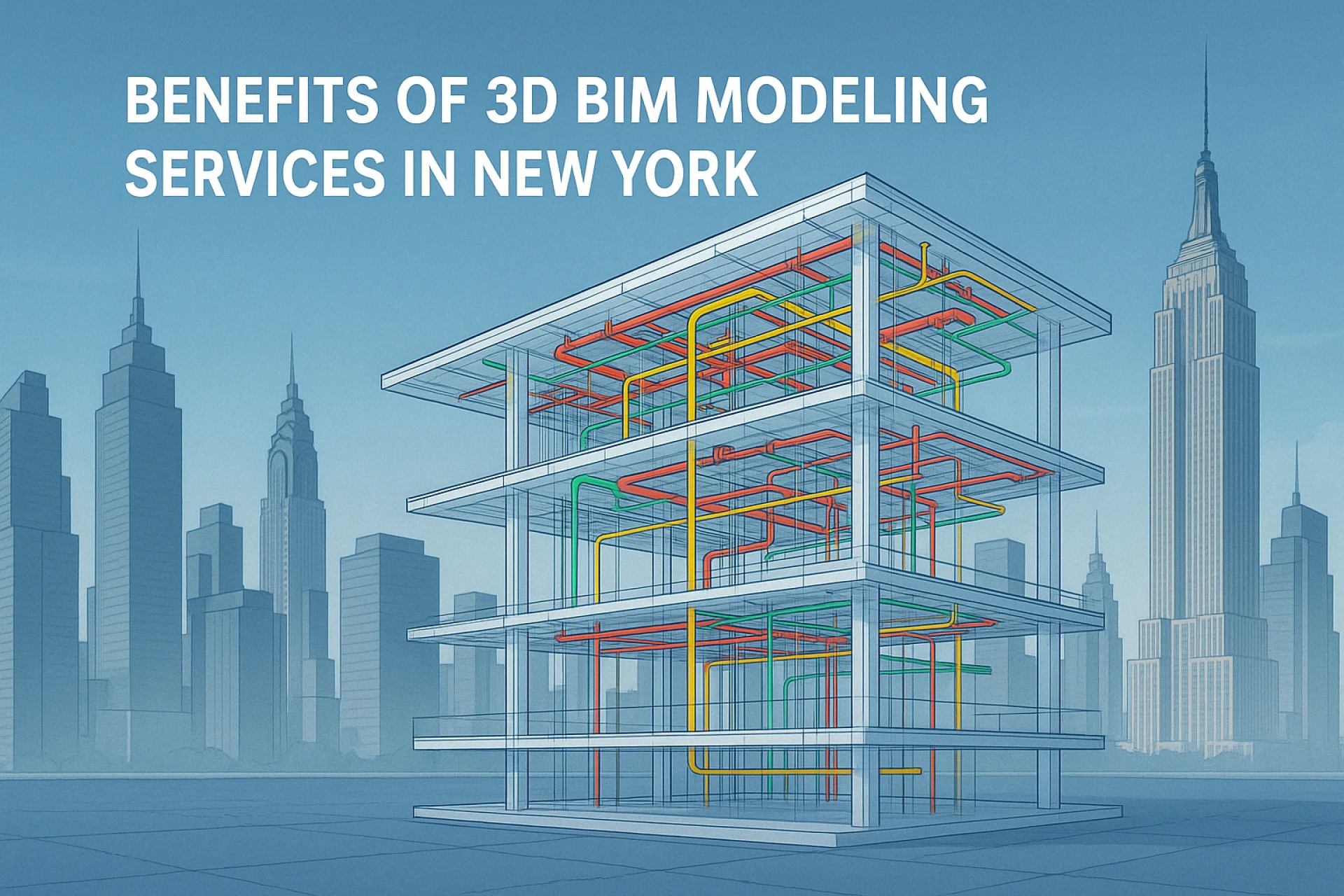
One of BIM’s most practical benefits lies in clash detection. Before construction begins, the model can be reviewed for conflicts between systems — such as a plumbing riser intersecting a structural beam. Identifying these issues in advance avoids costly change orders and prevents onsite delays.
Constructability review further enhances planning. With BIM, project teams can simulate the sequencing of installation and identify access issues early. This foresight supports accurate scheduling and helps ensure work is completed safely and efficiently, even in constrained urban environments like midtown Manhattan or the Financial District.
Integration with design, fabrication, and facilities management
BIM models are not limited to the design phase — they continue to deliver value throughout fabrication and into building operation. Fabricators can use model data for precise offsite production, reducing waste and accelerating installation. Contractors benefit from detailed assemblies and accurate quantities derived directly from the model.
Facilities teams also gain from this integration. With BIM data linked to asset management platforms, building owners can access detailed information on systems, warranties, and maintenance requirements. This model-based approach simplifies long-term upkeep and reduces the risk of misplacing critical documentation during handover.
Benefits of 3D BIM Modeling Services in New York
Meeting the demands of high-density, high-complexity projects
New York’s building landscape demands efficiency. Sites are small, access is limited, and schedules are aggressive. 3D BIM modeling services help overcome these challenges by giving project teams detailed insights before physical work begins. By rehearsing construction virtually, teams can streamline logistics and minimise disruption, which is especially valuable in neighbourhoods where public access and services must remain uninterrupted.
Detailed digital models also help to evaluate constructability in tight conditions. Whether integrating with underground infrastructure or coordinating vertical systems in a high-rise, BIM enables a level of foresight that static drawings cannot match. This reduces costly surprises during construction and allows for smarter sequencing in dense environments.
Improved turnaround for design approvals
With multiple regulatory layers across city, state, and federal levels, getting design approval in New York is rarely straightforward. BIM models can simplify this process. By presenting a visual, data-rich representation of the proposed building, design teams can better demonstrate compliance with zoning laws, accessibility codes, and environmental regulations.
Authorities reviewing models can identify concerns more easily and provide faster feedback. Some New York City agencies have even begun accepting BIM files directly as part of submission packages. This change shortens approval cycles, helping developers keep projects moving and meet aggressive timelines in a competitive real estate market.
Navigating local regulations and building codes with ease
New York’s building codes are among the most detailed in the country. They also evolve regularly. Keeping up with these changes is critical to avoid rework or penalties. 3D BIM modeling services in New York assist teams in aligning with current standards from the outset, reducing the risk of non-compliance.
By embedding code requirements directly into the model, teams can flag potential issues early. Whether verifying egress paths, accessibility features, or mechanical system clearances, BIM offers a proactive way to check against rules as the design develops. This reduces reliance on manual code checks and helps deliver projects that pass inspection the first time.
Real-World Use Cases from New York Projects
Major public infrastructure developments
Large-scale public infrastructure projects in New York — including transport terminals, bridges, and civic centres — benefit heavily from 3D BIM modeling. These projects typically involve multiple agencies, strict timelines, and a mix of new construction with existing assets. BIM brings clarity to complex coordination, helping teams visualise each stage and ensure all stakeholders work from the same model.
For example, during upgrades to subway stations or airport terminals, BIM can be used to map legacy systems, reroute traffic, and phase work without disrupting daily operations. Visual simulations assist in planning around commuter flow, noise limits, and security zones. The ability to rehearse construction virtually improves safety and keeps services operational during works.
Mixed-use commercial and residential buildings
In high-density areas like Brooklyn, Queens, and Manhattan, mixed-use developments often combine residential units, commercial spaces, and retail within one structure. These buildings come with competing requirements — different fire codes, mechanical systems, and spatial layouts. BIM helps architects and contractors juggle these needs within the same coordinated model.
By using BIM architectural modeling services, design teams can ensure that retail space meets storefront regulations, mechanical units serve both public and private areas effectively, and residential zones maintain privacy without sacrificing ventilation or light. This integrated approach is especially valuable during preconstruction reviews, where investors and city planners want to see how the project performs across all functions.
Retrofit and renovation of historic properties
Renovating older buildings presents a unique challenge: limited documentation, unknown conditions, and strict preservation rules. Reality capture combined with 3D BIM modeling provides an accurate foundation for planning. Laser scanning can be used to generate detailed models of existing structures, including irregular geometries and hidden elements.
In areas like the Upper West Side or Tribeca, where heritage protections apply, digital models help design teams explore updates without altering protected features. These models can also be used to visualise how new systems — like modern HVAC or fire suppression — will integrate with existing construction. This reduces intrusive work and ensures that preservation goals are respected throughout.
The Future of Digital Modelling in the AEC Sector
Advancements in automation and AI
Automation is changing how project teams interact with BIM and CAD models. Tools powered by AI can now generate optimised layouts, detect code violations, and even simulate construction timelines with limited human input. In fast-paced markets like New York, where labour costs and deadlines are high, these capabilities offer a distinct edge.
Machine learning can also analyse model data to identify recurring risks across projects, suggesting changes to improve outcomes. For example, if a particular layout consistently triggers coordination issues during MEP installation, automated systems can flag it and recommend alternatives. This shift from reactive to predictive planning marks a step forward for the industry.
Smart cities and digital twins
As New York and other global cities embrace smart infrastructure, the demand for digital twins — live models that reflect a building’s operational state — is increasing. These twins are built on top of BIM models, enriched with sensor data and real-time analytics. They support active facility management, helping building operators track energy use, security, and maintenance needs.
On a citywide level, digital twins also support urban planning. Municipalities can assess how changes in traffic, zoning, or weather might affect infrastructure before making policy decisions. The foundation of these efforts is accurate 3D and BIM data, reinforcing the value of early-stage modelling for long-term civic management.
Evolving roles of consultants and project teams
The shift toward data-driven modelling changes how teams collaborate. Consultants who once focused solely on drawing production now support decision-making throughout a project’s lifecycle. Their role includes guiding teams through software selection, coordinating across disciplines, and extracting insights from model data.
This evolution also affects staffing. Firms are seeking professionals who can bridge technical knowledge with design sensibility and construction awareness. In this environment, 3D BIM modeling services in New York become less about drafting and more about leadership — helping project teams work smarter, faster, and with more confidence in their decisions.
Selecting the Right Partner for BIM Services
What to look for in a 3D CAD and BIM consultant
Choosing a modelling partner requires more than reviewing a portfolio. A strong consultant should offer technical precision, familiarity with local building practices, and the ability to translate project goals into actionable digital models. In a city like New York, this also means navigating site logistics, stakeholder expectations, and shifting regulatory landscapes.
The right partner takes ownership of the coordination process, anticipating issues before they emerge. Look for firms that ask the right questions early, provide clear documentation, and maintain responsiveness throughout. Their involvement should extend beyond model production — they should guide the project team in using that model effectively at every stage.
Questions to ask before engaging a provider
Before selecting a BIM service provider, consider what they bring beyond software expertise. Ask how they manage model updates when project requirements change. Understand whether their team works natively in all required platforms — Revit, Navisworks, Rhino, or others. Confirm how they handle cross-discipline coordination, especially for MEP and structural models.
It’s also worth asking how their team supports facilities turnover. The best providers will help ensure models remain useful long after construction ends. Whether for asset tracking, maintenance scheduling, or future renovations, the long-term value of the BIM model should be built in from the start.
Why experience in local markets matters
New York’s construction scene is distinct — layered with legacy infrastructure, aggressive timelines, and a web of regulatory requirements. A consultant familiar with these constraints will understand how to model accordingly. From ensuring model elements align with DOB submission standards to addressing space constraints for staging, local experience directly affects project success.
Working with a provider who understands the realities of construction in this market means fewer delays, better coordination, and greater value for the client. 3D BIM modeling services in New York are most effective when paired with this local insight, turning digital models into practical tools for execution.