Opening the Door to a New Era of Marketing Innovation
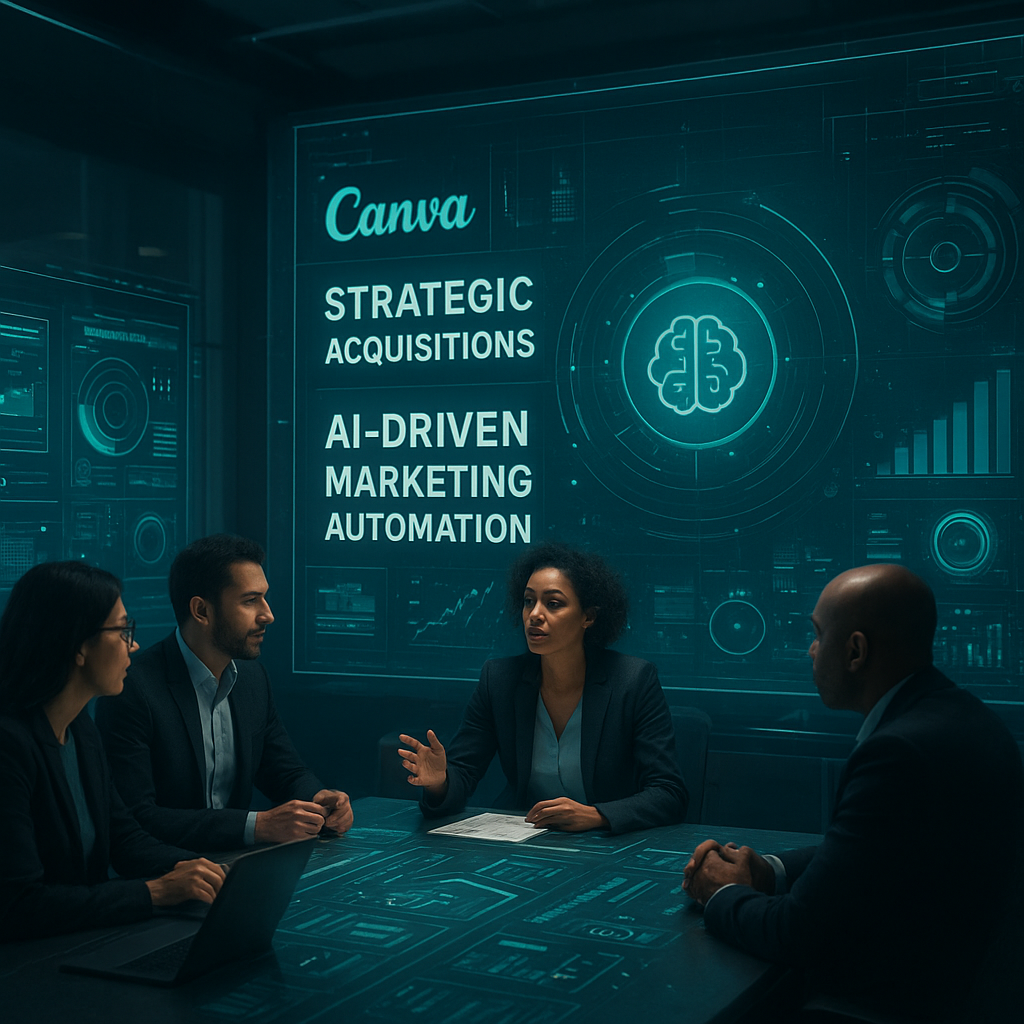
On April 28, 2026, Canva announced its acquisition of two pioneering technology companies, Simtheory and Ortto, marking a decisive move to deepen its foothold in AI-enhanced marketing automation. This strategic expansion aims to fuse Canva’s renowned design platform with cutting-edge automation tools, promising to reshape how businesses create and deploy marketing campaigns. The acquisitions come amid an increasingly competitive digital marketing landscape where AI-driven personalization and automation have become indispensable.
Simtheory, a leader in AI-powered content generation and predictive analytics, and Ortto, a trailblazer in customer data platforms and sophisticated marketing automation, bring complementary capabilities. Together, they enable Canva to evolve beyond a design-centric tool into a fully integrated marketing powerhouse. This development is a significant milestone for Canva, which has steadily expanded its product ecosystem since its 2012 inception.
“Integrating Simtheory’s AI content generation with Ortto’s customer journey automation allows Canva to provide marketers a seamless, intelligent platform that drives engagement and ROI,” said Canva CEO Melanie Perkins in a recent press briefing.
As of May 2026, the marketing technology market is projected to exceed $150 billion globally, with AI and automation driving much of this growth, according to industry analysts. Canva’s acquisitions position it to capture a larger share of this lucrative and fast-evolving sector.
Tracing Canva’s Evolution: From Graphic Design to AI Marketing Hub
Canva’s journey from a simple online design tool to a multi-billion-dollar SaaS platform is marked by continuous innovation and strategic diversification. Originally launched as a user-friendly graphic design application, Canva quickly became a staple for marketers, educators, and businesses worldwide, boasting over 100 million active users by 2024.
Recognizing the increasing demand for integrated marketing workflows, Canva began investing heavily in AI capabilities around 2023, launching features such as Magic Write, an AI text generation assistant, and Brand Kit automation to help users maintain brand consistency. These features laid the groundwork for deeper AI integration.
The acquisitions of Simtheory and Ortto build on this momentum. Simtheory, founded in 2020, developed proprietary AI models for dynamic content personalization, enabling marketers to forecast campaign performance and tailor messaging at scale. Ortto, established in 2017, revolutionized marketing automation with an intuitive customer data platform (CDP) that unifies customer profiles across touchpoints, automates complex workflows, and provides actionable insights.
Combined, these technologies complement Canva’s existing design strengths with advanced AI-driven marketing execution capabilities, addressing a critical gap in the market: the integration of creative design and marketing automation in a single platform.
Dissecting the Acquisitions: What Simtheory and Ortto Add to Canva’s Arsenal
Simtheory’s AI content generation tools excel at creating hyper-personalized marketing copy, social media posts, emails, and ad creatives by leveraging deep learning models trained on billions of data points. This capability enables marketers to automate content creation workflows while maintaining relevance and brand voice.
Ortto’s strength lies in orchestrating customer journeys through a powerful CDP that aggregates data from multiple sources — CRM systems, web analytics, email platforms, and social media. Its automation engine can trigger highly targeted campaigns based on real-time user behavior, segmentation, and predictive scoring.
- Enhanced Personalization: Simtheory’s AI enables dynamic adaptation of messaging for different audience segments, boosting engagement rates up to 30%, according to internal case studies.
- Unified Customer View: Ortto’s CDP consolidates fragmented data, providing marketers with a 360-degree view of their customers to inform smarter campaign decisions.
- Automated Workflows: Combined platform capabilities facilitate end-to-end campaign automation, from design through deployment and analytics.
- Predictive Analytics: Simtheory’s models forecast customer behavior and campaign outcomes, allowing marketers to optimize budgets and creative strategies.
- Scalability: Both platforms support enterprises scaling complex marketing efforts across multiple channels.
“The synergy between Simtheory’s AI-driven content creation and Ortto’s sophisticated automation workflows will empower marketers to move faster and smarter than ever before,” remarked industry analyst Karen Lee from Frost & Sullivan.
This integrated approach allows Canva to transcend its original value proposition as a design tool to become a comprehensive marketing platform that leverages AI at every stage.
2026 and Beyond: What This Means for Digital Marketing Practitioners
The implications of Canva’s acquisitions reverberate strongly across the digital marketing ecosystem. Marketers face growing pressure to deliver personalized, relevant content at scale while managing increasingly complex customer journeys. Canva’s new capabilities address these challenges by unifying creative production with data-driven automation.
Key trends in 2026 amplify the importance of such platforms:
- AI-Driven Personalization: Nearly 75% of marketers report AI as critical to their personalization strategies, per recent surveys.
- Cross-Channel Automation: Consumers expect seamless experiences across email, social, web, and mobile, necessitating integrated automation tools.
- Data Privacy Compliance: Platforms that centralize customer data with robust privacy controls are increasingly vital amid stricter regulations worldwide.
- Creative-Data Integration: The convergence of creative design and marketing automation reduces time to market and increases campaign effectiveness.
Canva’s expanded toolset promises to significantly shorten the campaign lifecycle, from concept to execution, while providing marketers with actionable insights to continuously optimize performance. By offering these capabilities within a single platform, Canva reduces friction and complexity, a critical advantage for small and medium businesses as well as enterprise clients.
For deeper insight into how these acquisitions reshape AI marketing automation, you might enjoy our detailed analysis in How Canva’s Acquisitions of Simtheory and Ortto Are Shaping AI Marketing Automation. Additionally, Why Social Media’s Future Hinges on Authenticity and AI Innovation explores complementary trends driving demand for enhanced marketing tools.
Industry Voices: What Experts Are Saying
Industry experts and marketing leaders have widely acknowledged Canva’s strategic acquisitions as a bold and timely move. The integration of AI-powered content generation with robust automation has been an unmet need for many digital marketers.
“This move signals Canva’s ambition to become a one-stop solution for marketers by embedding AI into every phase of campaign development and execution,” commented Raj Patel, CMO of a leading marketing consultancy.
Marketers praise the potential for reducing reliance on multiple disparate tools, which often leads to inefficiencies and data silos. The ability to design, automate, and analyze campaigns within a unified environment is seen as a major productivity booster.
“With Ortto and Simtheory under its umbrella, Canva is poised to democratize advanced marketing automation, making it accessible to businesses of all sizes,” noted digital strategist Emily Chen.
Experts also highlight the competitive pressure this places on other marketing platforms, which must now accelerate their AI integration efforts to keep pace.
Looking Ahead: What Marketers Should Watch
As Canva continues to roll out integrated features combining Simtheory’s and Ortto’s technologies, marketers should anticipate several key developments:
- Seamless AI-Driven Campaign Creation: Expect tools that automatically generate design assets and copy tailored to segmented audiences.
- Advanced Customer Journey Mapping: Greater visibility into multi-touchpoint interactions powered by real-time data integration.
- Intelligent Automation Triggers: Automation workflows that adapt dynamically based on predictive customer behaviors.
- Enhanced Analytics Dashboards: Unified reporting combining creative performance with marketing metrics for holistic insights.
- Privacy-First Data Handling: Features ensuring compliance with evolving global data regulations.
Marketers should also monitor how Canva leverages these acquisitions to expand its enterprise offerings, potentially disrupting incumbents like HubSpot, Salesforce Marketing Cloud, and Adobe Experience Cloud.
For marketers seeking to stay competitive, embracing platforms that unify creative and automation workflows will be increasingly critical. Canva’s moves in 2026 underscore this trend and offer a glimpse into the future of AI-powered marketing.
Those interested in actionable tactics for leveraging AI marketing tools may find value in DUI Lawyer Marketing: Proven Strategies to Get More High-Value Clients, which highlights practical automation use cases applicable across industries.
Conclusion: Canva’s Bold Leap Toward AI-Integrated Marketing Excellence
Canva’s acquisitions of Simtheory and Ortto represent a watershed moment in the evolution of marketing technology. By integrating AI-driven content creation and sophisticated automation into its design ecosystem, Canva is poised to redefine how marketers conceptualize, execute, and optimize campaigns.
This strategy aligns with broader trends emphasizing personalization, automation, and data-driven decision-making. As businesses strive to deliver more meaningful and timely customer experiences, platforms like Canva that combine creativity with intelligence will become indispensable.
While challenges remain—such as ensuring data privacy and managing AI-generated content quality—Canva’s approach offers a compelling blueprint for the future of digital marketing tools. Early adopters stand to gain significant competitive advantages by leveraging this integrated platform.
In sum, Canva’s 2026 acquisitions signal the dawn of a new marketing era where design, AI, and automation converge seamlessly to empower marketers worldwide.