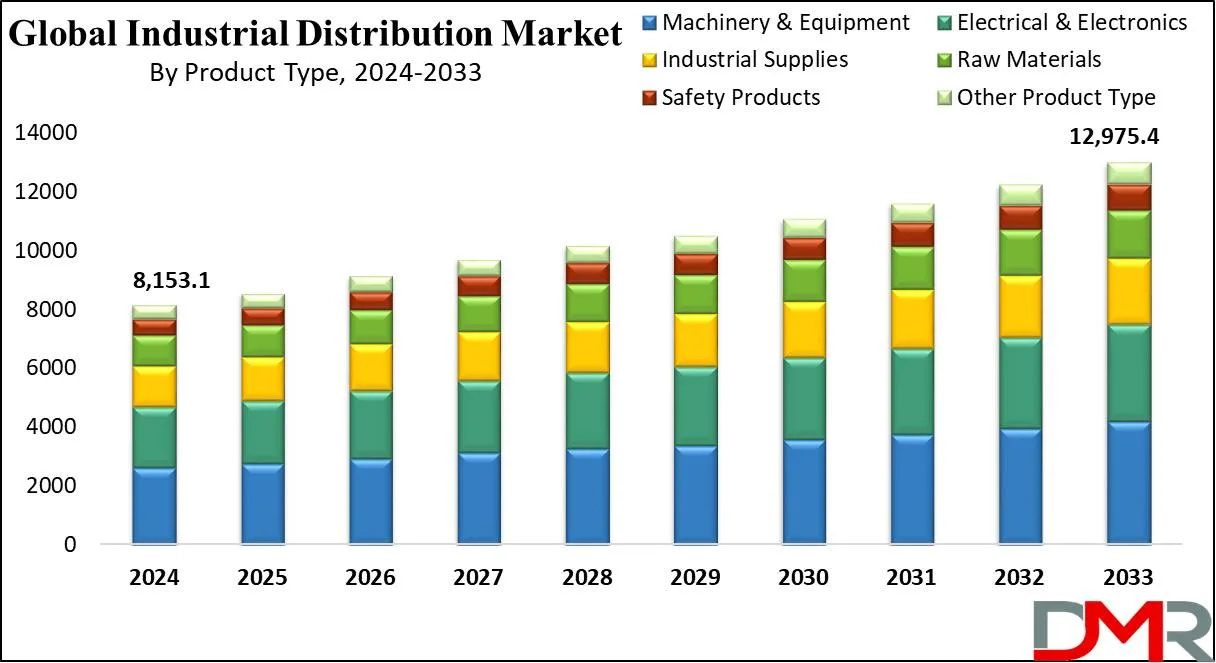
According to Dimension Market Research, the Industrial Distribution Market is evolving rapidly as manufacturers, construction companies, energy businesses, and other industrial organizations increasingly rely on specialized distributors for machinery, maintenance supplies, electrical products, raw materials, safety equipment, and other essential products. The market was valued at USD 8,153.1 billion in 2024 and is projected to reach USD 12,975.4 billion by 2033, growing at a CAGR of 5.3% during the forecast period.
Industrial distribution companies act as a critical connection between manufacturers and end users. They help businesses source products, manage inventories, improve procurement efficiency, and maintain the availability of essential materials and equipment.
The industry is being influenced by digital transformation, e-commerce, Industry 4.0, automation, supply-chain modernization, and increasing demand for maintenance, repair, and operations products. These changes are creating new opportunities for distributors that can combine broad product portfolios with digital procurement and value-added services.
What Is Industrial Distribution?
Industrial distribution is the process through which specialized distributors supply industrial products and related services to businesses.
Rather than purchasing every component directly from manufacturers, companies can rely on distributors for access to machinery, industrial supplies, electrical products, safety equipment, raw materials, and maintenance products.
Distributors can provide several additional services, including inventory management, product sourcing, technical support, repair, calibration, and maintenance assistance.
This makes industrial distributors an important part of the broader manufacturing and industrial supply chain.
Explore the Industrial Distribution Market Report
Manufacturing Remains a Major Demand Center
Manufacturing is projected to dominate the industry vertical segment, accounting for 24.1% of market share in 2024.
Factories require a continuous supply of machinery, tools, spare parts, electrical components, safety products, and maintenance supplies. Distributors help manufacturers obtain these products without requiring them to maintain extensive inventories for every possible requirement.
The increasing adoption of automation and advanced manufacturing technologies is creating additional demand for specialized industrial products.
As factories modernize, distributors are also adapting their offerings to include automation components, connected devices, sensors, robotics-related equipment, and advanced maintenance products.
Machinery and Equipment Lead Product Demand
Machinery and equipment are expected to dominate the product segment with 32.2% of market share in 2024.
Industrial organizations in manufacturing, construction, mining, energy, and other sectors depend on equipment to support daily operations.
The increasing adoption of automation, robotics, and IoT technologies is creating demand for more sophisticated machinery and related components.
Distributors can play an important role by providing access to specialized equipment, replacement parts, maintenance products, and technical assistance.
This relationship becomes particularly valuable for companies that prefer to outsource procurement and maintenance rather than maintain large internal inventories.
Digital Procurement Reshapes Distribution
Digital transformation is one of the most important trends affecting the industry.
Businesses are increasingly using online procurement platforms to identify products, compare specifications, review availability, and place orders.
E-commerce provides industrial distributors with opportunities to improve purchasing convenience and expand their geographic reach.
Digital platforms can also integrate inventory information, order tracking, customer accounts, and product recommendations.
As industrial buyers become more familiar with digital purchasing, distributors are increasingly investing in user-friendly online platforms.
E-Commerce Creates New Opportunities
The growth of industrial e-commerce is changing traditional procurement practices.
In the past, businesses often depended heavily on sales representatives, physical catalogs, and direct supplier relationships. Online platforms now make it possible to research and purchase industrial products more efficiently.
For distributors, e-commerce can improve customer engagement and create access to smaller businesses that may not have previously received extensive sales support.
Digital ordering can also reduce administrative workloads and improve order-processing efficiency.
However, customers still value technical expertise and personalized assistance for complex products, meaning digital platforms are likely to complement rather than completely replace traditional sales channels.
Maintenance, Repair and Operations Demand
Maintenance, Repair and Operations, commonly known as MRO, represents an important opportunity for industrial distributors.
Manufacturing facilities depend on spare parts, tools, lubricants, safety products, electrical components, and maintenance supplies to keep operations running.
Reliable access to these products can help reduce equipment downtime.
Distributors can add value by providing inventory-management services and ensuring that frequently needed products remain available.
The growing complexity of industrial equipment is also increasing demand for specialized maintenance components.
Industry 4.0 Changes Customer Requirements
The adoption of Industry 4.0 technologies is influencing the type of products purchased by industrial customers.
Smart factories use connected machinery, sensors, robotics, automation platforms, and data-management systems.
These technologies require specialized hardware and components that distributors can provide.
As businesses modernize production facilities, industrial distributors are expanding product portfolios to include automation equipment, IoT devices, electrical components, and digital solutions.
This creates a growing connection between industrial distribution and industrial technology.
IoT and Automation Improve Operations
Internet of Things technologies enable industrial equipment to collect and transmit operational information.
Distributors are increasingly supporting this transformation by providing sensors, connectivity hardware, automation components, and related supplies.
Automation can also improve warehouse operations by helping distributors track inventory, organize storage, and manage order fulfillment.
The combination of industrial IoT and automated distribution operations can improve product availability while reducing manual processes.
Supply Chain Resilience Becomes a Priority
Recent supply-chain disruptions have highlighted the importance of resilience and supplier diversification.
Industrial customers increasingly want reliable access to essential products and shorter response times when disruptions occur.
Distributors can help by maintaining strategically located inventories, offering multiple product alternatives, and working with diverse suppliers.
The DMR report notes that 74% of surveyed firms were investing in supply-chain resilience strategies, including supplier diversification and improved visibility.
This trend is expected to support demand for distributors capable of providing flexible and dependable supply solutions.
Inventory Management Becomes More Strategic
Industrial customers often face a difficult balance between maintaining enough inventory and avoiding unnecessary stock.
Holding excessive inventory can increase costs, while insufficient stock can cause production delays.
Distributors can help customers manage this challenge through inventory programs, automated replenishment, vendor-managed inventory, and data-driven forecasting.
Digital platforms can provide greater visibility into product availability and purchasing patterns.
These services increase the value of distributors beyond simple product sales.
AI in Industrial Distribution
Artificial intelligence is becoming an increasingly useful technology within the distribution ecosystem.
AI can support demand forecasting by analyzing historical sales data and changing purchasing patterns.
It can also improve inventory management by identifying products that are likely to experience increased or decreased demand.
Logistics operations can benefit from AI-powered route optimization, while automated order processing can improve fulfillment efficiency.
Predictive analytics can further support warehouse and equipment management.
The increasing use of AI is likely to create opportunities for distributors that combine physical supply capabilities with digital intelligence.
Sustainability Influences Product Portfolios
Sustainability is becoming increasingly important to industrial customers.
Businesses are looking for energy-efficient equipment, environmentally responsible materials, and products that support resource efficiency.
Industrial distributors are responding by expanding offerings in sustainable products and improving their own logistics practices.
Energy-efficient machinery and recyclable or lower-impact materials may become increasingly important components of distributor portfolios.
Sustainable supply-chain practices can also help companies reduce waste and improve operational efficiency.
Construction Supports Market Demand
Construction is another major industry vertical requiring industrial distribution services.
Contractors and construction companies purchase tools, machinery, electrical products, safety equipment, building materials, and maintenance supplies.
Large infrastructure projects can create significant demand for specialized equipment.
Distributors can help contractors reduce procurement complexity by providing multiple product categories from a single supply source.
As infrastructure investment continues, demand for construction-related industrial products is expected to remain important.
Energy Sector Applications
The energy sector also depends on reliable distribution networks.
Power-generation facilities, oil and gas operations, renewable-energy projects, and related industrial activities require equipment, spare parts, electrical products, safety supplies, and maintenance components.
Distributors can support these operations by maintaining inventories of critical products and coordinating deliveries.
The expansion of renewable-energy infrastructure is also creating new opportunities for distributors supplying electrical equipment, components, tools, and installation materials.
Electrical and Electronics Distribution
Electrical and electronic components are another important product category.
Industrial automation, factory modernization, building systems, and energy infrastructure all require electrical components.
Distributors can supply circuit-related equipment, controls, connectors, automation components, lighting products, and other industrial electrical products.
The increasing use of smart systems and automation is expanding the range of electronic and electrical products required by industrial customers.
Safety Products Remain Essential
Workplace safety is a core requirement across industrial sectors.
Safety products can include protective equipment, warning systems, workplace supplies, and other items required to support safe operations.
Distributors play an important role because industrial customers often need reliable access to safety products across multiple locations.
The increasing focus on worker safety and regulatory compliance provides a stable demand base for this category.
Regional Outlook
North America
North America is projected to lead the Industrial Distribution Market, accounting for approximately 39.2% of revenue in 2024.
The region has a strong manufacturing, construction, energy, and industrial-services ecosystem.
High technology adoption is also encouraging demand for advanced industrial products and digital procurement services.
The United States is projected to grow from USD 2,687.8 billion in 2024 to USD 4,162.6 billion by 2033, representing a 5.0% CAGR.
Europe
Europe has an established industrial sector and strong demand for machinery, electrical products, maintenance supplies, and safety equipment.
The region's focus on industrial modernization and sustainability is influencing product demand and procurement practices.
Asia-Pacific
Asia-Pacific offers substantial growth opportunities because of expanding manufacturing capacity, infrastructure development, industrialization, and digital transformation.
China, India, Japan, South Korea, and other regional economies are investing in manufacturing and logistics infrastructure.
Increasing adoption of Industry 4.0 technologies is expected to support demand for specialized industrial products.
Latin America and Middle East & Africa
Emerging industrial and infrastructure projects in Latin America and the Middle East & Africa are creating additional opportunities.
Construction, energy, manufacturing, and infrastructure development are generating demand for industrial equipment, maintenance products, and specialized supplies.
Challenges in Industrial Distribution
Supply-chain disruptions remain one of the largest challenges.
Geopolitical events, transportation issues, natural disasters, and other unexpected disruptions can affect product availability and delivery times.
Raw-material price volatility can also make it difficult for distributors to maintain stable pricing.
Inventory management becomes more challenging when demand changes unexpectedly.
Distributors therefore need resilient supplier networks, strong forecasting systems, and flexible logistics strategies.
Competitive Landscape
Competition in the industry includes large multinational distributors, regional specialists, and niche providers.
Key companies covered by Dimension Market Research include W.W. Grainger, WESCO International, Sonepar USA, Würth Industry, Wolseley Industrial Group, DXP Enterprises, Border States, Kaman Distribution Group, F.W. Webb, Edgen Murray, HD Supply, Motion Industries, Fastenal Company, and Rexel USA.
Companies are competing through product availability, digital procurement, logistics capabilities, technical support, inventory management, and value-added services.
E-commerce and automated procurement are becoming particularly important competitive tools.
Strategic Importance of Value-Added Services
Industrial distribution is increasingly moving beyond product delivery.
Customers are looking for services such as equipment repair, maintenance support, calibration, inventory management, technical consultation, and procurement assistance.
These services can help businesses reduce downtime and simplify operations.
Distributors capable of combining products with specialized services can create stronger customer relationships and improve customer retention.
Technology-Driven Future
Technology is expected to remain central to the future of industrial distribution.
AI, IoT, automation, cloud computing, and advanced analytics can improve inventory forecasting, warehouse management, logistics, and customer engagement.
Digital procurement platforms can provide customers with greater visibility into pricing, stock levels, delivery schedules, and product alternatives.
As industrial businesses become more digitally connected, distributors will increasingly operate as technology-enabled supply-chain partners.
Market Outlook
According to Dimension Market Research, the Industrial Distribution Market is projected to increase from USD 8,153.1 billion in 2024 to USD 12,975.4 billion by 2033, representing a 5.3% CAGR.
Machinery and equipment will remain the leading product category, while manufacturing is expected to remain the largest industry vertical.
North America is projected to maintain its leading position, while Asia-Pacific is expected to offer significant growth opportunities.
The continued adoption of e-commerce, Industry 4.0, automation, AI, and supply-chain technologies will reshape the competitive environment.
Buy the Complete Industrial Distribution Market Report
Conclusion
The Industrial Distribution Market is evolving into a technology-enabled component of modern industrial supply chains.
Manufacturers, construction companies, energy businesses, and other industrial customers increasingly depend on distributors for equipment, MRO supplies, electrical products, safety items, raw materials, and specialized components.
Digital procurement, e-commerce, inventory management, automation, AI, and supply-chain resilience are creating new opportunities for companies that can provide both products and value-added services.
With the market expected to reach USD 12,975.4 billion by 2033, industrial distribution is positioned to remain an essential link between manufacturers and end users as global industrial activity continues to modernize.