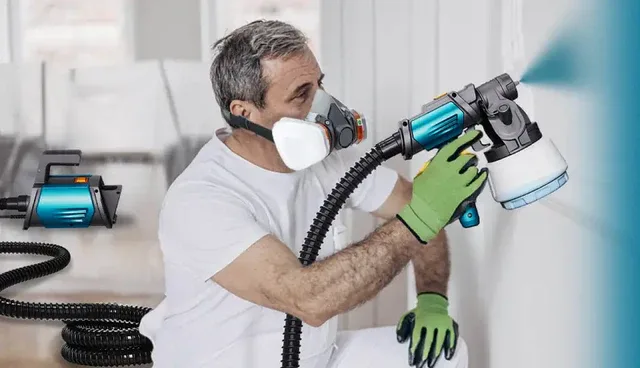
If you are deciding whether to buy an HVLP paint sprayer or an airless sprayer, the short answer is that an HVLP model is often better for detail-oriented work, while an airless sprayer is usually better for large, fast-coverage projects. The real HVLP vs. airless paint sprayer decision comes down to the finish you want, the size of the surface, the coating you plan to spray, and how much setup and masking you are willing to do.
A paint sprayer can help you work faster than a brush or roller, but different spraying technologies are designed for different results. An HVLP sprayer emphasizes control and finish quality. An airless sprayer emphasizes speed and coverage. Understanding their strengths and limitations can help you avoid purchasing a tool that is either underpowered or unnecessarily complicated for your project.
Understanding HVLP Paint Sprayers
HVLP means high volume, low pressure. This type of sprayer uses a high volume of air at relatively low pressure to atomize paint, stain, varnish, or another finish into a fine mist. The lower pressure slows the material as it travels from the nozzle to the surface, giving the user more control over the application.
That extra control is a major advantage for small and detailed projects. When you are painting cabinet doors, a dining table, trim, or a piece of furniture with raised details, you do not want paint blowing past the target or collecting heavily in corners. An HVLP paint sprayer makes it easier to apply thin, consistent coats and gradually build coverage.
HVLP systems are popular with woodworking hobbyists, furniture refinishers, and DIY homeowners because they can produce a smooth-looking finish with less effort than brushing. A brush can leave visible strokes, while a roller can create texture. With proper preparation and technique, an HVLP sprayer can provide a more even coating across flat surfaces, edges, and shaped components.
However, HVLP sprayers work best when the coating is at the right viscosity. Materials such as stain, lacquer, shellac, polyurethane, sealer, and certain thinned paints are often suitable. Thicker latex paints or primers may need thinning, depending on the sprayer’s power and nozzle design. Always review the sprayer instructions and coating label before beginning.
Understanding Airless Paint Sprayers
An airless paint sprayer uses a pump to force paint through a small tip at high pressure. Unlike an HVLP unit, an airless sprayer does not use a large volume of air to atomize the coating. The pressure itself breaks the paint into fine particles and sends it toward the surface.
The primary strength of airless equipment is speed. It can apply a large volume of paint quickly, making it ideal for large, open surfaces. Homeowners and contractors often use airless sprayers for interior walls, ceilings, exterior siding, long fences, decks, garages, sheds, and renovation projects.
For example, painting several empty rooms with a roller can take an entire weekend. An airless sprayer can cover the walls much more quickly, especially if the rooms are empty and properly masked. It may also handle standard wall paints and primers with less thinning than many HVLP systems.
The drawback is that airless sprayers require more preparation. Because paint exits at high pressure, overspray can travel onto surfaces you never intended to paint. Floors, windows, hardware, light fixtures, trim, landscaping, vehicles, and adjacent structures all need protection. Airless sprayers also require disciplined technique: holding the gun too close, moving too slowly, or overlapping too heavily can lead to runs, drips, and an uneven finish.
HVLP vs Airless Paint Sprayer: Core Differences
The HVLP vs. airless paint sprayer comparison is best understood by looking at how each system balances precision, productivity, and paint handling.
CategoryHVLP Paint SprayerAirless Paint SprayerOperating methodUses high air volume at low pressureUses a pump and high pressureBest project sizeSmall to mediumMedium to very largePrimary advantageControlled, fine finishingFast, high-volume coverageBest surfacesCabinets, furniture, doors, trimWalls, ceilings, fences, sidingOverspray levelTypically lower and easier to manageTypically higher and requires extensive maskingCoating compatibilityOften best with thinner coatingsOften better with thicker paints and primersSetup timeUsually simpler for small projectsOften longer because of hoses and maskingCleanupCommonly easier for compact jobsCan be more involvedSkill emphasisSmooth hand movement and light coatsConsistent distance, speed, and overlapIdeal userDetail-focused DIYer or woodworkerLarge-project DIYer or contractor
Neither system automatically creates a perfect finish. Surface preparation, paint quality, nozzle selection, viscosity, spray distance, temperature, humidity, and drying time all affect the final result. Still, the choice of sprayer strongly influences how easy it will be to achieve the result you want.
When Is an HVLP Sprayer Better?
An HVLP paint sprayer is generally better when your project is small enough that speed is not the main concern and detailed control is more important. It is especially useful when the painted surface will be seen up close.
Choose an HVLP sprayer for projects like:
- Kitchen cabinets, vanity doors, and drawer fronts
- Tables, chairs, dressers, and bookcases
- Interior doors, molding, baseboards, and window trim
- Shelving, picture frames, and decorative woodwork
- Wood stains, clear coats, sealers, and varnishes
- Small outdoor furniture, planters, and craft projects
A cabinet-refinishing project is a clear example. Cabinets have narrow edges, recessed panels, corners, and visible surfaces that need a uniform finish. An HVLP sprayer lets you apply lighter coats and control the spray fan more carefully. Instead of trying to cover everything in one heavy pass, you can build multiple thin layers, reducing the risk of runs and helping the finish look more refined.
HVLP can also be the more practical choice if you have limited workspace. You should still mask the area, wear appropriate protective gear, and ensure ventilation. But lower-pressure application is generally easier to control around small workpieces than a powerful airless spray stream.
When Is an Airless Sprayer Better?
An airless sprayer is better when productivity is the priority. Large wall surfaces, exterior projects, and high-volume work can make the setup effort worthwhile because the sprayer can apply material quickly.
An airless sprayer is a strong fit for:
- Painting whole rooms, apartments, or houses
- Covering ceilings and large drywall surfaces
- Exterior siding and broad garage walls
- Long fences and wide decks
- New construction or major remodels
- Large sheds, barns, and outbuildings
For a large fence, an airless sprayer can turn a long brushing job into a more efficient spraying task. Still, the prep work is non-negotiable. Cover plants, windows, concrete, outdoor furniture, and neighboring surfaces. Work on a calm day outdoors, since wind can carry overspray well beyond the target.
Airless sprayers are often more capable of handling thicker coatings. This can be helpful for latex wall paint, exterior paint, and primer. But the correct tip is essential. A tip that is too small may restrict the paint and create poor atomization, while a tip that is too large can release too much material and cause a heavy coat.
Paint Type, Setup, and Technique
The coating you intend to spray should influence your decision. HVLP sprayers commonly handle thinner products very well, but some paints need to be thinned according to the product instructions. Do not thin blindly: excessive thinning can weaken coverage, affect sheen, or compromise durability.
Airless sprayers often accept thicker paints with fewer adjustments, but they are not maintenance-free. You still need to strain paint, choose the right tip, prime the system, and clean the unit thoroughly after use. Dried paint inside a hose, tip, gun, or pump can cause clogs and shorten the equipment’s useful life.
For either sprayer, use the same basic technique:
- Prepare and clean the surface before spraying.
- Strain the paint or finish to remove debris.
- Test the pattern on cardboard or scrap material.
- Hold the gun perpendicular to the surface.
- Move steadily and overlap each pass slightly.
- Apply multiple thin coats instead of one heavy coat.
- Let the coating dry fully between coats as directed.
Safety should be part of every spraying project. Wear eye protection and a respirator appropriate for the coating. Provide ventilation, especially when working indoors or with solvent-based finishes. Keep ignition sources away from flammable materials. With an airless sprayer, never point the gun at skin or attempt to stop a leak with your hand, because high-pressure injection injuries are serious.
Final Verdict: HVLP or Airless?
In the HVLP vs Airless Paint Sprayer debate, an HVLP sprayer is better for controlled, finish-focused work. If you are painting cabinets, furniture, doors, trim, or detailed woodwork, it can help you apply even coats with more confidence and less overspray.
An airless sprayer is better for large surfaces where speed matters most. Walls, ceilings, fences, decks, garages, and siding are all projects where high-volume spraying can save time, provided you are prepared to mask carefully and manage overspray.
If you are a DIY painter who wants a practical tool for furniture refinishing, cabinets, interior doors, trim, and other smaller projects, consider the Tilswall HVLP paint sprayer. It is a good option for users who want the controllability associated with HVLP technology and a cleaner, more polished finish on detail-focused work.