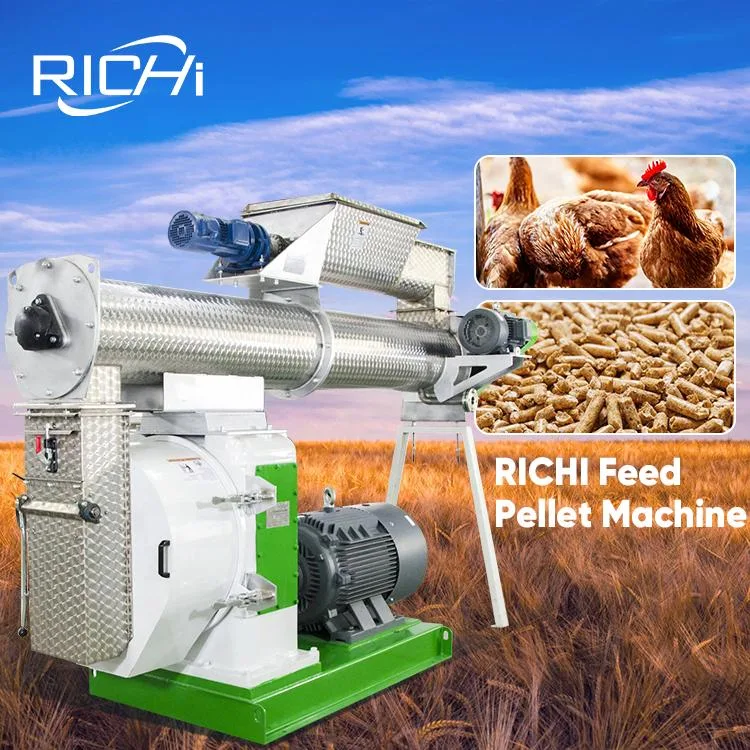
For poultry farms planning to produce their own feed, equipment investment is often one of the first questions to address. Instead of purchasing finished feed continuously, some producers prefer to process corn, soybean meal, wheat bran, rice bran, and other ingredients on-site. This can provide greater control over feed formulation and production schedules, but the equipment must be properly matched to actual farm requirements.
When comparing the poultry feed pellet machine price per ton, buyers should consider more than the initial machine quotation. Capacity, raw material characteristics, electricity consumption, auxiliary equipment, labor, maintenance, and the expected operating hours can all influence the actual cost of producing each ton of feed.
What Does the Investment Include?
A poultry feed pellet machine is generally only one part of the production process. A basic system may include a hammer mill for grinding, a mixer for blending ingredients, the pellet mill for forming pellets, and a cooler and screener for downstream processing.
For larger farms, conveyors, storage bins, automatic batching systems, and packaging equipment may also be required. Therefore, two projects with similar pellet mill prices can have very different total investments depending on their equipment configurations.
Farmers should request quotations based on the complete process rather than asking only for the price of the main machine. This makes it easier to compare suppliers and avoid unexpected costs later.
Why Does Capacity Affect Cost Per Ton?
Production capacity has a direct influence on the economics of a feed project. A machine that is too small may need to operate for many hours every day, increasing labor and maintenance requirements. An oversized machine, meanwhile, may have a higher purchase price while remaining underutilized.
For farms with moderate feed consumption, a chicken feed pellet machine 500kg per hour can be one possible configuration. Its suitability depends on flock size, daily feed demand, working hours, and future expansion plans.
Actual output can also change according to the feed formula, moisture, particle size, and pellet diameter. Therefore, rated capacity should be treated as a reference rather than a guaranteed production figure for every formula.
How Does Raw Material Preparation Affect Costs?
Raw material preparation can significantly influence pelletizing efficiency. Corn and other grains may need to be crushed before mixing, while soybean meal and bran should be evenly distributed throughout the formula.
A suitable particle size improves mixing and can make pellet formation more stable. Moisture should also be controlled carefully. Material that contains too much moisture may affect pellet durability and increase the need for drying, while excessively dry mixtures may create difficulties during pelletizing.
For this reason, farms should provide actual raw material information before purchasing equipment. Suppliers can then recommend a more suitable grinding, mixing, and pelletizing configuration.
Should Small Farms Automate Production?
Automation should correspond to production scale. A small farm may operate a semi-automatic system with manual feeding and packaging. As the number of birds increases, automatic conveying, weighing, batching, cooling, screening, and packing can be introduced.
A modular design can reduce initial investment while leaving room for expansion. Instead of purchasing every possible machine at the beginning, farmers can start with the equipment required for current production and add additional components later.
However, factory space should be planned carefully so future equipment can be installed without major reconstruction.
What About Long-Term Operating Costs?
The purchase price does not determine the actual cost of producing a ton of poultry feed. Electricity, spare parts, maintenance, labor, downtime, and raw material losses should also be considered.
Machine durability is particularly important for farms running equipment every day. The quality of the pellet die, rollers, bearings, motors, and electrical components can affect maintenance frequency and operating stability.
For the same reason, buyers should compare technical specifications and after-sales support rather than choosing a supplier solely because of a low quotation.
How Can Farms Improve Production Economics?
The most effective approach is to match the complete system to actual feed demand. A properly sized pellet mill can avoid excessive idle capacity while still providing enough output for daily operations.
Farmers can also reduce unnecessary costs by using locally available raw materials, optimizing feed formulations, maintaining equipment regularly, and minimizing production downtime. Cooling and screening efficiency should also be considered because poor downstream handling can reduce the quality of otherwise well-produced pellets.
A reliable feed pellet machine should therefore be evaluated as part of the entire production system rather than as an isolated piece of equipment.
Conclusion
Investing in a poultry feed pellet machine can be practical for farms with sufficient feed consumption and reliable access to raw materials. However, the real economics depend on the complete production configuration and long-term operating conditions.
Before purchasing, farmers should determine daily feed demand, pellet size, raw materials, required capacity, automation level, and future expansion plans. Comparing the total project cost instead of only the machine price provides a more realistic basis for investment decisions. read more about poultry feed equipment and compare complete configurations before selecting the final system.
SEO Title:
How Poultry Farms Can Evaluate Feed Equipment Cost Per Ton
Meta Description:
Learn how poultry farms can evaluate feed equipment costs by considering capacity, raw materials, electricity, automation, maintenance, and output.