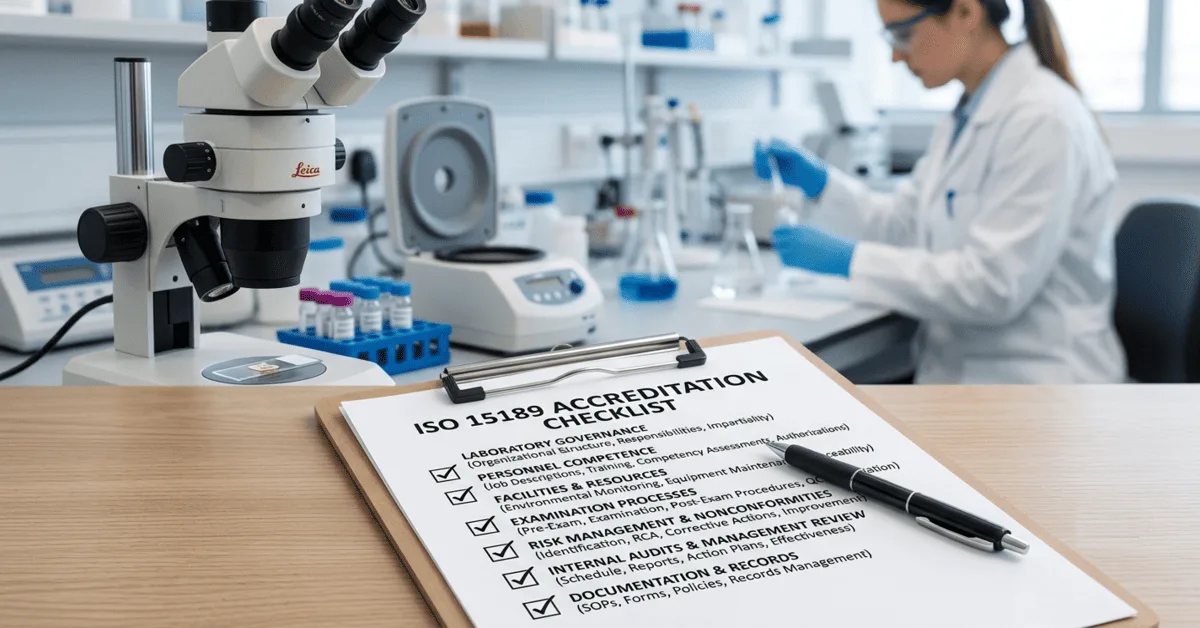
Preparing for ISO 15189 accreditation requires more than creating documents and completing internal audits. A medical laboratory needs to demonstrate that its quality management system is effectively implemented and that its technical activities consistently support reliable patient results. ISO 15189:2022 covers requirements for quality and competence in medical laboratories, including management, resources, laboratory processes, and continual improvement.
A practical checklist can help laboratories identify gaps before an accreditation assessment and organize the evidence needed to demonstrate conformity.
1. Check Laboratory Governance and Responsibilities
Review whether the laboratory has clearly defined its organizational structure, responsibilities, authority, and reporting relationships. Check whether:
- Roles and responsibilities are documented.
- Management has defined authority for quality and technical activities.
- Impartiality and confidentiality are addressed.
- The laboratory scope is clearly defined.
- Risks and opportunities for improvement are identified.
Clear governance ensures that quality responsibilities are understood throughout the laboratory.
2. Review Personnel Competence and Training
Competent personnel are essential for producing reliable laboratory results. Laboratories should maintain evidence showing that staff are qualified, trained, authorized, and assessed for competence.
Review:
- Job descriptions and competency requirements
- Education and qualification records
- Training and retraining records
- Competency assessment records
- Personnel authorization records
- Continuing professional development
The laboratory should demonstrate that personnel performing specific activities are competent for their responsibilities.
3. Check Facilities, Equipment, and Resources
The ISO 15189 checklist should cover facilities and resources that can influence examination results. Environmental conditions should be suitable and monitored where necessary.
Verify controls for:
- Laboratory facilities and environmental conditions
- Equipment maintenance and calibration
- Metrological traceability where applicable
- Reagents and consumables
- Storage conditions
- Externally provided products and services
Equipment records should remain current and demonstrate suitability for intended use.
4. Review Pre-Examination, Examination, and Post-Examination Processes
Laboratory processes should be controlled from sample collection through reporting. Check whether procedures address patient preparation, sample collection, identification, transportation, receipt, processing, examination, result review, and reporting.
Also review method selection, verification or validation, quality control, examination performance, and management of critical results.
5. Evaluate Risk Management and Nonconforming Work
Risk management is an important part of laboratory quality. Review whether risks affecting patients, examination processes, and laboratory operations have been identified and evaluated.
Laboratories preparing for ISO 15189 accreditation can benefit from professional guidance when they need support with readiness assessment, documentation, implementation, and addressing gaps before the assessment.
Also check whether the laboratory has effective processes for:
- Recording nonconforming work
- Performing root-cause analysis
- Implementing corrective actions
- Evaluating corrective-action effectiveness
- Monitoring risks and improvement opportunities
6. Check Internal Audits and Management Review
Before the accreditation assessment, verify that internal audits have been planned and performed across relevant areas. Audit results should lead to appropriate corrections and corrective actions. The audit program should consider patient risk, previous audit results, nonconformities, incidents, complaints, and changes affecting laboratory activities.
A structured ISO 15189 gap analysis can help laboratories identify areas where existing processes, documentation, or records may not fully meet applicable requirements before the assessment.
Management review should provide evidence that laboratory performance, quality objectives, audit results, complaints, risks, and improvement opportunities are being evaluated.
7. Verify Documentation and Records
Finally, review whether controlled documents and records are complete, current, accessible, and properly maintained. Procedures, forms, policies, work instructions, audit records, training records, equipment records, quality-control records, and corrective-action records should support actual laboratory practices.
A structured checklist helps identify missing documentation and implementation gaps before the assessment.
Conclusion
An effective ISO 15189 accreditation checklist should cover governance, personnel competence, facilities, equipment, laboratory processes, risk management, quality control, documentation, internal audits, corrective actions, and management review. Using the checklist as a readiness tool allows laboratories to identify weaknesses early and focus resources on closing important gaps.
If your laboratory needs professional guidance for planning, implementing, or preparing for assessment, explore ISO 15189 accreditation consultancy support to help organize the accreditation process and strengthen the laboratory quality management system.