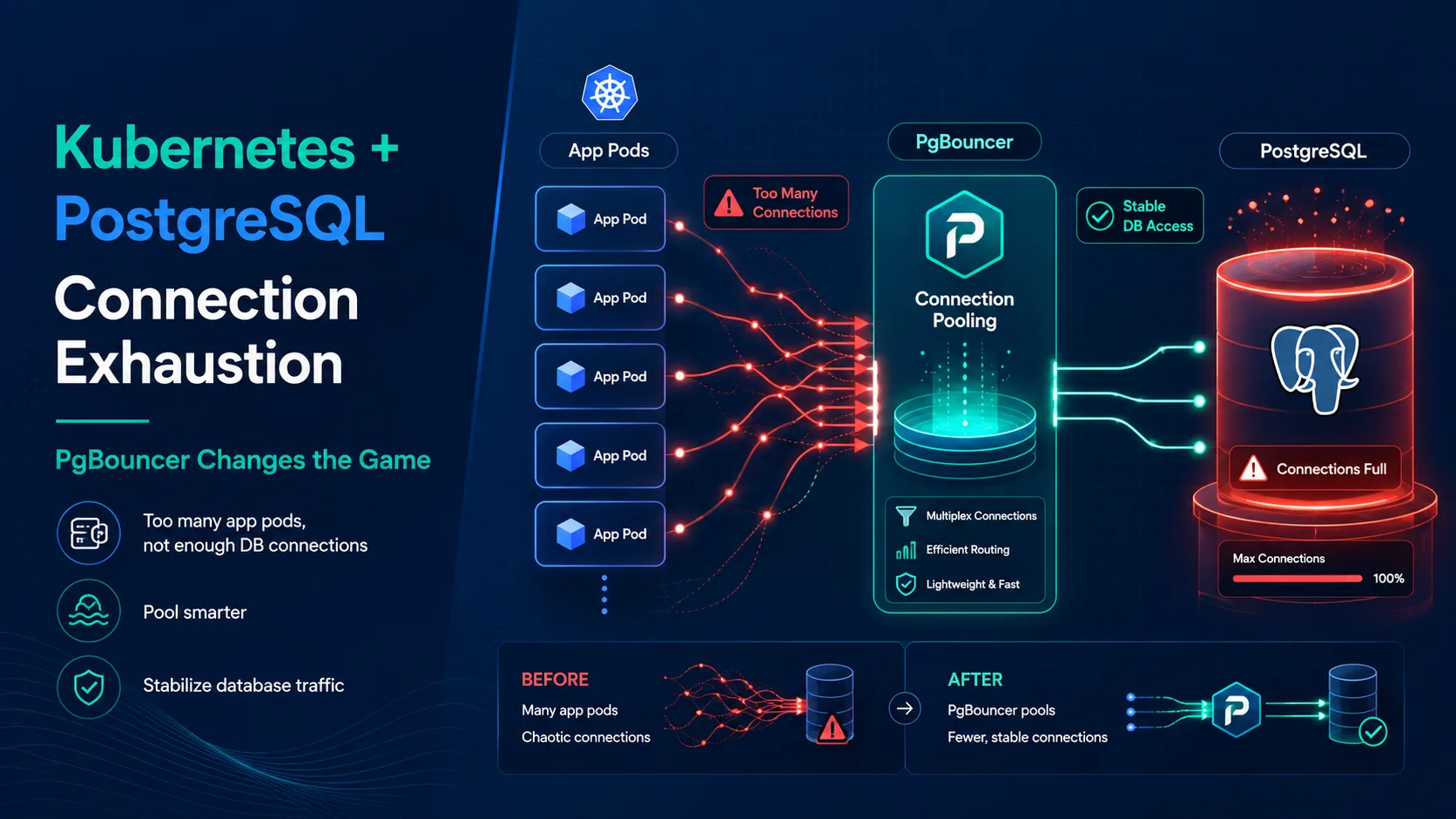
Kubernetes makes application scaling wonderfully easy.
That is exactly why it can be dangerous for PostgreSQL connection management.
A deployment goes from ten pods to fifty pods during a traffic spike. Every pod starts its own database connection pool. PostgreSQL suddenly receives hundreds or thousands of new sessions.
Nothing is wrong with Kubernetes.
Nothing is necessarily wrong with PostgreSQL either.
The architecture simply scaled one layer without understanding the limits of the next.
Pod scaling multiplies connection pools
Suppose every pod keeps twenty PostgreSQL connections.
Ten pods create potential demand for two hundred.
Fifty pods create one thousand.
If another service follows the same pattern, connection demand multiplies again.
Now consider a rolling deployment.
Kubernetes may temporarily run old and new pods simultaneously while replacing the workload.
Your normal connection count might be safe, but deployment-time demand can exceed PostgreSQL's capacity.
That is why teams using managed Kubernetes should include database connection budgets in autoscaling design.
CPU based pod scaling without database-aware limits can simply move the bottleneck downstream.
Application pools do not solve server connection fan-out
Developers often tell me they already use connection pooling.
Usually they mean every application process has its own pool.
That improves connection reuse within the process, but it does not necessarily reduce total PostgreSQL connections across the cluster.
Fifty independent pools are still fifty independent pools.
This is where PgBouncer becomes useful.
It sits between application clients and PostgreSQL and can allow many client connections to share a smaller number of server-side database connections.
Transaction pooling can dramatically reduce demand
PgBouncer supports different pooling approaches.
For many stateless web applications, transaction pooling is the mode I find most interesting.
A server connection is assigned to a client for the duration of a transaction and can then be reused by another client.
This works well when application requests perform short transactions and do not depend heavily on persistent session state.
The result can be thousands of logical client connections feeding a much smaller number of actual PostgreSQL backends.
That allows managed PostgreSQL infrastructure to spend more resources executing useful database work and less on excessive connection fan-out.
Transaction pooling changes some assumptions
I never introduce PgBouncer transaction pooling without checking application behaviour.
Applications may assume they keep the same PostgreSQL session between transactions.
Features relying on session state can therefore behave differently.
Temporary tables, certain prepared statement patterns, session-level settings, advisory locks, and similar behaviours deserve review.
Modern PgBouncer versions support more workflows than older deployments did, but compatibility should still be tested.
The point is not that transaction pooling is dangerous.
The point is that pooling mode is an architectural choice.
Size the pool for the database rather than the pods
This is the conceptual shift I want teams to make.
Without a shared pooler, developers often calculate connection counts from the application side.
With PgBouncer, I start from database capacity.
How many concurrent transactions can PostgreSQL process efficiently?
How many connections should be reserved for administration, migrations, monitoring, and background systems?
How much concurrency can the workload sustain before latency rises sharply?
The pool should protect that capacity.
Application demand can queue rather than forcing the database to create unlimited backends.
A short queue at the pooler can be healthier than a database collapse caused by extreme concurrency.
Watch for connection storms during scaling
A good architecture should survive rapid pod creation.
I test what happens when many Kubernetes pods start simultaneously.
Do they all open their maximum pool size immediately?
Do they retry aggressively if connections are unavailable?
Do readiness probes fail and trigger additional restarts?
Does PgBouncer itself have enough file descriptors and client capacity?
Does authentication become a bottleneck?
These are production questions, not theoretical details.
Do not make PgBouncer another single point of failure
Connection pooling infrastructure also needs availability planning.
If every application depends on one PgBouncer process and that process disappears,
the database can be perfectly healthy while applications lose access.
Deployment options depend on the architecture.
Some teams place PgBouncer close to the database.
Others run it alongside applications or through redundant service endpoints.
The right design depends on failure domains and traffic patterns.
What matters is that the pooler is treated as production infrastructure.
Use autoscaling signals carefully
Kubernetes might scale because application CPU is high while PostgreSQL is already saturated.
Adding more pods can then increase database pressure without increasing useful application throughput.
I like autoscaling policies that consider downstream limits where possible.
At minimum, monitor active database connections, pool saturation, waiting clients, database CPU, lock waits, transaction latency, and error rates alongside pod count.
The real goal is controlled concurrency
PgBouncer is not valuable because PostgreSQL is incapable of handling connections.
It is valuable because elastic application platforms create connection demand much faster than traditional databases should accept it.
Kubernetes gives the application layer elasticity.
PgBouncer gives the database layer a pressure regulator.
When those two systems are designed together, application pods can scale without every new container demanding a permanent PostgreSQL backend.
That is the architecture I prefer.
Scale requests aggressively when the business needs it.
Scale database concurrency deliberately.