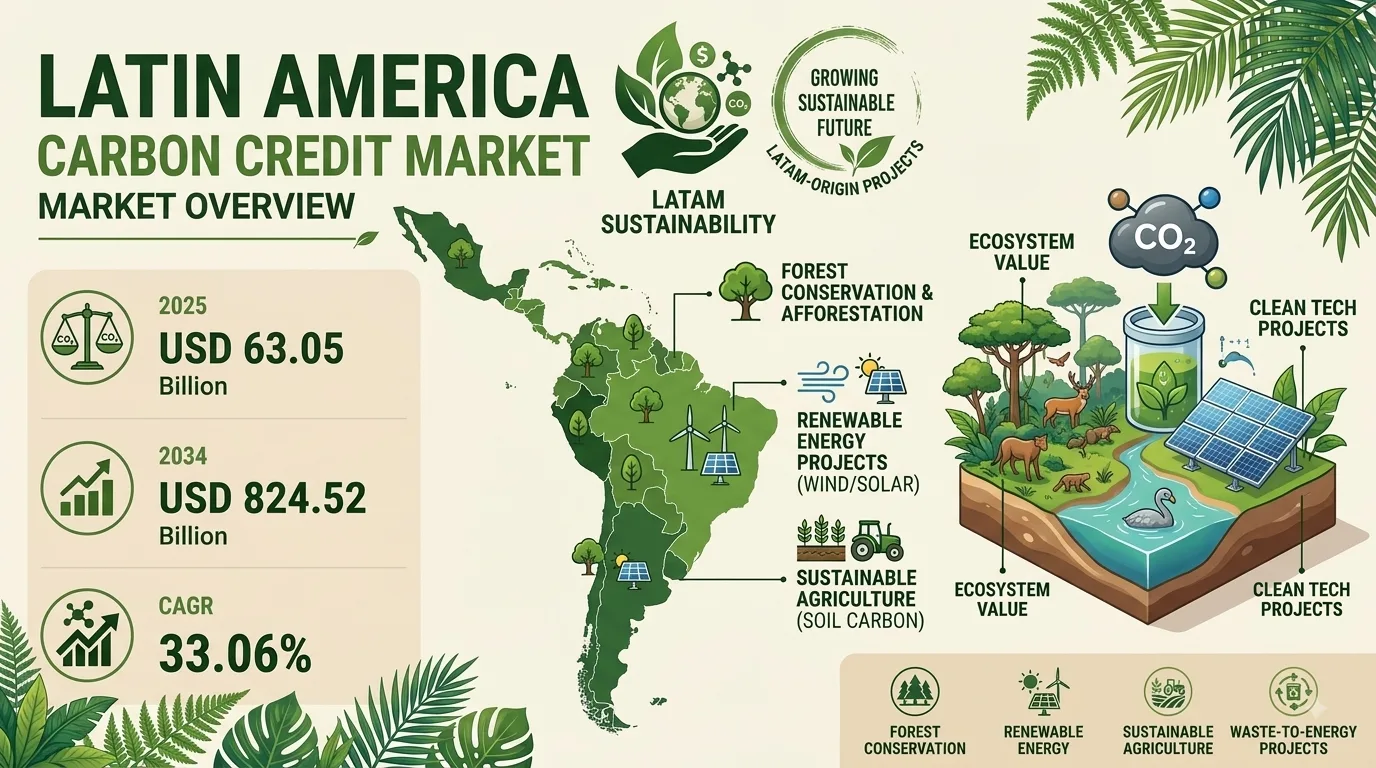
The Latin America carbon credit market is witnessing exponential growth driven by increasing corporate sustainability commitments, strengthening regulatory frameworks, and the region's vast natural resources for nature-based carbon sequestration. The market size was valued at USD 63.05 Billion in 2025 and is projected to reach USD 824.52 Billion by 2034, exhibiting an exceptional compound annual growth rate (CAGR) of 33.06% during 2026-2034 . Latin America represents a strategic global hub for carbon credit generation, with the region accounting for 22% of all carbon credits issued worldwide over the last five years and 50% of global credits in forestry and agricultural sectors . The convergence of regulatory mandates, corporate net-zero commitments, and international climate finance is creating unprecedented demand for verified emissions offsets across the region.
The Latin America carbon credit market is poised for transformative growth, driven by abundant nature-based solutions, the operationalization of Article 6 of the Paris Agreement, and USD 185 Billion in regional energy investments. With a projected CAGR of 33.06% through 2034, the market presents significant opportunities for project developers, financial institutions, and technology providers focused on high-integrity carbon credits.
LATIN AMERICA CARBON CREDIT MARKET SUMMARY
- Market Size (2025): USD 63.05 Billion, with projections reaching USD 824.52 Billion by 2034 at a CAGR of 33.06% .
- Dominant Type: The voluntary segment leads with a market share of 58% in 2025, driven by corporate sustainability commitments, ESG reporting standards, and flexible participation frameworks .
- Dominant Project Type: Avoidance/reduction projects (including REDD+) lead with a 52% share, leveraging the region's vast forest resources and cost-effective deforestation prevention initiatives .
- Dominant End-Use: The power sector represents the largest segment with a 20% market share, driven by electricity generators offsetting emissions from thermal plants while transitioning toward cleaner energy portfolios .
- Dominant Region: Brazil leads with a 35% share, reflecting its extensive Amazon rainforest resources, established regulatory frameworks, and position as a global leader in nature-based carbon credit generation .
- Regulatory Milestone: Brazil enacted Law 15,042/2024 in December 2024, establishing the Brazilian Greenhouse Gas Emissions Trading System (SBCE), targeting firms emitting above 10,000 tCO2e annually .
- Regional Integration: The creation of Red Carbono LATAM in August 2025, comprising eight organizations from across the region, aims to strengthen carbon markets, improve regulatory conditions, and consolidate common positions internationally .
- Article 6 Participation: Eleven Latin American countries are positioned as credit sellers under Article 6.2, representing approximately 20% of global bilateral agreements, with credits trading at two to five times voluntary market prices .
PORTER'S FIVE FORCES ANALYSIS - LATIN AMERICA CARBON CREDIT MARKET
The competitive dynamics of the Latin America carbon credit market can be analyzed using Porter's Five Forces framework.
Porter's Five Forces Analysis - Latin America Carbon Credit Market
- Competitive Rivalry: Moderate to High. Competition centers on project quality, verification standards, and technology integration. Major financial groups (BTG Pactual), specialized project developers (Manoa Carbon, Pachama), and international certification bodies (Verra, Gold Standard, Climate Action Reserve) compete for corporate buyers seeking high-integrity credits. Business implication: Project developers must differentiate through robust verification methodologies, technology-enabled transparency (blockchain, satellite monitoring), and demonstrated social and biodiversity co-benefits.
- Supplier Power (Project Originators): Moderate to High. Landowners, indigenous communities, and forest conservation project developers have increasing negotiating power as international corporations compete for high-quality nature-based credits. Long-term offtake agreements (e.g., BTG Pactual's commitment to supply Microsoft with up to 8 Million credits by 2043) demonstrate supplier leverage. Business implication: Buyers must establish long-term partnerships and offer premium pricing for verified, high-integrity credits to secure supply.
- Buyer Power (Corporations): Moderate. Large multinational corporations (Amazon, Meta, Microsoft) have significant negotiating power due to the scale of their procurement, but face limited supply of high-integrity nature-based credits. Buyers increasingly demand verified additionality, permanence, and co-benefits. Business implication: Project developers must ensure rigorous third-party verification, transparent monitoring, and alignment with ICVCM Core Carbon Principles to attract premium buyers.
- Threat of Substitutes: Moderate. Alternative decarbonization strategies (direct renewable energy investments, on-site emissions reductions, carbon capture technology) and competing carbon credit origins (Africa, Southeast Asia) pose substitution threats. Business implication: Latin American projects must emphasize unique value propositions - superior biodiversity co-benefits, cost-effective nature-based solutions, and strong alignment with global climate goals.
- Threat of New Entrants: Moderate to High. Barriers are lowering due to digital platforms, blockchain tokenization, and growing climate finance availability. New specialist developers, technology startups, and international investors are entering the market. Regulatory complexity and verification standards create some entry barriers. Business implication: Established players should build defensible positions through technology integration, proprietary project pipelines, and strong relationships with certification bodies and corporate buyers.
Competitive Rivalry - Moderate to High (Dynamic)
- Multi-tier competition spans international financial groups (BTG Pactual), specialized project developers (Manoa Carbon, Pachama, BioCarbon Fund), certification bodies (Verra, Gold Standard, Climate Action Reserve), and technology platforms enabling tokenization and transparent trading.
- Strategic developments include BTG Pactual's USD 1 Billion forestry program supplying Microsoft with up to 8 Million nature-based reduction credits by 2043 (June 2024), and Meta's agreement to purchase up to 3.9 Million carbon offset credits from BTG Pactual's forestry arm through 2038 (September 2024) .
Request for Sample Report: https://www.imarcgroup.com/latin-america-carbon-credit-market/requestsample
MARKET GROWTH DRIVERS:
Several key factors are propelling the expansion of the Latin America carbon credit market.
Abundant Natural Resources and Large-Scale Nature-Based Projects serve as a powerful demand driver, particularly the region's vast tropical forests, wetlands, and biodiversity-rich ecosystems. The region offers ideal conditions for nature-based solutions such as REDD+, afforestation, reforestation, and conservation projects that generate high-quality carbon credits. These projects can deliver large-scale emissions reductions at comparatively lower costs than industrial decarbonization initiatives. Strong alignment with global climate goals enhances demand from corporations seeking credible offsets. The availability of land and established forestry practices further support project scalability, positioning Latin America as a leading global supplier of carbon credits, sustaining long-term market growth .
Strong Demand from International Voluntary Carbon Markets is significantly fueling market growth. Corporations across North America, Europe, and Asia are increasingly purchasing credits from Latin America to meet net-zero and ESG commitments.
Buyers are attracted by the region's cost-effective credits, robust project pipelines, and strong environmental integrity. Multinational companies value the social and biodiversity co-benefits associated with regional projects. In June 2024, BTG Pactual Timberland Investment Group committed to supply Microsoft with up to 8 Million nature-based carbon reduction credits by 2043 through a USD 1 Billion forestry and restoration program, representing the largest carbon dioxide elimination credit transaction to date . Long-term offtake agreements provide revenue certainty for developers, encouraging new project investments.
MARKET GROWTH DRIVERS:
The Latin America carbon credit market is also benefiting from accelerating regulatory framework expansion and evolving market mechanisms. Latin American governments are accelerating the development of comprehensive carbon pricing mechanisms to meet national climate commitments. Countries including Brazil, Colombia, Mexico, and Chile are implementing or expanding carbon taxes and emissions trading systems that create compliance-driven demand. In December 2024, Brazil enacted Law 15,042/2024, establishing the Brazilian Greenhouse Gas Emissions Trading System (SBCE), targeting firms emitting above 10,000 tCO2e annually and 25,000 tCO2e yearly . These regulatory advances are harmonizing domestic markets with international standards and attracting institutional investment.
Advancements in Digital Monitoring, Verification, and Trading Platforms are accelerating growth through technologies such as satellite imaging, remote sensing, blockchain, and AI that improve transparency, traceability, and accuracy of emissions data . Digital platforms enable faster transactions, broader market access, and price discovery. Tokenization and digital registries allow fractional ownership and improve liquidity in voluntary markets. Improved monitoring capabilities strengthen confidence in project permanence and additionality. As technology adoption increases, smaller project developers gain access to global buyers, modernizing market infrastructure and supporting scalable growth.
Integration of Blockchain Technology and AI-Driven Monitoring is reshaping carbon credit markets through platforms that enhance transparency, traceability, and transaction efficiency. Technology providers are developing tokenization solutions that enable secure trading and fractional ownership of carbon credits. These innovations are improving market accessibility, reducing transaction costs, and building confidence among international buyers seeking verified, tamper-proof records of carbon offset ownership. Integration of AI-driven monitoring and satellite data further strengthens verification accuracy and real-time emissions tracking .
LATIN AMERICA CARBON CREDIT MARKET SEGMENTATION
Segmentation analysis provides a detailed view of the Latin America carbon credit market by category:
- Type Insights: Voluntary (58% market share, 2025), Compliance. The voluntary segment dominates due to growing corporate sustainability commitments and the flexibility offered to organizations seeking to offset emissions beyond regulatory requirements .
- Project Type Insights: Avoidance/Reduction Projects (52% market share, 2025), Removal/Sequestration Projects (Nature-based, Technology-based). Avoidance/reduction projects maintain market leadership due to the region's extensive tropical forest coverage and the proven effectiveness of REDD+ initiatives in preventing deforestation .
- End-Use Insights: Power (20% market share, 2025), Energy, Aviation, Transportation, Buildings, Industrial, Others. The power sector's leading position reflects substantial carbon credit demand from electricity generators operating thermal power plants and seeking to transition toward cleaner energy portfolios .
- Regional Insights: Brazil (35% market share, 2025), Mexico, Argentina, Colombia, Chile, Peru, Others. Brazil leads due to its vast natural capital, mature project ecosystem, strong integration with global voluntary markets, and well-developed network of project developers and certification bodies .
COMPETITIVE LANDSCAPE
The Latin America carbon credit market features a dynamic competitive landscape characterized by diverse participants including project developers, financial institutions, verification bodies, and trading platforms. Key players operating in the market include:
- BTG Pactual Timberland Investment Group - Committed to supplying Microsoft with up to 8 Million nature-based credits by 2043 through a USD 1 Billion forestry program
- Verra, Gold Standard, Climate Action Reserve - International certification bodies ensuring credit credibility
- Manoa Carbon, Pachama, BioCarbon Fund - Specialized project developers gaining traction with Latin American environmental priorities
- Petrobras and Brazilian Development Bank (BNDES) - Launched ProFloresta+ initiative in November 2025 to acquire 5 Million high-integrity carbon credits related to Amazon restoration
Strategic developments are shaping the competitive arena, notably major financial groups establishing dedicated carbon credit divisions, specialized startups focusing on innovative project development and technology solutions, and strategic partnerships between project developers and multinational corporations creating long-term supply agreements.
REGIONAL ANALYSIS:
Regional dynamics within the Latin America carbon credit market are shaped by varying levels of regulatory maturity and project development.
- Brazil emerges as the dominant regional market with a 35% share, driven by the Amazon rainforest, mature REDD+ initiatives, and the newly established Brazilian Greenhouse Gas Emissions Trading System (SBCE) under Law 15,042/2024 . Brazil possesses a well-developed network of project developers, certification bodies, and technical experts, supporting efficient project execution and verification .
- Chile represents one of the most advanced regulatory frameworks with five projects authorized by the Ministry of Environment, three linked to international agreements, representing estimated investments of USD 1,400 Million .
- Peru focuses on forest-based projects and REDD+ initiatives in the Amazon, having identified 66 mitigation measures and advancing systems to scale projects and channel international financing .
- Colombia holds the largest volume of carbon credits in circulation in the region (28.5% of Latin America), surpassing Brazil and Peru in recent years .
- Paraguay advances with an export-oriented strategy supported by its renewable energy matrix and the development of its National Carbon Registry to position itself as a competitive supplier in the global market .
- Argentina shows significant potential, with estimates indicating it could generate at least 131.4 Million carbon credits annually, representing potential revenues of between USD 1,400 Million and USD 3,900 Million .
RECENT INDUSTRY DEVELOPMENTS
November 2025: Petrobras and the Brazilian Development Bank (BNDES) launched a public request for proposals through the ProFloresta+ initiative to acquire 5 Million high-integrity carbon credits related to Amazon restoration, aiming to establish a definitive price standard for restoration credits and draw investment in the restoration industry .
August 2025: Eight organizations from across Latin America established Red Carbono LATAM, a collaborative platform to strengthen carbon markets, improve regulatory conditions, and consolidate common positions internationally .
September 2024: Meta agreed to purchase up to 3.9 Million carbon offset credits from Brazilian investment bank BTG Pactual's forestry arm through 2038, supporting reforestation efforts involving over 7 Million seedlings .
June 2024: BTG Pactual Timberland Investment Group committed to supply Microsoft with up to 8 Million nature-based carbon reduction credits by 2043 through a USD 1 Billion forestry and restoration program, representing the largest carbon dioxide elimination credit transaction to date .
December 2024: Brazil enacted Law 15,042/2024, establishing the Brazilian Greenhouse Gas Emissions Trading System (SBCE), targeting firms emitting above 10,000 tCO2e annually .
Key Aspects Required for the Latin America Carbon Credit Market
- Market Performance: USD 63.05 Billion in 2025, with a projected trajectory to USD 824.52 Billion by 2034 .
- Market Outlook: A 33.06% CAGR through 2034 indicates exceptional growth across voluntary and compliance carbon markets, nature-based solutions, and technology-enabled trading platforms .
- Growth Drivers: Abundant natural resources and nature-based project potential; strong demand from international voluntary carbon markets; regulatory framework expansion and emissions trading systems; advancements in digital monitoring, blockchain, and AI-driven verification; integration of Article 6 of the Paris Agreement creating structured international transfers .
- Competitive Landscape: Dynamic competition among international financial groups (BTG Pactual), specialized project developers (Manoa Carbon, Pachama), certification bodies (Verra, Gold Standard, Climate Action Reserve), and technology platforms enabling tokenization and transparent trading .
- Value Chain Analysis: From project development and certification through verification, trading, and corporate offset procurement, with increasing integration of digital platforms and blockchain technology.
- Industry Trends: Rising demand for large-scale nature-based offset agreements; expansion of regulatory frameworks and emissions trading systems; integration of blockchain technology and AI in carbon credit trading; corporate preference for high-integrity credits with biodiversity and community co-benefits; participation in Article 6 mechanisms enabling international transfers .
- Strategic Recommendations: Focus on high-integrity nature-based projects with robust verification and co-benefits; invest in digital monitoring, blockchain, and AI technologies; develop long-term offtake agreements with multinational corporations; align with ICVCM Core Carbon Principles and international integrity standards; participate in regional coordination through initiatives like Red Carbono LATAM; leverage Article 6 opportunities for premium pricing .
Note: If you need any specific information that is not covered currently within the scope of the report, we will provide the same as a part of customization.
Request Customization: https://www.imarcgroup.com/request?type=report&id=30138&flag=E
Write this before about us -
- Report Format, Delivery, and Customization Details
- Report Format Mode: PPT, PDF, and Excel
- Report Delivery Mode: Online Delivery, Physical Delivery
- Report Delivery Time: Report Delivered Over Email within 24 to 48 hours. If requested by the client, a physical copy will be delivered within three to ten days.
- Report Confirmation Mode: Yes via Email
- Report Customization Mode: Yes via Email / Call
- Report Table of Content: Yes
- Report List of Figures: Yes
- Report Methodology Mode: Yes
- Request For Sample Report: Yes