
Market Overview
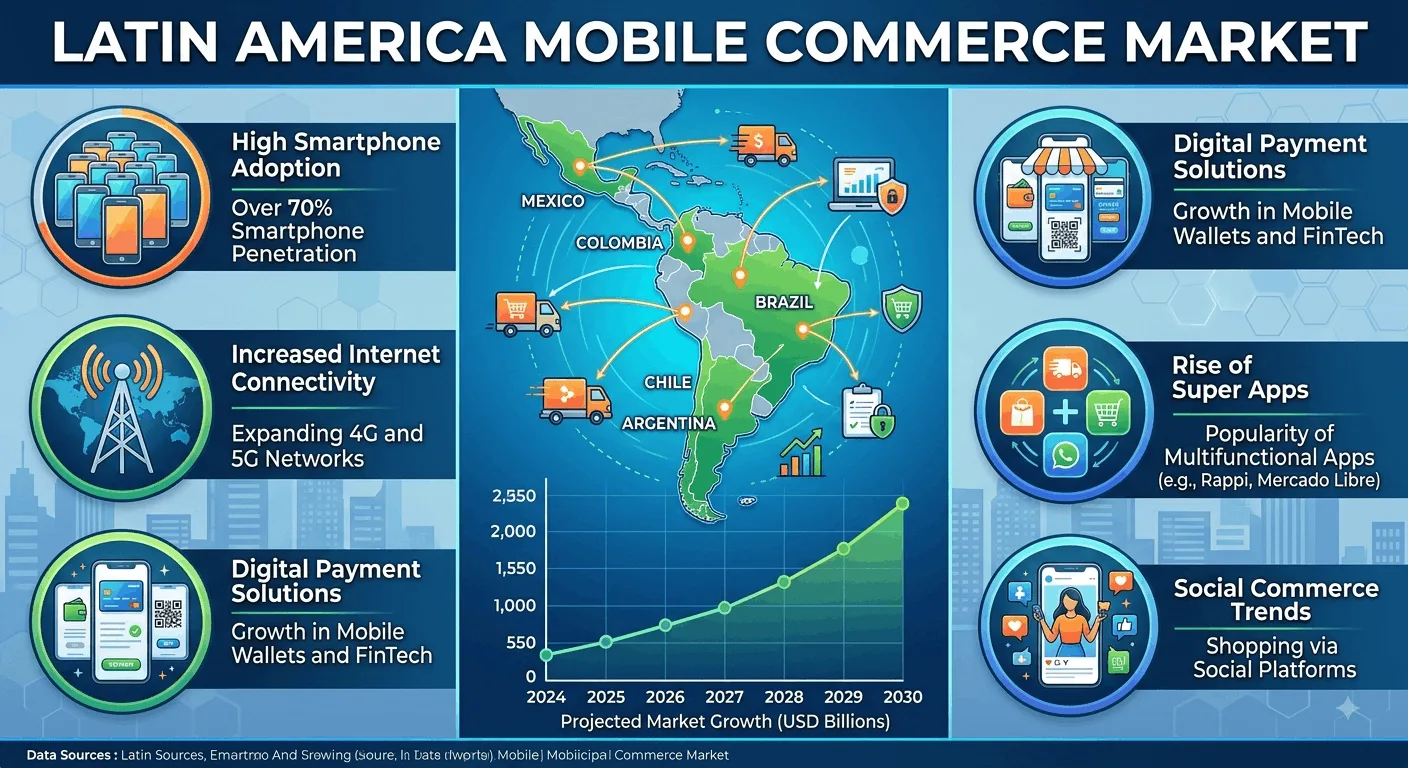
The Latin America mobile commerce market size reached USD 138.3 Billion in 2025 and is projected to reach USD 971.1 Billion by 2034, exhibiting a CAGR of 23.45% during 2026-2034. Key factors driving the market include the rising reliance on smartphones, a high number of internet users, a shift to digital payments, and increasing social media influence across the region. Online shopping in Latin America is growing 1.5 times faster than the rest of the world, with nearly 85% of regional e-commerce growth concentrated in three markets: Argentina, Brazil, and Mexico. Over 70% of e-commerce transactions in the region were initiated on smartphones in 2025.
This market is strategically important to Latin America's digital and retail economy, supporting the region's transition toward mobile-first consumer engagement and digital financial inclusion. The Latin American mobile commerce market encompasses m-retailing, m-ticketing, m-billing, and other mobile-based commercial transactions, serving a rapidly growing base of over 300 million digital buyers. The region's e-commerce market is expected to reach USD 215.31 billion in 2026, with mobile commerce accounting for the vast majority of transactions.
The Latin America mobile commerce market is poised for extraordinary expansion, underpinned by smartphone penetration growth, improving internet infrastructure, and the rapid adoption of digital payment solutions. With a projected CAGR of 23.45% through 2034, the market presents significant opportunities for businesses focusing on mobile-first strategies, social commerce integration, and digital wallet solutions.
LATIN AMERICA MOBILE COMMERCE MARKET SUMMARY
The Latin America mobile commerce market encompasses all commercial transactions conducted via mobile devices, including m-retailing, m-ticketing, m-billing, and other mobile-based services.
The ecosystem spans mobile commerce platforms, payment service providers, telecommunications companies, social media platforms, retailers, and end consumers across the region's diverse markets.
By Transaction Type, the market is segmented into M-Retailing, M-Ticketing, M-Billing, and Others.
By Payment Mode, the market covers Near Field Communication (NFC), Premium SMS, Wireless Application Protocol (WAP), and Others.
By Type of User, the market serves Smart Device Users and Feature Phone Users.
By Country, the market serves Brazil, Mexico, Argentina, Colombia, Chile, Peru, and Others.
Key trends shaping the market include rising smartphone adoption, increasing internet penetration, social media influence on purchasing decisions, and the growing shift toward digital payment methods.
PORTER'S FIVE FORCES ANALYSIS – LATIN AMERICA MOBILE COMMERCE MARKET
Competitive Rivalry: High. The market features intense competition among regional e-commerce giants such as MercadoLibre, global platforms, and emerging mobile-first startups. Business implication: Companies must differentiate through user experience, logistics efficiency, and payment integration.
Supplier Power (Technology and Payment Infrastructure): Moderate. Mobile commerce platforms rely on technology providers, payment gateways, and telecommunications infrastructure. The technical expertise required for secure payment processing and mobile app development gives specialised suppliers moderate leverage. Business implication: Strategic partnerships and in-house technology development can reduce supplier dependency.
Buyer Power (Consumers): High. Latin American consumers benefit from extensive choice across mobile commerce platforms, with the ability to compare prices, delivery options, and payment methods. The prevalence of social media influence and user reviews strengthens buyer negotiating power. Business implication: Brands must invest in user experience, competitive pricing, and customer trust.
Threat of Substitutes: Moderate. Physical retail represents a partial substitute, but the convenience, time savings, and expanding product range of mobile commerce provide strong differentiation, particularly in the region's rapidly urbanizing areas.
Threat of New Entrants: Moderate. Significant capital requirements for logistics infrastructure, payment integration, and brand building create barriers. However, the growing demand for mobile commerce and social commerce has enabled new entrants focused on niche segments and innovative delivery models.
KEY ASPECTS REQUIRED FOR THE LATIN AMERICA MOBILE COMMERCE MARKET
Market Performance: USD 138.3 Billion in 2025, projected to reach USD 971.1 Billion by 2034, driven by smartphone adoption, internet penetration, and digital payment shift.
Market Outlook: A 23.45% CAGR through 2034 reflects exceptional growth led by mobile-first consumer behavior, social commerce integration, and expanding digital payment infrastructure.
Growth Drivers: Rising smartphone adoption (20% increase to 33.5 million units in Q2 2024); increasing number of internet users (94% of Chile's population has internet access); social media influence (Facebook 49.3%, YouTube 10.56% in July 2024); shift to digital payments and mobile wallets; growing e-commerce market (expected to reach USD 215.31 billion in 2026).
Market Restraints: Economic volatility in key markets; logistical challenges across vast geographic areas; digital divide between urban and rural areas; regulatory complexity across different countries.
Competitive Landscape: Regional e-commerce giants, global platforms, and emerging mobile-first startups competing across user experience, logistics, and payment integration.
Value Chain Analysis: From mobile device ownership and internet connectivity through platform discovery and transaction processing to payment settlement and last-mile delivery.
Industry Trends: Social commerce integration; mobile wallet adoption; AI-powered personalization; cross-border mobile commerce; voice commerce; augmented reality shopping experiences; BNPL (Buy Now, Pay Later) integration.
Strategic Recommendations: Invest in mobile-first user experience and app development; integrate social commerce capabilities; develop seamless digital payment solutions; expand logistics and delivery infrastructure; target underserved rural and emerging markets; leverage AI for personalization and customer engagement.
Request for Sample Report: https://www.imarcgroup.com/latin-america-mobile-commerce-market/requestsample
MARKET GROWTH DRIVERS
Rising Smartphone Adoption
Smartphone adoption across Latin America is accelerating at a remarkable pace, fundamentally reshaping consumer access to digital commerce. Shipments in Latin America's smartphone market increased 20% to 33.5 million units in the second quarter of 2024. A wide range of smartphone models at different price points makes it easier for individuals to own devices, helping bridge the urban-rural divide and allowing individuals in rural areas to engage in mobile commerce. Smartphones provide user-friendly interfaces and applications, making it easier for users to browse products, compare prices, and make purchases. Mobile devices equipped with features such as touch screens, voice recognition, and augmented reality (AR) aid in enhancing the shopping experience. Smartphones make it simple for users to exchange reviews and experiences, influencing purchasing decisions and increasing consumer confidence. Furthermore, smartphone users can make use of a variety of digital payment options such as mobile wallets, favoring the Latin America mobile commerce market growth.
Increasing Number of Internet Users
Internet penetration across Latin America continues to expand, creating a larger addressable market for mobile commerce. According to the World Bank Group, around 94% of the population in Chile have internet access in 2023. The wide availability of affordable data plans in Latin America is playing a pivotal role in facilitating mobile commerce. Improving internet access in both urban and rural areas on account of the growth of broadband networks, which include fiber-optic cables and wireless technologies including 4G and 5G, is favoring market expansion. Faster internet connections shorten the time it takes for websites and apps to load, making buying easier and promoting mobile commerce. The introduction of competitive pricing among telecom providers is leading to more affordable data plans, making it easier for individuals to access the internet on their mobile devices. Enhanced internet connectivity enables users to stream videos, browse social media, and access digital content more easily, leading to an increase in consumer engagement with brands and products.
Social Media Influence
Social media platforms have become powerful drivers of mobile commerce in Latin America, fundamentally changing how consumers discover and purchase products. According to recent industry reports, Facebook accounts for 49.3% and YouTube holds 10.56% in July 2024 in Latin America. Social media platforms allow businesses to reach consumers directly and showcase their products. Through visually appealing content and targeted ads, these platforms engage users, leading to significant traffic to mobile commerce sites. With features such as shoppable posts, stories, and integrated checkout options, the platform allows for a seamless purchasing experience. Algorithms analyze the behavior of users to serve them personalized ads and thus increase the chance of converting. This also allows users to easily interact with brands and discover new products without leaving their social media feeds.
Shift to Digital Payments
The growing adoption of digital payment methods, including mobile wallets, NFC payments, and Buy Now, Pay Later (BNPL) solutions, is removing friction from the mobile commerce experience. Digital payment options provide convenience, security, and accessibility, encouraging more consumers to transact via mobile devices. As Latin American consumers increasingly trust digital payment infrastructure, mobile commerce transaction volumes continue to rise.
LATIN AMERICA MOBILE COMMERCE MARKET SEGMENTATION
Segmentation analysis provides a detailed view of the Latin America mobile commerce market by category:
Transaction Type Insights:
- M-Retailing – the dominant transaction type, encompassing all retail purchases made via mobile devices, including fashion, electronics, groceries, and household goods.
- M-Ticketing – mobile-based purchase of tickets for events, transportation, and entertainment.
- M-Billing – mobile bill payments for utilities, telecommunications, and other services.
- Others – including mobile banking, money transfers, and other financial transactions.
Payment Mode Insights:
- Near Field Communication (NFC) – contactless payments using mobile devices at physical point-of-sale terminals.
- Premium SMS – payments processed via premium-rate SMS messages.
- Wireless Application Protocol (WAP) – mobile commerce conducted through WAP-enabled browsers.
- Others – including mobile wallets, QR code payments, and Buy Now, Pay Later solutions.
Type of User Insights:
- Smart Device Users – the dominant user segment, reflecting the accelerating shift from feature phones to smartphones across the region.
- Feature Phone Users – a declining but still significant segment, particularly in rural areas and among lower-income consumers.
Country Insights:
- Brazil – the largest market, driven by its massive population, high smartphone penetration, and dominant e-commerce ecosystem.
- Mexico – a key market with rapidly growing mobile commerce adoption and strong cross-border e-commerce activity.
- Argentina – significant market with high mobile penetration and growing digital payment adoption.
- Colombia – an emerging market with expanding mobile commerce infrastructure.
- Chile – high internet penetration (94%) driving strong mobile commerce growth.
- Peru – a growing market with increasing smartphone adoption and digital payment integration.
- Others – including remaining Latin American countries with developing mobile commerce ecosystems.
COMPETITIVE LANDSCAPE
The competitive landscape of the Latin America mobile commerce market features intense competition among regional e-commerce giants, global platforms, and emerging mobile-first startups. Companies compete across user experience, logistics efficiency, payment integration, and customer trust. The market research report has provided a comprehensive analysis of the competitive landscape, including market structure, key player positioning, top winning strategies, competitive dashboard, and company evaluation quadrant. Detailed profiles of all major companies have been provided.
Investment opportunities exist in mobile-first user experience development, social commerce integration, digital payment solutions, logistics infrastructure, AI-powered personalization, and cross-border mobile commerce platforms.
REGIONAL ANALYSIS
Brazil represents the largest mobile commerce market in Latin America, driven by its massive population of over 200 million, high smartphone penetration, and a dominant e-commerce ecosystem led by MercadoLibre and other regional players. Brazil's large and diverse consumer base, combined with improving logistics infrastructure, creates significant opportunities for mobile commerce growth.
Mexico is a key market with rapidly growing mobile commerce adoption. Mexico benefits from strong cross-border e-commerce activity with the United States, a young and digitally native population, and expanding digital payment infrastructure.
Argentina represents a significant market with high mobile penetration and growing digital payment adoption. Despite economic challenges, Argentina's tech-savvy population and strong social media engagement drive mobile commerce growth.
Colombia is an emerging market with expanding mobile commerce infrastructure. The country's growing middle class, increasing smartphone adoption, and improving internet connectivity support market development.
Chile benefits from the highest internet penetration in the region at 94%, driving strong mobile commerce adoption. Chile's advanced digital infrastructure and high consumer trust in online transactions support market growth.
Peru and other countries represent growing markets with increasing smartphone adoption and digital payment integration. As internet connectivity improves and smartphone prices decline, these markets offer significant growth potential.
RECENT INDUSTRY DEVELOPMENTS
2025 Activity: The Latin America mobile commerce market continued its growth trajectory from USD 138.3 Billion in 2025 to USD 971.1 Billion by 2034 at a CAGR of 23.45%.
February 4, 2025: Moove successfully acquired Kovi, a Brazilian company, to enhance its presence in the mobile commerce sector across Latin America, thereby bolstering its vehicle financing services tailored for gig economy drivers. Supported by Uber, Moove and Kovi achieved a revenue of USD 275 Million in 2024, operating a fleet of 36,000 vehicles. This acquisition combines Moove's international expertise with Kovi's established local network, thereby improving mobility solutions within the region.
2025 Activity: Over 70% of e-commerce transactions in Latin America were initiated on smartphones. Argentina, Brazil, and Mexico concentrated nearly 85% of regional e-commerce sales.
2025 Activity: Smartphone shipments in Latin America increased 20% to 33.5 million units in Q2 2024.
2026 Activity: Latin American e-commerce is projected to reach USD 215.31 billion, growing 1.5 times faster than the rest of the world.
FREQUENTLY ASKED QUESTIONS
Q1: What is the current size of the Latin America mobile commerce market?
A: The Latin America mobile commerce market size reached USD 138.3 Billion in 2025 and is projected to reach USD 971.1 Billion by 2034, exhibiting a CAGR of 23.45% during 2026-2034.
Q2: What are the key drivers of the Latin America mobile commerce market?
A: The market is driven by: (i) rising smartphone adoption (20% increase in shipments); (ii) increasing number of internet users (94% in Chile); (iii) social media influence (Facebook 49.3%, YouTube 10.56%); (iv) shift to digital payments; and (v) growing e-commerce market (projected at USD 215.31 billion in 2026).
Q3: What are the major transaction types in the Latin America mobile commerce market?
A: Major transaction types include M-Retailing, M-Ticketing, M-Billing, and Others.
Q4: What are the major payment modes in the Latin America mobile commerce market?
A: Major payment modes include Near Field Communication (NFC), Premium SMS, Wireless Application Protocol (WAP), and Others.
Q5: What are the major user types in the Latin America mobile commerce market?
A: Major user types include Smart Device Users and Feature Phone Users.
Q6: Which countries lead the Latin America mobile commerce market?
A: Brazil leads the market, followed by Mexico, Argentina, Colombia, Chile, Peru, and others. Argentina, Brazil, and Mexico collectively account for nearly 85% of regional e-commerce sales.
Q7: How fast is Latin America's e-commerce growing compared to the rest of the world?
A: Online shopping in Latin America is growing 1.5 times faster than the rest of the world.
Q8: Who are the major players in the Latin America mobile commerce market?
A: Major players include regional e-commerce giants such as MercadoLibre, global platforms, and emerging mobile-first startups. Comprehensive competitive analysis including market structure, key player positioning, and company profiles are covered in the full report.
Note: If you need any specific information that is not covered currently within the scope of the report, we will provide the same as a part of customization.
https://www.imarcgroup.com/request?type=report&id=28995&flag=E
Report Format, Delivery, and Customization Details
Report Format Mode: PPT, PDF, and Excel
Report Delivery Mode: Online Delivery, Physical Delivery
Report Delivery Time: Report Delivered Over Email within 24 to 48 hours. If requested by the client, a physical copy will be delivered within three to ten days.
Report Confirmation Mode: Yes via Email
Report Customization Mode: Yes via Email / Call
Report Table of Content: Yes
Report List of Figures: Yes
Report Methodology Mode: Yes
Request For Sample Report: Yes