Ask around in any small-dealer WhatsApp group or a car-flipping subreddit and you'll hear the same complaint: leads come in through Facebook, OLX, or a cousin's referral, then die somewhere between the first message and the test drive. Nobody's tracking them. Nobody's following up. Research into dealer CRM tools backs this up — dealerships that respond to a lead within minutes close meaningfully more deals than ones working off scattered WhatsApp screenshots, and a bare listing site with no lead-tracking layer quietly recreates that same chaos online.
That's the actual problem a car classified website solves, and it's a bigger opportunity than most people realize. Market research on the online car category puts the global online car market at roughly $294 billion in 2022, with projections putting it near $564 billion by 2028 — an 11% annual growth rate that shows no sign of slowing. Yet the guides that show up when you search "how to build a car classified website" mostly read like procurement checklists: a feature list, a price range, a "book a call" button at the bottom. They skip the two questions that actually decide whether the project succeeds — should you build custom or start from a ready-made script, and what makes a buyer trust a listing enough to pick up the phone?
Why Car Classifieds Are Still a Wide-Open Opportunity
Used car sales are messier than most categories, which is exactly why they're still ripe for a good platform. A house sale might happen once every seven years. A car changes hands every two to three. Multiply that turnover across a region with fragmented dealer networks — most of South Asia, parts of the Gulf, plenty of Southeast Asia — and you get thousands of individual sellers and small dealers who currently list on Facebook Marketplace or a generic classifieds site because nothing built specifically for cars exists locally.
That gap is the opening. A regional or city-specific car marketplace doesn't need to out-feature Cars.com or CarGurus. It needs to solve the two things those giants don't bother with at a local level: trust between strangers, and a faster path from browsing to a phone call.
The Real Decision Most Guides Skip — Custom Build vs. Ready Script
Here's where most cost guides stop short. They'll tell you a custom marketplace built like AutoScout24 or Autotrader costs anywhere from $15,000 to $150,000-plus depending on scope, and that's true — for a fully custom build with a dedicated dev team, months of sprints, and ongoing engineering overhead. What they don't mention is that most first-time founders don't need that scope on day one. They need to prove the model works in one city with one set of dealers first.
This is where a pre-built car classified script changes the math. Instead of writing listing management, search filters, and admin moderation from scratch, a founder starts from a working base and spends the budget on what's actually unique to their market — currency, language, local payment rails, dealer verification rules. One developer documented exactly this path while building a UAE-specific used car marketplace: starting from a PHP-based classified script gave them roughly 60-70% of the core functionality (listings, search, admin approvals, multi-image upload) out of the box, leaving the custom work for Arabic localization and AED currency support rather than reinventing listing management.
Some India-based studios — Originate Soft among them — offer a ready-made car classified script built specifically for this kind of fast, localized launch, rather than a from-scratch build. It's not the only route, but it's worth knowing it exists before committing six figures and six months to a custom build you might not need yet.
What Actually Makes a Buyer Trust a Car Listing?
Feature lists are easy to copy. Trust is not. A used car is a high-value purchase from a stranger, and every successful car marketplace — regardless of region — solves for the same handful of trust signals before it worries about anything else. Guides that break down full-featured marketplace builds tend to bury these signals under dozens of nice-to-have features, when in practice three of them do most of the work.
Vehicle history and verification
Buyers want to know a car isn't hiding accident damage, a salvage title, or a mileage rollback before they drive an hour to see it. Even a lightweight version of this — a seller-submitted service history, an odometer photo requirement, a "verified" badge for dealers who've submitted registration documents — does more for conversion than another search filter.
Dealer vs. individual seller signals
A listing from a verified dealer with 40 other cars reads differently than one from an individual with no history on the platform. Surfacing that distinction clearly (a dealer badge, a response-time indicator, a "member since" date) helps buyers self-select into the risk level they're comfortable with, instead of treating every listing the same.
Search, filtering, and mobile experience
This part is table stakes, but it's still where a lot of budget listing sites fall down. Buyers filter by budget, fuel type, transmission, and year before anything else, and they're doing it on a phone in traffic, not a desktop at a desk. A slow mobile search experience quietly kills conversion long before a buyer ever reaches a listing page.
None of this needs to be built from zero. It needs to be prioritized correctly, which is the part a generic feature checklist rarely tells you.
What a Car Classified Website Actually Costs to Build
Budget expectations vary wildly depending on which path you take. A single-dealer site with basic inventory and lead capture can start around $3,000 to $5,000. A full custom multi-vendor marketplace — dealer dashboards, payment splitting, a mobile app, advanced search — realistically lands between $20,000 and $50,000-plus, and can climb past $150,000 for something built to compete directly with the established players.
The script-based route sits well below that for an initial launch, since the core engineering is already done and the spend goes toward localization, hosting, and design instead of building listing infrastructure from scratch. The honest trade-off is flexibility: a script gets you to market fast, but a fully custom build gives you a codebase shaped exactly around your business model from day one. Most founders are better served picking the first option and re-evaluating once the model is proven — rebuilding on a validated business is a much easier conversation than fundraising for one that hasn't launched yet.
Realistic Timelines: From Script to Launch
Timeline is where the two paths diverge most sharply. A custom-built marketplace, done properly with a dedicated team, typically runs 4 to 9 months from planning to launch once you account for design, backend development, testing, and the inevitable scope changes that show up around month three.
A script-based launch compresses that dramatically. The UAE case study mentioned earlier had a working, localized marketplace running in a matter of weeks, not months, because the founder wasn't debugging user authentication or building an admin panel from scratch — they were adapting an existing one. That speed matters more than it sounds like it should. A car marketplace's early value comes from having enough dealers and enough inventory to make buyers keep coming back, and every month spent in development is a month a local Facebook group keeps absorbing that demand instead.
Where This Actually Goes
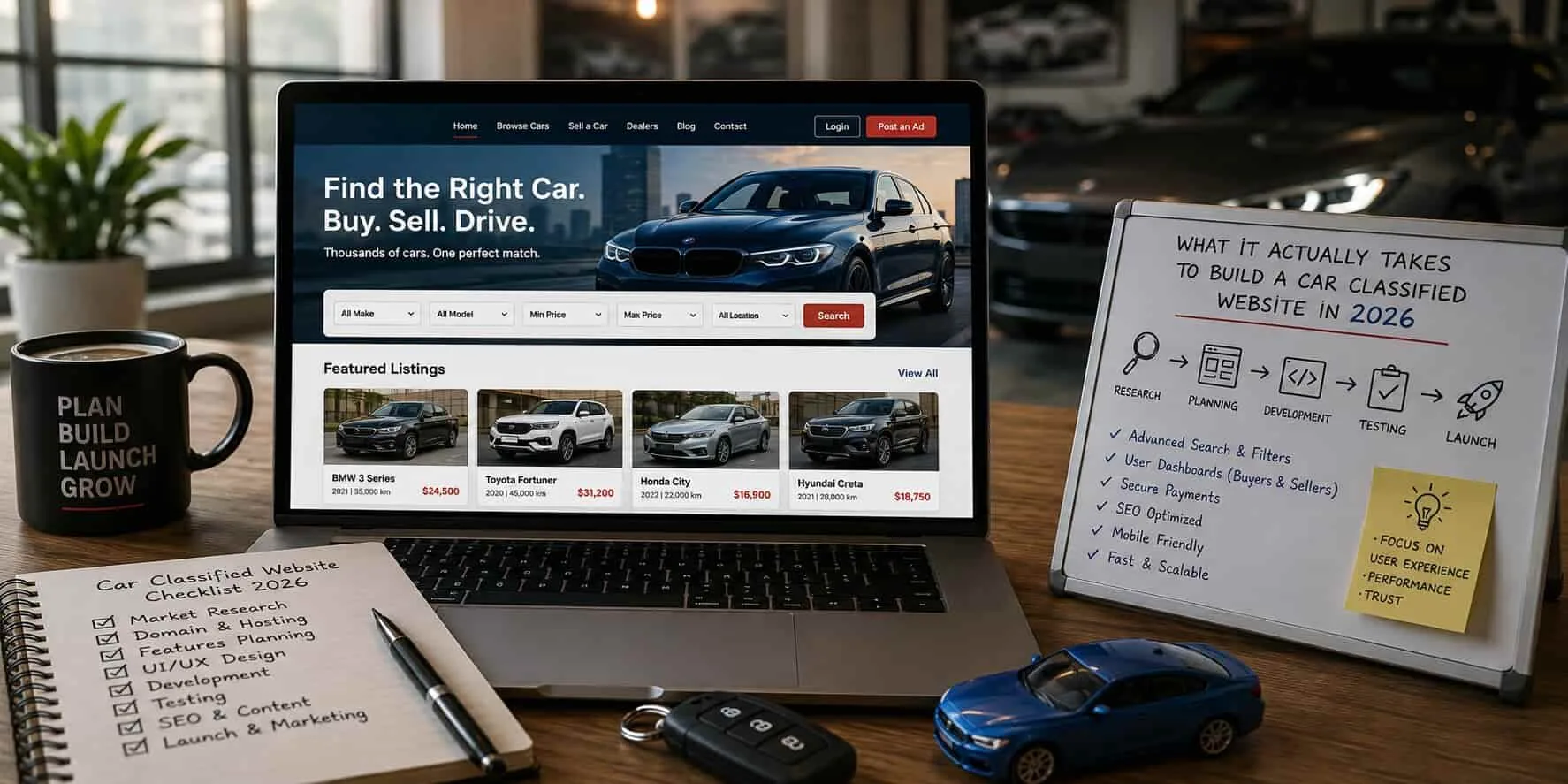
Building a car classified website isn't really a technology decision — it's a sequencing decision. Solve trust and speed first, in whichever order gets a working platform in front of real dealers fastest, and worry about matching Cars.com feature-for-feature later, if ever. Most local car marketplaces don't fail because they lacked a feature. They fail because they took too long to find out whether anyone wanted them.
The founders who do this well tend to treat the first version as a test, not a monument. Ship something narrow, watch what dealers and buyers actually do with it, and let that — not a competitor's feature list — decide what gets built next.