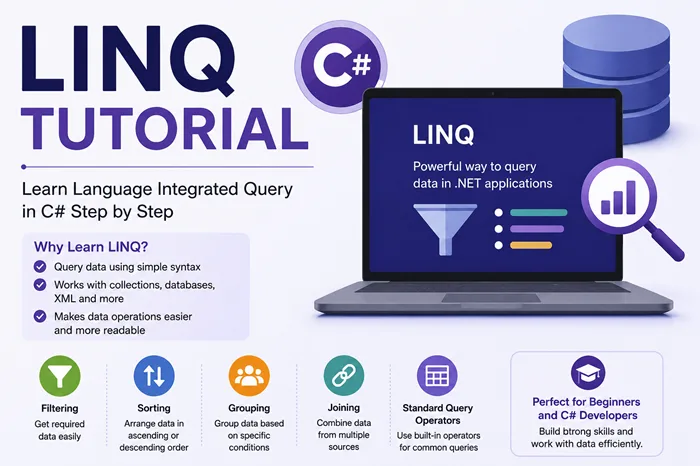
Working with data is an important part of software development. Applications often need to search, filter, sort, group, and organize large amounts of information. C# provides a useful technology called LINQ that makes many of these data-related tasks easier. LINQ stands for Language Integrated Query and is designed to provide a common way to work with different types of data.
LINQ is useful for developers who work with collections, databases, XML documents, and other data sources. It allows developers to perform different operations on data without depending on a separate query language for every type of data source. This makes data handling more organized and easier to understand.
What Is LINQ?
LINQ is a feature of the .NET platform that adds query capabilities to programming languages such as C#. It provides a consistent approach for retrieving and manipulating data. Developers can use LINQ to find specific records, arrange information, select required values, and perform calculations on data.
One important advantage of LINQ is its readability. Data operations can be expressed in a structured way, making applications easier to understand and maintain. It can also reduce repetitive data-handling work.
Important LINQ Concepts
A good understanding of LINQ begins with its basic concepts. Developers can learn about query syntax and method syntax, which are two common approaches to working with LINQ.
LINQ also provides standard query operators for performing different operations. Filtering helps retrieve only the required information. Sorting arranges data in a particular order. Grouping organizes related information into groups, while joining combines information from different data sources.
Other useful operations include selecting specific data, checking conditions, finding values, counting records, and performing calculations. Learning these operators helps developers handle data more efficiently.
Benefits of Learning LINQ
LINQ offers several benefits to C# developers. It provides a common approach for querying different data sources and can make data operations more readable. It also helps developers write applications that are easier to manage and update.
LINQ is especially useful when an application works with collections or database-related information. Understanding its concepts can improve a developer's ability to work with data in real-world applications.
Who Should Learn LINQ?
LINQ is useful for beginners who are learning C# as well as experienced developers who want to improve their data-querying skills. Students can learn LINQ to strengthen their knowledge of .NET programming, while working developers can use it to handle data more effectively.
Learning LINQ step by step is a good way to understand its features. Start with the basic concepts, then explore query operators, filtering, sorting, grouping, joining, and other operations.
For more information and detailed concepts, explore the LINQ Tutorial.