A couple of years ago, fine-tuning a large language model meant a rack of expensive GPUs, a dedicated ML team, and a training bill with a lot of zeros in it. Well, now in 2026, a developer with one decent GPU and an afternoon can fine-tune a 7B model on their own data, using tools that are genuinely mature now instead of half-working research code.
I have gone through this process enough times to know where people usually get stuck, so let me walk you through it properly, starting from what fine-tuning actually means and ending with when you actually need serious cloud hardware to pull it off.
What does fine-tuning an LLM actually mean, in plain terms?
It means taking a model that already understands language, and training it further on your own data so it picks up a specific tone, format, or domain knowledge. You are not teaching it to talk. You are teaching it to talk the way you need it to.
Is fine-tuning always the right choice, or should you try something else first?
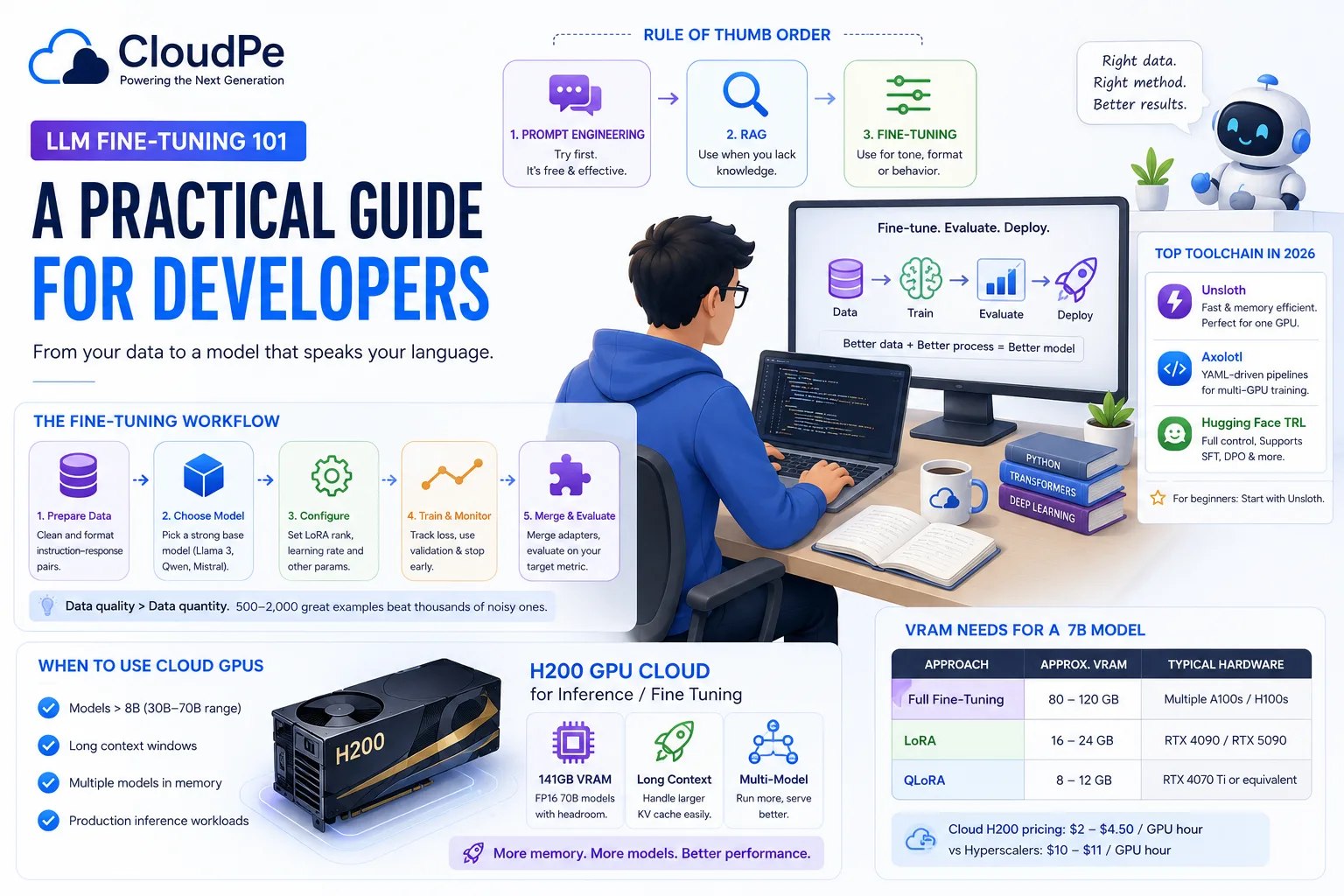
Try something else first, most of the time. The usual order that works well is:
- Prompt engineering first, because it costs nothing and solves more problems than people expect
- RAG (retrieval augmented generation) second, when the issue is missing knowledge, not missing behavior
- Fine-tuning third, only once you have a clear, measured gap that prompting and retrieval cannot close
Fine-tuning for pure knowledge is usually the wrong tool. RAG handles that better. Fine-tuning is best when you need consistent formatting, a specific tone, or behavior that would take an enormous prompt to describe every single time.
What are LoRA and QLoRA, and why does everyone use them now?
They are the reason fine-tuning became accessible in the first place. Instead of updating every parameter in a model, which for a 7B model can require 80 to 120GB of memory once you include optimizer states and gradients, these methods only train a small additional set of parameters.
- LoRA (Low-Rank Adaptation) freezes the original model and trains small added matrices instead, bringing memory needs down to roughly 16 to 24GB for a 7B model
- QLoRA goes further, quantizing the base model to 4-bit precision and training only the adapters, pushing requirements down to around 8 to 12GB
That difference is what makes an RTX 4070 Ti or similar consumer card viable for fine-tuning a 7B model, something that would have required a rented A100 not long ago.
How much GPU memory do you actually need for common approaches?
ApproachApproximate VRAM needed for a 7B modelTypical hardwareFull fine-tuning80 to 120GBMultiple A100s or H100sLoRA16 to 24GBRTX 4090, RTX 5090QLoRA8 to 12GBRTX 4070 Ti or equivalentWhat does the actual fine-tuning workflow look like, step by step?
Once you get past the theory, the practical steps stay fairly consistent across projects:
- Prepare and clean a dataset, usually formatted as instruction-response pairs
- Pick a base model, commonly something like Llama 3, Qwen, or Mistral
- Configure training settings, particularly LoRA rank and learning rate
- Monitor training and validation loss, and stop early if validation loss starts climbing
- Merge the trained adapters back into the base model
- Evaluate the result against your actual target metric, not just training loss
That last step trips people up more than any other. A fine-tune with beautifully low training loss that does not improve your actual target task has still failed.
How much data do you really need to fine-tune a model well?
Less than most people assume. Somewhere between 500 and 2,000 well curated examples is usually enough for a focused task. Data quality matters far more than raw volume. A smaller, cleaner dataset consistently beats a large, messy one.
What toolchain should you actually use in 2026?
The ecosystem has settled down quite a bit, which makes this easier than it used to be.
- Unsloth, for speed on a single consumer GPU
- Axolotl, for YAML-driven, multi-GPU production pipelines
- Hugging Face TRL, when you want full control over the training loop, now unified with support for SFT, DPO, and other training objectives in one library
Which one should a beginner actually start with?
Unsloth, in almost every case. It handles a single 7B model comfortably on consumer hardware, keeps memory usage low, and gets you a working fine-tuned model without needing to configure a complex multi-GPU pipeline first.
When does fine-tuning stop being a single consumer GPU job?
Once you move past 7B to 8B models into the 30B to 70B range, or once you need to serve a fine-tuned model in production with long context windows and multiple models resident at once. That is a very different memory problem than training on your laptop.
This is usually the point where developers start looking at h200 gpu cloud for inference / fine tuning instead of trying to force a larger job onto consumer hardware. A single H200 carries 141GB of memory, enough to hold a 70B model in FP16 with real headroom left over for KV cache, something the previous generation H100 usually cannot do without dropping to FP8 quantization.
What does the extra memory on an H200 actually unlock?
CardVRAMBest suited forH10080GB70B models at FP8, standard production inferenceH200141GB70B models at FP16, long context serving, multi-model colocationIf your fine-tuning or inference workload involves long context windows, RAG pipelines that keep an embedding model and an LLM resident together, or you simply do not want to compromise on precision, the extra memory pays for itself fairly quickly.
How much does this actually cost to run in the cloud?
More than most people expect on hyperscalers, and noticeably less on specialist GPU clouds.
- Specialist providers currently price H200 access somewhere around $2 to $4.50 per GPU hour, depending on demand and whether you go on-demand or spot
- Hyperscalers like AWS, Azure, and GCP often land closer to $10 to $11 per GPU hour, and frequently require renting a full 8-GPU node rather than a single card
Should you fine-tune locally or rent cloud GPUs?
For 7B and 8B models with LoRA or QLoRA, local hardware is usually fine if you already own a decent consumer GPU. Once you move into 30B+ territory, or need production-grade inference with long context, renting becomes the more sensible option, both financially and practically.
Where this leaves you if you are just starting out
Fine-tuning in 2026 is genuinely approachable. You do not need a research team or a five-figure budget to get real results on a focused task. Start with LoRA or QLoRA on a small, clean dataset, evaluate against your actual target metric, and only reach for bigger hardware once your model size or production requirements actually demand it. That order will save you both time and money.