
Introduction
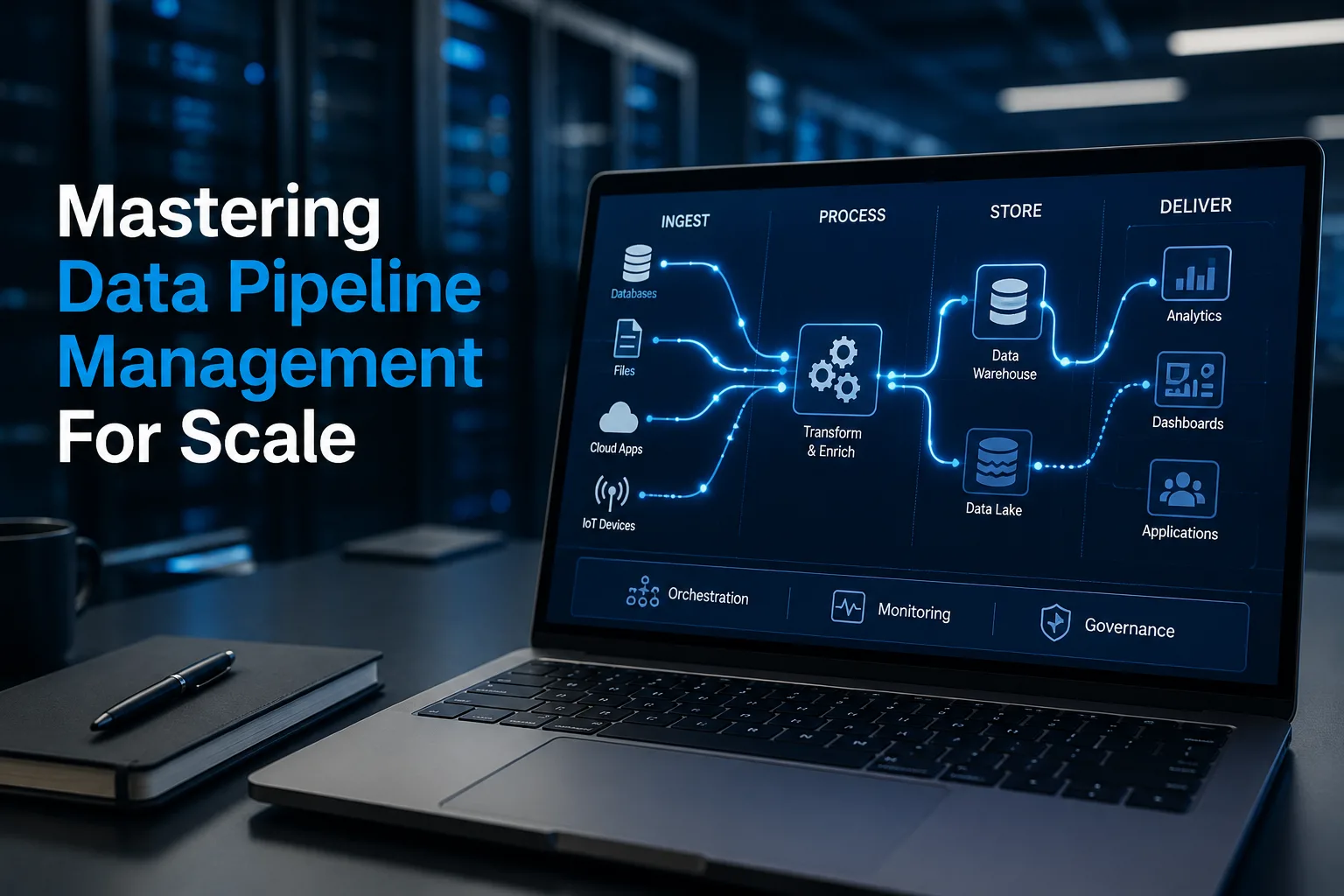
Modern organizations rely heavily on seamless data flows to drive decision-making, automate operational reporting, and fuel machine learning models. However, moving raw information from disparate sources into clean, actionable formats is rarely straightforward. Without structured oversight, data ingestion flows quickly break, deliver corrupted metrics, or fail during peak usage hours. Implementing proactive data pipeline management ensures that critical information flows smoothly, remains accurate, and reaches destination systems without unexpected interruptions.
Understanding how to maintain reliable data flows requires looking beyond simple script execution. A robust ingestion setup encompasses continuous monitoring, automated schema handling, modular orchestrations, and clear ownership protocols across the technical team.
The Foundation of Modern Data Infrastructure
An enterprise data ecosystem functions like a supply chain where incoming information must be collected, transformed, validated, and stored. When engineers construct these systems, they often focus primarily on initial connectivity and basic transformation logic. However, as the number of integrations expands, managing these complex pathways becomes a major operational burden. Unmonitored workflows often lead to silent failures, where corrupted or missing records pass into reporting dashboards unnoticed.
Proactive governance over ingestion workflows resolves these structural vulnerabilities. By introducing real-time health checks, automated error handling, and structured testing environments, technical teams prevent minor technical glitches from cascading into business-wide reporting failures. Furthermore, efficient workflow coordination allows teams to track exact lineage, ensuring that every transformed record can be traced back to its origin point.
Essential Components for Pipeline Governance
Maintaining consistent performance across varied source systems demands a multi-layered architectural approach. Rather than relying on rigid, monolithic codebases, scalable data processing relies on modular design choices that adapt dynamically to changing source schemas and variable workloads.
Observability forms the core of modern orchestration systems. Traditional logging records that a script ran, but deep observability provides visibility into record counts, latency trends, and transformation accuracy. When data drift occurs or an upstream API updates its response layout unexpectedly, comprehensive monitoring alerts engineers before downstream analytics tools report anomalies.
Schema evolution management acts as another critical safeguard. API parameters change, database tables gain new columns, and third-party tools alter payload structures without prior warning. Strategic data pipeline management incorporates flexible parsing systems capable of handling unexpected schema shifts without causing complete workflow halts. Incorporating schema registries and quarantine tables ensures that non-conforming records are isolated for review while valid data continues processing normally.
State management and automated recovery mechanics prevent partial run failures from polluting analytical environments. If a network disruption interrupts a heavy batch job, the orchestration tool should resume execution from the last successful checkpoint rather than restarting from zero or writing duplicate entries to the target data warehouse.
Overcoming Scale and Operational Friction
As business operations expand, the sheer volume and velocity of incoming records frequently introduce performance bottlenecks. Systems that perform smoothly handling gigabytes of records often experience severe latency or out-of-memory errors when processing terabyte-scale datasets. Resolving scale-related friction requires optimizing resource allocation, refining execution schedules, and leveraging distributed computation engines.
Resource allocation must balance cost with processing speed. Partitioning datasets logically—by timestamp, geographic region, or transaction type—allows execution engines to process smaller chunks in parallel. This distributed strategy drastically reduces processing times and limits the blast radius of localized failures. Additionally, setting up auto-scaling worker nodes ensures that compute resources expand during high-volume periods and scale down during off-peak hours to manage infrastructure expenditure.
Another significant challenge stems from managing dependencies across multiple departments. When different teams share execution pipelines, modifications made by software developers can unintentionally break downstream transformations maintained by analytics engineers. Implementing clear internal contracts, comprehensive integration testing, and shared staging environments keeps departmental dependencies aligned and prevents breaking changes from reaching production systems.
Operational Best Practices for Data Teams
Achieving long-term operational resilience requires combining strong software engineering principles with dedicated data governance techniques. Adopting modular orchestration frameworks enables developers to write reusable code blocks, streamlining the addition of new sources while maintaining consistent logging standards.
Continuous integration and continuous deployment practices belong in every data environment. Staging environments allow teams to simulate heavy loads and validate transformation logic using production-like sample data. Testing schema validation rules, edge-case transformations, and execution speeds prior to deployment minimizes live incidents and preserves organizational trust in analytical outputs.
Clear documentation and metadata tracking complete the governance operational loop. Capturing metadata at each execution stage allows analytics teams to confirm data freshness, review exact calculation methodologies, and trace historical modifications. Transparent lineage maps build cross-departmental confidence and ensure compliance with internal security policies and regulatory frameworks.
Effective data pipeline management transforms raw processing workflows into resilient, reliable information highways. By focusing on deep observability, automated fault tolerance, structured deployment practices, and dynamic scalability, technical teams can eliminate unexpected outages, control compute overhead, and deliver consistently reliable data across the enterprise.