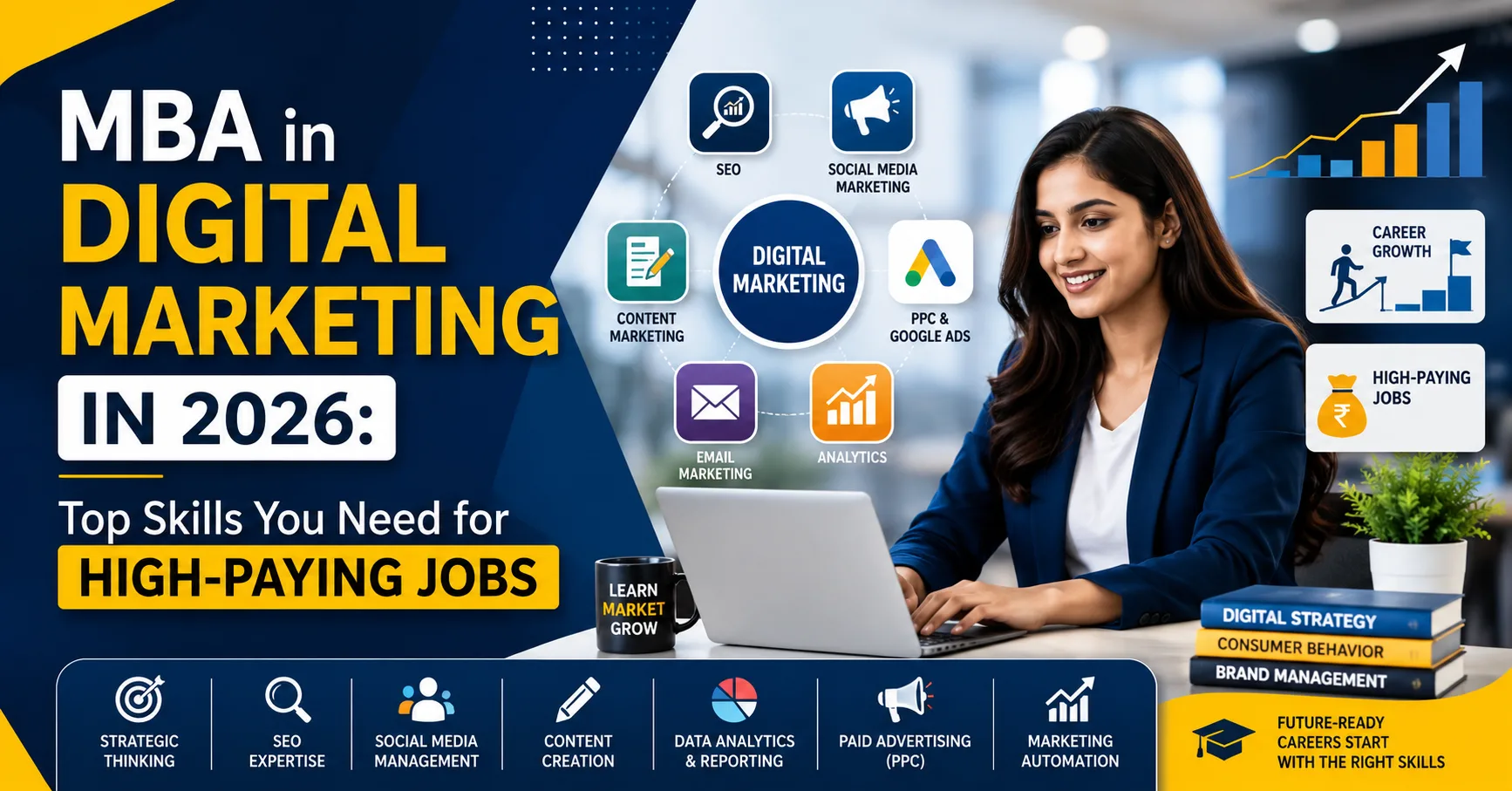
The digital economy is expanding at an unprecedented pace, transforming how businesses connect with customers, build brands, and drive revenue. From startups to multinational corporations, organizations are investing heavily in digital channels to remain competitive. As a result, an MBA in Digital Marketing has become one of the most sought-after management specializations for students who want to build successful careers in marketing, technology, and business strategy.
Today's employers are looking beyond academic qualifications. They want professionals who understand consumer behavior, can interpret data, leverage artificial intelligence, create impactful marketing campaigns, and adapt to rapidly changing market trends. Whether you aspire to work for a global technology company, an e-commerce brand, a digital agency, or launch your own venture, developing the right skills during your MBA can significantly improve your career prospects.
Why MBA in Digital Marketing Is Growing Rapidly
Marketing has evolved far beyond television advertisements and newspaper campaigns. Businesses now rely on search engines, social media, email marketing, influencer collaborations, mobile applications, and online marketplaces to reach their audiences.
The increasing use of artificial intelligence, automation, voice search, and data-driven decision-making has changed the expectations of employers. Companies now prefer graduates who can combine strategic business thinking with practical digital marketing expertise.
An MBA specializing in digital marketing helps students understand both business management principles and modern marketing technologies, making them valuable across multiple industries.
Top Skills Every MBA Student Should Master
Success in digital marketing depends on continuously learning new technologies while strengthening business fundamentals. Here are some of the most valuable skills employers seek in 2026.
Strategic Digital Marketing
Every successful campaign begins with a well-defined strategy. Students should learn how to identify target audiences, develop customer personas, analyze competitors, and create integrated marketing plans that support business objectives.
Understanding how different marketing channels work together allows professionals to deliver consistent customer experiences across multiple platforms.
Search Engine Optimization (SEO)
Organic search continues to generate high-quality traffic for businesses. Professionals who understand keyword research, content optimization, technical SEO, user experience, and search intent are highly valued.
SEO is no longer limited to rankings—it now focuses on creating useful, trustworthy, and user-centric content that answers real questions.
Performance Marketing
Performance marketing has become essential for businesses that want measurable results. MBA students should understand paid advertising strategies, campaign optimization, audience targeting, bidding models, and return on investment analysis.
Knowledge of advertising platforms enables marketers to make data-backed decisions rather than relying on assumptions.
Content Marketing
Quality content remains the foundation of successful digital marketing. Blogs, videos, podcasts, newsletters, case studies, and social media posts all influence customer engagement and purchasing decisions.
Students should develop strong storytelling skills while learning how to create content that educates, informs, and builds trust.
Social Media Management
Social platforms continue to influence purchasing behavior across industries. Modern marketers must understand content planning, community engagement, brand communication, influencer partnerships, and campaign analytics.
Successful social media management requires both creativity and analytical thinking.
Marketing Analytics
One of the biggest differences between traditional and digital marketing is measurable performance.
Students should become comfortable using analytics platforms to evaluate website traffic, user behavior, campaign performance, customer acquisition costs, and conversion rates. Data-driven decision-making helps organizations improve marketing efficiency and maximize business growth.
Artificial Intelligence in Marketing
Artificial intelligence is transforming how marketers create content, analyze customer behavior, automate campaigns, and personalize user experiences.
Learning AI-powered tools for content creation, campaign optimization, predictive analytics, and customer segmentation has become an essential skill rather than an optional advantage.
Professionals who combine marketing knowledge with AI capabilities will remain highly competitive in the coming years.
Email Marketing and Automation
Despite the growth of social media, email marketing continues to deliver excellent returns for businesses.
Students should understand customer segmentation, automation workflows, lead nurturing, personalization, and lifecycle marketing to build long-term customer relationships.
Customer Relationship Management (CRM)
Building lasting customer relationships is at the heart of successful marketing.
Understanding CRM systems helps professionals manage customer interactions, improve retention strategies, and deliver personalized experiences throughout the customer journey.
Communication and Leadership
Marketing professionals frequently collaborate with designers, developers, sales teams, content creators, and business leaders.
Strong communication, presentation, negotiation, and leadership skills enable MBA graduates to manage projects effectively and work successfully within cross-functional teams.
Why AI Is Becoming a Core Marketing Skill
Artificial intelligence has become one of the biggest drivers of digital transformation. Businesses now use AI to generate content, predict customer preferences, automate repetitive tasks, optimize advertising campaigns, and improve decision-making.
Instead of replacing marketers, AI allows professionals to focus on creativity, strategic planning, customer relationships, and innovation.
Students who understand how to use AI responsibly alongside human expertise will have a significant advantage in future job markets.
The Growing Importance of MBA in Digital Marketing and E-Commerce
The rapid expansion of online shopping has increased the demand for professionals who understand both digital marketing and e-commerce operations. Pursuing an MBA in Digital Marketing and E-Commerce equips students with the knowledge to manage online businesses, improve customer experiences, optimize digital sales funnels, and develop growth strategies for modern brands.
Graduates gain exposure to topics such as online consumer behavior, marketplace management, digital payments, logistics, customer retention, and omnichannel marketing. These skills are increasingly valuable as businesses continue to invest in digital commerce across domestic and global markets.
Career Opportunities After Graduation
An MBA in digital marketing opens doors to diverse career paths across industries. Graduates can pursue roles such as:
- Digital Marketing Manager
- SEO Specialist
- Performance Marketing Manager
- Brand Manager
- Marketing Analyst
- Social Media Manager
- Content Marketing Manager
- CRM Manager
- Growth Marketing Specialist
- Product Marketing Manager
- E-commerce Manager
- Digital Strategy Consultant
These opportunities exist in technology companies, e-commerce businesses, healthcare organizations, educational institutions, financial services, consulting firms, startups, manufacturing companies, and multinational corporations.
Why Practical Experience Matters
Employers increasingly prioritize candidates who can demonstrate practical expertise rather than theoretical knowledge alone.
Students should actively participate in:
- Live marketing campaigns
- Industry internships
- Business case competitions
- Research projects
- Certification programs
- Marketing workshops
- Digital portfolio development
These experiences help students build confidence while developing the problem-solving abilities required in professional environments.
Choosing the Right MBA Program
Selecting the right institution is one of the most important decisions for aspiring management professionals. Students exploring mba in digital marketing in delhi ncr should evaluate factors such as curriculum relevance, faculty expertise, industry partnerships, internship opportunities, placement support, and exposure to emerging technologies.
A quality MBA program should combine classroom learning with practical projects, guest lectures from industry experts, certification opportunities, and real-world business challenges. When comparing institutions, it is also helpful to review academic infrastructure, alumni outcomes, and opportunities for entrepreneurship.
Why E-Commerce Knowledge Gives You a Competitive Advantage
The continued growth of online retail has made mba in e commerce an increasingly relevant area of study. Businesses are investing in professionals who understand digital storefronts, customer acquisition strategies, inventory management, online branding, and marketplace optimization.
Combining digital marketing expertise with e-commerce knowledge enables graduates to contribute across multiple business functions, making them valuable assets in organizations focused on digital growth.
Final Thoughts
Digital marketing is no longer just a specialization it has become an essential business function across industries. As organizations continue embracing artificial intelligence, automation, analytics, and digital commerce, professionals with the right blend of strategic thinking and practical skills will remain in high demand.
If you're planning to pursue an MBA in Digital Marketing, focus on developing technical expertise alongside leadership, communication, analytical thinking, and real-world problem-solving abilities. Choosing a program that emphasizes industry exposure, innovation, and hands-on learning will help you build a strong foundation for long-term career success in the evolving digital economy.