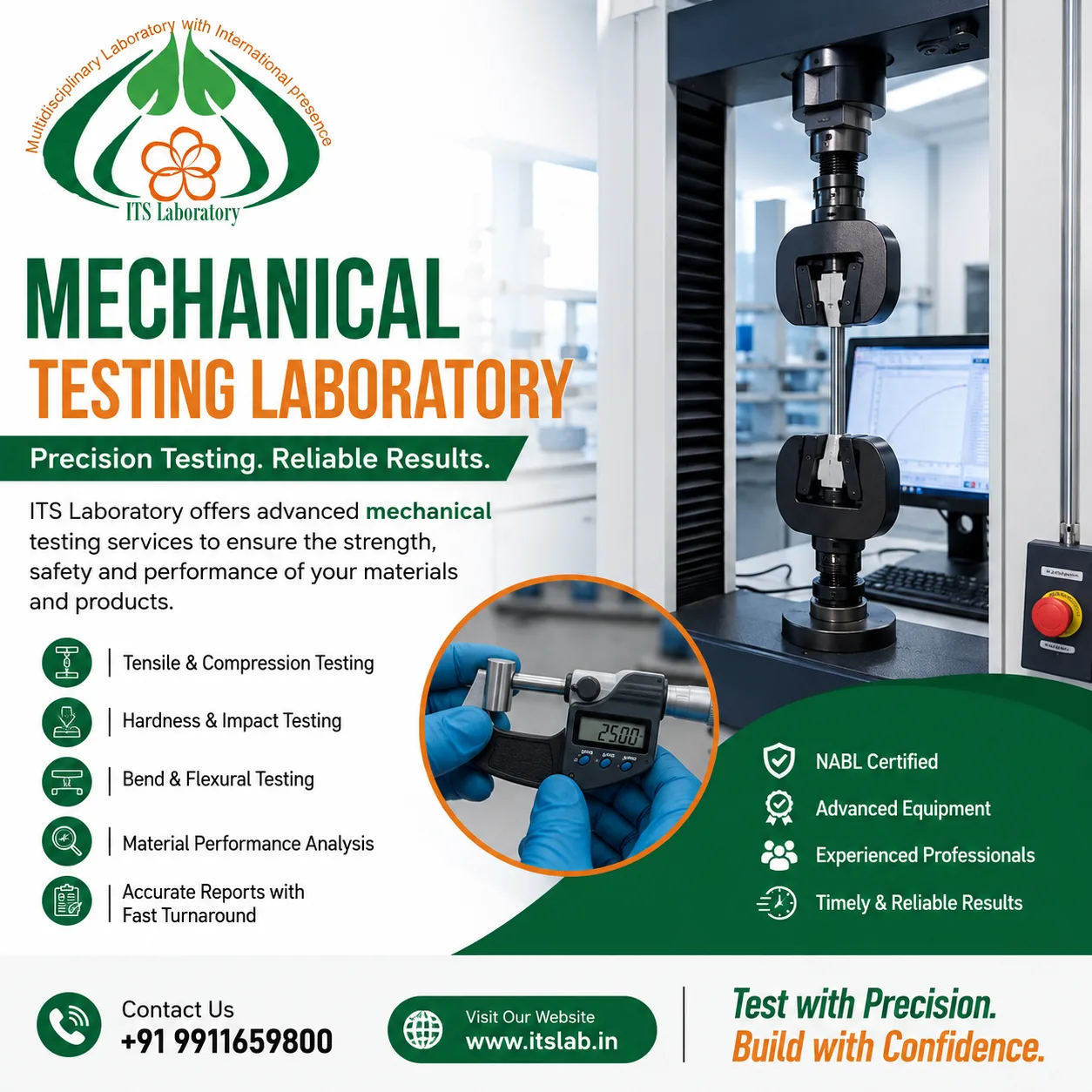
In today's competitive manufacturing environment, maintaining consistent product quality is essential for building customer trust and achieving long-term business growth. Materials used in industrial products must possess the right mechanical characteristics to withstand their intended operating conditions. A professional Mechanical Testing Laboratory helps manufacturers and engineering companies evaluate these characteristics through systematic laboratory testing.
ITS Laboratory provides professional testing services to organizations that need dependable information about the mechanical properties of materials and products. From raw material verification to finished product evaluation, laboratory testing can support quality control, product development, material selection, and technical decision-making.
What Is Mechanical Testing?
Mechanical testing involves examining how a material responds when exposed to controlled forces or mechanical conditions. It helps determine whether the material can withstand the stresses it may experience during manufacturing, transportation, installation, or actual use.
The type of testing required depends on the material, product, intended application, and applicable testing requirements.
Mechanical testing may include evaluation of:
- Tensile strength
- Yield strength
- Elongation
- Hardness
- Impact resistance
- Compression properties
- Bending characteristics
- Other relevant mechanical properties
These measurements provide useful technical information for engineers, manufacturers, quality managers, and product developers.
Why Mechanical Testing Is Important
Material failure can affect product reliability and may result in rejected batches, production losses, customer complaints, or costly repairs. Testing helps organizations identify potential issues and verify material performance before products reach the market.
A dependable Mechanical Testing Laboratory can help businesses:
- Verify raw material properties
- Evaluate finished products
- Monitor production quality
- Compare different materials
- Support product development
- Investigate material failures
- Verify technical specifications
- Improve manufacturing processes
- Support research and development
Reliable laboratory data allows businesses to make decisions based on measurable evidence.
Tensile Testing
Tensile testing is commonly used to understand how a material behaves when subjected to a controlled pulling force. It can provide important information about material strength and deformation.
Depending on the applicable test method, tensile testing may determine tensile strength, yield behavior, and elongation.
For manufacturers, these results can help evaluate material consistency and determine whether materials are suitable for specific applications.
Hardness Testing
Hardness testing evaluates a material's resistance to localized deformation. It is commonly used as part of quality control for various industrial materials.
Hardness testing can help manufacturers monitor consistency, compare material batches, and verify specified requirements.
For products exposed to wear or mechanical stress, maintaining appropriate hardness can be an important quality consideration.
Impact Testing
Impact testing evaluates material behavior under sudden mechanical loading. It can be useful for products and components that may experience shock or dynamic forces during operation.
The results can provide valuable information about material response under defined impact conditions and support material selection and product development.
Mechanical Testing in Manufacturing
Mechanical testing can contribute to quality assurance throughout the production process.
Raw Material Inspection
Testing incoming materials can help businesses verify mechanical characteristics before the materials are used in production.
Batch Quality Control
Periodic testing can help manufacturers identify differences between batches and maintain consistent product quality.
Finished Product Testing
Testing completed products or components can provide information about whether relevant mechanical properties meet established requirements.
Product Development
Engineers and R&D teams can use mechanical test results to compare materials and evaluate new product concepts.
Failure Analysis
When a product or component does not perform as expected, mechanical testing can contribute to a technical investigation into potential causes.
Industries That Benefit from Mechanical Testing
Mechanical testing has applications across many industrial sectors.
Automotive
Automotive components are exposed to different loads, vibrations, and operating conditions. Mechanical testing can help manufacturers evaluate material suitability.
Construction
Construction materials and components need appropriate strength and mechanical properties for their intended applications. Laboratory testing supports quality evaluation.
Engineering
Engineering companies use mechanical testing to evaluate metals, components, fabricated products, and other materials.
Manufacturing
Manufacturers can incorporate mechanical testing into their quality control programs to monitor raw materials and finished products.
Metal Fabrication
Fabricated metal components can require mechanical evaluation to verify properties such as strength, hardness, and other relevant characteristics.
Plastics and Polymers
Certain plastic and polymer products may require mechanical testing to understand their behavior under defined loads and conditions.
Benefits of Professional Mechanical Testing
Choosing a professional laboratory offers several advantages for businesses.
Objective Results
Laboratory testing provides measurable data that supports technical and quality decisions.
Improved Quality Assurance
Testing can help identify material variations and support consistent manufacturing.
Better Material Selection
Comparative test results help engineers select materials suitable for particular applications.
Product Improvement
Mechanical data can support product design improvements and manufacturing optimization.
Failure Investigation
Testing can provide useful technical information when investigating unexpected product or material failures.
Mechanical Testing Laboratory in Noida
Noida is a growing industrial hub with companies involved in engineering, manufacturing, automotive, construction, electronics, plastics, fabrication, and other sectors. These businesses often require professional testing services to verify the quality and performance of their materials and products.
A reliable Mechanical Testing Laboratory in Noida can provide convenient access to technical testing services for manufacturers and businesses operating in the region.
Local laboratory support can make sample submission, communication, testing coordination, and report management more efficient.
Why Choose ITS Laboratory?
ITS Laboratory provides professional testing solutions for organizations with different material and product evaluation requirements. Its testing services can support quality control, material analysis, product development, and technical investigations.
Businesses should clearly define the sample type, required mechanical property, purpose of testing, applicable test method, and reporting requirements before requesting laboratory services. When accredited testing is required, the relevant accreditation scope should also be confirmed.
ITS Laboratory can help organizations understand their testing requirements and identify suitable laboratory solutions.
Conclusion
Mechanical testing provides valuable information about the strength, hardness, toughness, durability, and performance of materials. It is an important tool for manufacturers looking to maintain quality, improve products, select appropriate materials, and reduce the risk of unexpected failures.
If your business is searching for a dependable Mechanical Testing Laboratory, ITS Laboratory offers professional testing services for a range of industrial applications.
With a quality-focused approach and professional laboratory support, ITS Laboratory can help businesses obtain the technical information they need to make confident decisions.
Contact ITS Laboratory
ITS Laboratory
Phone: +91 9911659800
Website: www.itslab.in
For reliable mechanical testing and professional laboratory services, contact ITS Laboratory today to discuss your specific material or product testing requirements.