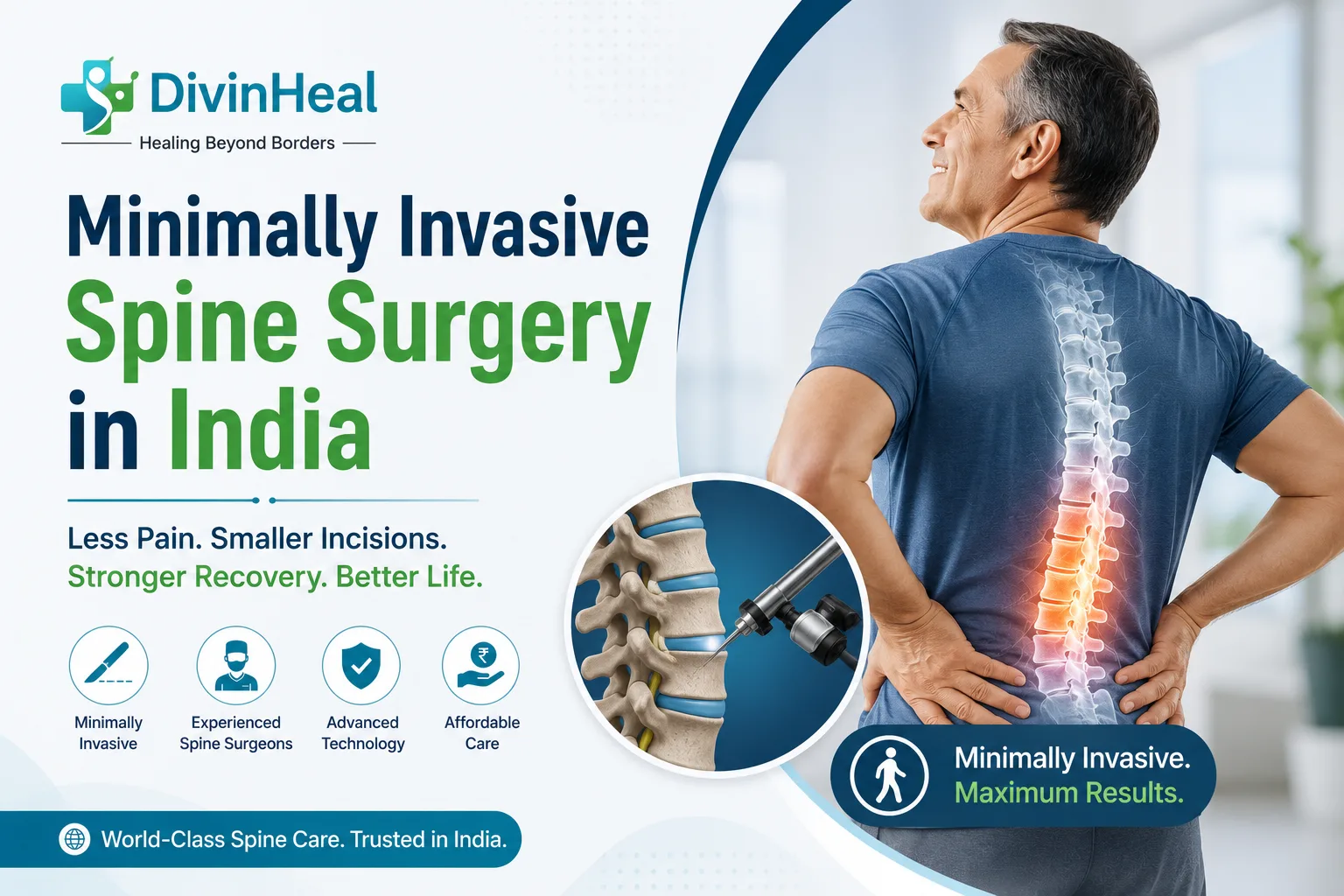
Minimally Invasive Spine Surgery in India: Less Cutting, Faster Healing, Better Outcomes
Back surgery has a complicated reputation. For decades, open spinal surgery - large incisions, extensive muscle stripping, prolonged recovery - was the only option for patients who needed surgical treatment for disc herniation, spinal stenosis, or instability. Many patients delayed surgery for years, fearing the procedure as much as the pain.
Minimally invasive spine surgery (MISS) has fundamentally changed this picture. Using tubular retractors, working through incisions measured in millimetres rather than centimetres, guided by real-time fluoroscopic and endoscopic visualisation, India's spine surgeons now routinely perform procedures that achieve the same or better surgical results as open surgery - with dramatically less tissue damage, less pain, faster recovery, and lower complication rates.
DivinHeal connects international patients with India's leading MISS specialists.
The Core Principle of Minimally Invasive Spine Surgery
Traditional open spine surgery strips the paraspinal muscles away from the spine over a wide area - necessary to see and access the pathology, but causing significant muscle damage, scarring, and blood loss. This muscle damage is a major contributor to post-operative pain and prolonged recovery.
MISS approaches the spine through small tubular dilators that gently separate rather than cut the muscle fibres. Working through this tubular corridor, the surgeon uses a microscope or endoscope for magnified visualisation, performing the same decompression or stabilisation as open surgery while leaving the surrounding muscles largely intact.
Procedures Performed Using MISS Techniques in India
Microdiscectomy: For lumbar disc herniation causing sciatica (radiating leg pain, numbness, weakness), microdiscectomy removes the herniated disc fragment through a 15-20mm incision under microscopic visualisation. The nerve root is immediately decompressed. Post-operative pain is minimal. Most patients go home the same day or after one overnight stay.
Endoscopic Discectomy (PELD/PECD): The most minimally invasive approach to disc herniation. An endoscope the diameter of a pen is inserted through a small incision (7-8mm) - either via a posterolateral approach (for lumbar disc disease) or an anterior cervical approach (for cervical disc disease). The herniated disc fragment is removed under endoscopic vision. Day procedure. Return to light activities within 3-7 days.
Minimally Invasive TLIF (Transforaminal Lumbar Interbody Fusion): For patients with lumbar instability, spondylolisthesis, or degenerative disc disease requiring fusion, MI-TLIF places interbody cages and percutaneous pedicle screws through small incisions, achieving the same stabilisation as open TLIF with approximately 60% less blood loss and significantly faster recovery.
Minimally Invasive Lumbar Decompression (MILD, Laminotomy): For lumbar spinal stenosis causing neurogenic claudication (leg pain with walking), minimally invasive decompression removes the tissue causing canal narrowing through a small incision, restoring space for the nerve roots.
XLIF/OLIF (Lateral Approaches to the Lumbar Spine): The spine is accessed from the side, through the flank, entirely avoiding the spinal muscles. Used for disc replacement, interbody fusion, and deformity correction. Particularly valuable at multiple levels where conventional posterior approaches would require extensive muscle stripping.
Vertebroplasty and Kyphoplasty: For vertebral compression fractures (typically due to osteoporosis), bone cement is injected percutaneously into the collapsed vertebra under imaging guidance, stabilising the fracture and relieving pain. Day procedure under local anaesthesia and sedation. Immediate pain relief in most patients.
Who Is a Candidate for MISS?
Most patients with disc herniation, spinal stenosis, spondylolisthesis, or vertebral fractures who meet surgical criteria are candidates for minimally invasive approaches. MISS is particularly beneficial for patients with obesity, diabetes, or other comorbidities that increase the risk of wound complications with open surgery - since the smaller incisions significantly reduce this risk.
Cost of Minimally Invasive Spine Surgery in India
Endoscopic discectomy in the US: $15,000-$30,000. In India through DivinHeal: $2,500-$4,500. MI-TLIF in the UK: $20,000-$40,000. In India: $5,000-$9,000.
Conclusion
Minimally invasive spine surgery represents the most significant advance in spinal treatment of the past two decades. Less pain, faster recovery, lower complications, and equivalent or superior surgical outcomes compared to open approaches - the advantages are well-established and consistently demonstrated in the medical literature. India's spine surgeons have embraced MISS techniques across the full range of spinal pathology, and several centres have become genuine subspecialty centres of excellence for endoscopic and percutaneous spinal surgery. DivinHeal connects patients with spine surgeons whose training and experience in MISS techniques matches the procedure required, ensuring that the technology delivers on its promise. Back pain has taken enough from you. Let DivinHeal help you find the right solution.
FAQs
Q1. How do I know if my spine problem can be treated with minimally invasive surgery?
DivinHeal's spine surgeons review your MRI and clinical history to determine whether MISS is appropriate for your specific pathology. Most disc herniations, single-level stenosis, and straightforward spondylolistheses are suitable for MISS. Complex multi-level disease, severe deformity, or revision surgery after failed open procedures may require conventional approaches or a combination. An honest assessment is provided before any commitment is made.
Q2. Is endoscopic spine surgery as effective as open surgery?
For disc herniation, multiple randomised controlled trials have shown equivalent or superior outcomes for endoscopic discectomy compared to open microdiscectomy - with significantly less post-operative pain and faster recovery. For fusion procedures, MI-TLIF achieves equivalent fusion rates to open TLIF in most series, with the added benefits of reduced blood loss and muscle damage.
Q3. How long is recovery after endoscopic discectomy?
Most patients are mobile within hours of endoscopic discectomy. Post-operative discomfort is typically mild and managed with oral pain relief for 2-5 days. Return to desk work in 5-7 days. Return to physical work and sport in 4-6 weeks. This compares to 2-6 weeks for conventional microdiscectomy.
Q4. Will I need physiotherapy after minimally invasive spine surgery?
Yes. A structured physiotherapy programme after MISS addresses core muscle strengthening, posture correction, and movement pattern retraining - reducing the risk of recurrence. DivinHeal provides a post-operative physiotherapy protocol for continuation with a physiotherapist in your home country after return travel.
Q5. What is the risk of paralysis from spine surgery?
Serious neurological complications including paralysis are rare in spine surgery performed by trained surgeons for appropriate indications. Intraoperative neuromonitoring (SSEP and MEP) is used during procedures near the spinal cord. DivinHeal selects spine surgeons with specific training in MISS techniques and proven safety records.