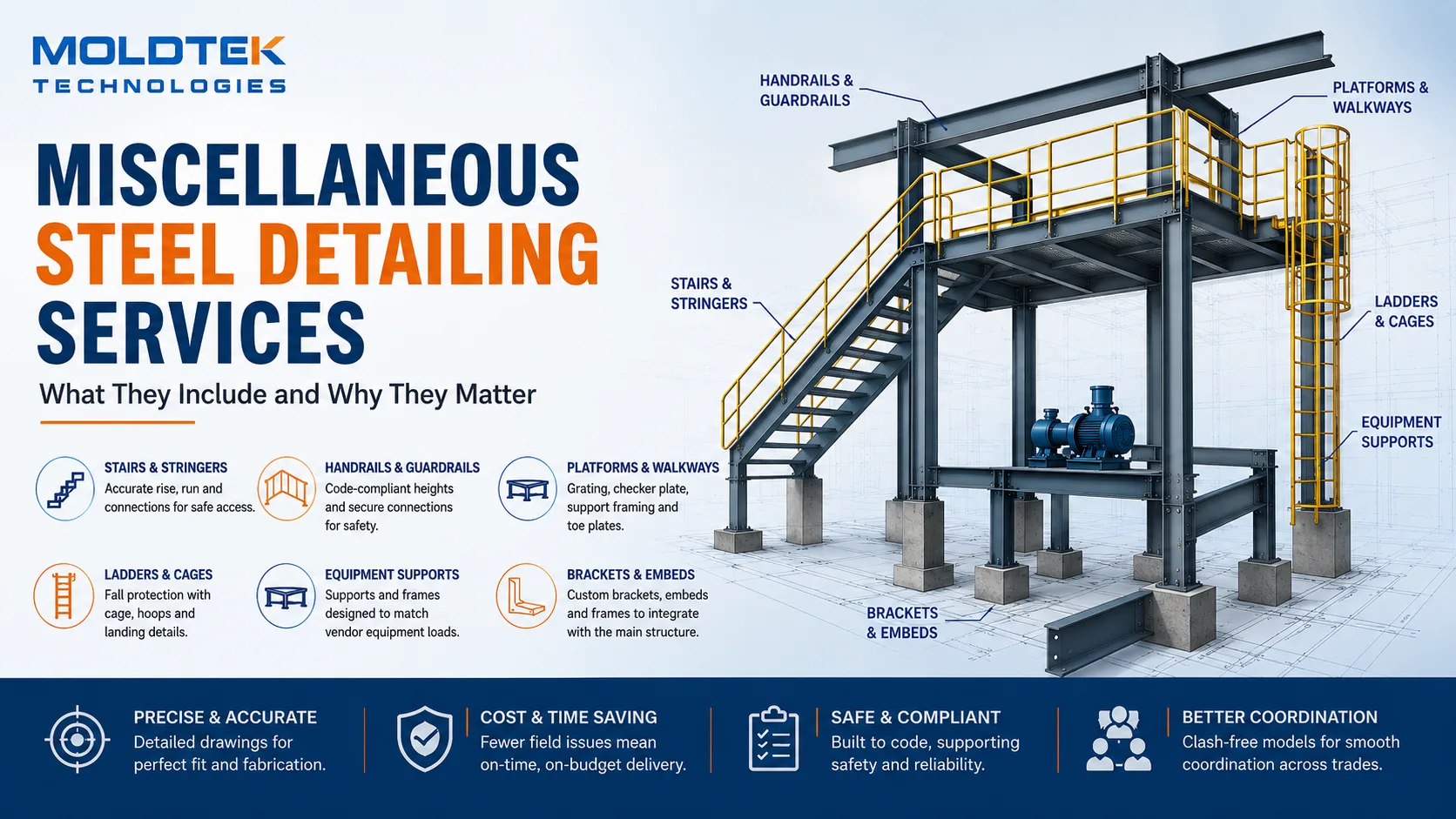
Walk any completed steel structure and most of what you touch isn't primary frame - it's stairs, handrails, ladders, platforms, and brackets holding mechanical equipment in place. That's miscellaneous steel, and even though it carries less load than the main columns and beams, it still needs the same detailing discipline. Miscellaneous steel detailing services take that secondary steelwork from design intent to fabrication-ready and installation-ready drawings, covering dimensions, connections, materials, and how each piece ties into the primary structure.
What Are Miscellaneous Steel Detailing Services?
Primary structural detailing deals with the main frame - columns, beams, braces, moment connections. Miscellaneous steel detailing covers everything built around and onto that frame: stairs, guardrails, ladders, platforms, equipment supports, embeds. These items are often designed with less prescriptive engineering detail than primary members, leaving the detailer to work out dimensions, plate sizes, and connection types based on code minimums, manufacturer standards, and the engineer's general notes. The detailer still produces shop drawings a fabricator can cut and weld from, and erection drawings a crew can install from, just like on the primary package.
What Components Are Typically Detailed?
Stairs and stringers need accurate rise-and-run calculations, landing dimensions, and connections back to floor framing. Handrails and guardrails must meet code-required heights and loading, affecting post spacing and baseplate sizing. Ladders require cage details where fall protection applies. Platforms and walkways get detailed with grating or checker plate, support framing, and toe plates, sized to whatever live load the equipment or foot traffic demands. Equipment and pipe supports are trickier since they depend on vendor drawings - a pump skid support has to match bolt patterns and loads from outside the structural team. Brackets, embeds, and miscellaneous frames round out the package, often the last drawings issued since they depend on architectural or MEP information finalizing.
What Does the Detailing Process Involve?
Work starts with a review of design drawings, specifications, and any vendor or architectural documents that affect dimensions. The detailer then builds the components in the 3D model alongside the primary steel, details each connection, and runs clash checks - a stair stringer landing on a beam that isn't where the model says it is, a platform support conflicting with ductwork. Shop and erection drawings get issued along with a material take-off and bolt list. QA/QC review checks dimensions, connection capacities, and code compliance before approval, with revisions coming back as coordination with other trades progresses. Because miscellaneous steel touches architectural finishes, MEP routing, and equipment vendors, it often needs more back-and-forth than the primary frame.
Why Accurate Miscellaneous Steel Detailing Matters
A platform sized wrong, or a stair stringer connection that doesn't line up with the framing, turns into a field cut or a return trip to the shop - both slower and costlier than catching it on paper. Accurate dimensions and connection details mean fabricated pieces fit the first time. Clear BOMs mean the shop orders the right plate and grating quantities. And because much of this steel is safety-related - handrails, guardrails, ladder cages - getting it right the first time avoids re-work on items hard to inspect after installation.
Conclusion
Miscellaneous steel may sit outside the main frame, but poor detailing shows up just as fast on site - in fit-up problems, safety concerns, or delays waiting on a fix. Detailing should follow the project's contract documents, engineer's requirements, and applicable codes and fabrication standards - AISC, IS 800, BS, or Eurocodes, depending on the project. Treating these components with the same care as primary steel keeps installation moving without surprises.