
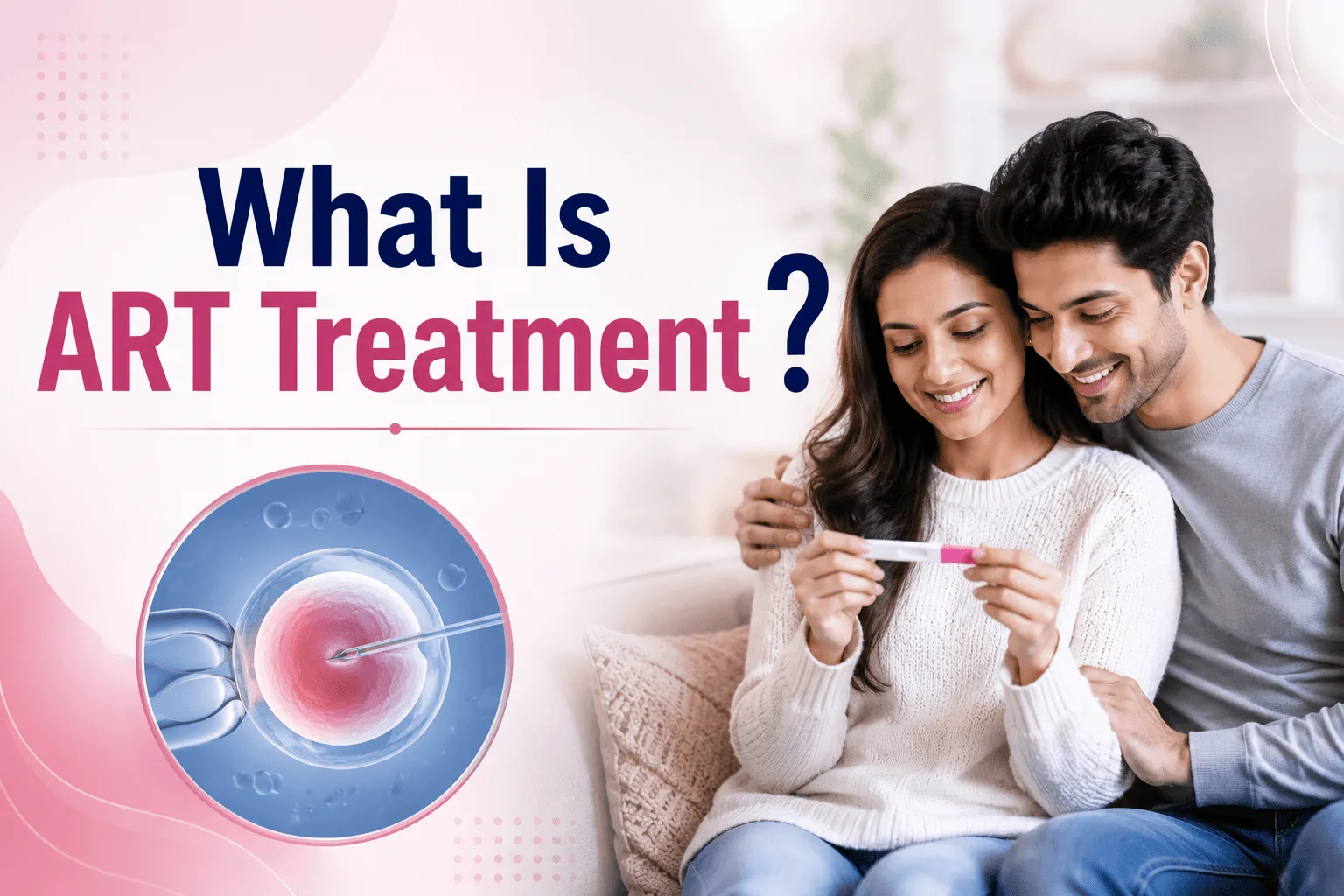
Stepping into the world of fertility treatment often means hearing a lot of new terms at once. ART is usually one of the first ones you come across, and it can feel like a confusing umbrella term at first.
Let us slow down and walk through what ART actually means, and how the different treatments under it compare to each other.
So what is ART, really?
ART stands for Assisted Reproductive Technology. In simple words, it covers any fertility treatment where eggs, sperm, or embryos are handled outside the body to help create a pregnancy.
It is not one treatment. Think of it as a family of options, each designed for different fertility situations.
Why do couples turn to ART?
There are many paths that lead couples here, such as:
- Trying to conceive naturally for over a year without success.
- Blocked or damaged fallopian tubes.
- Sperm related challenges, like low count or movement.
- Ovulation issues, including PCOS.
- Endometriosis affecting fertility.
- Infertility with no clear identified cause.
- Fertility changes that come with age.
- Same sex couples or single parents building a family through donor eggs or sperm.
Whatever brought you here, you are not alone, and there are real options ahead.
IUI: often the gentlest first step
IUI, or Intrauterine Insemination, is usually the simplest treatment tried first. Sperm is carefully prepared and placed directly into the uterus around ovulation, giving it a head start.
It does not involve surgery or sedation, and is usually suggested for mild fertility concerns or unexplained infertility.
IVF: the treatment most people have heard of
IVF, or In Vitro Fertilisation, is a more involved process, but it can be broken down simply:
- Eggs are collected after a period of hormone stimulation.
- Sperm is collected from a partner or donor.
- The eggs and sperm are combined in a lab dish, where fertilisation happens naturally.
- The embryo is carefully monitored as it grows.
- A healthy embryo is placed into the uterus.
IVF is often recommended for blocked tubes, more complex fertility issues, or when IUI has not worked.
ICSI: extra help when sperm needs it
ICSI, or Intracytoplasmic Sperm Injection, works alongside IVF. Instead of waiting for sperm to fertilise the egg naturally, a single healthy sperm is gently injected directly into the egg.
This is particularly helpful when sperm count, movement, or shape make things harder than usual.
A few more options you might hear about
Depending on your journey, your doctor may also mention:
- Egg or sperm freezing: A way to preserve fertility for the future.
- Embryo freezing: Storing extra embryos safely for a later attempt.
- Donor eggs or sperm: Used when a partner's own eggs or sperm cannot be used.
- Genetic testing of embryos: Helpful in specific cases to check embryo health beforehand.
- Surrogacy: An option when carrying a pregnancy is not medically possible.
How does a doctor choose the right one for you?
There is no one size fits all answer here. Your doctor will look at things like:
- The known or suspected cause of infertility.
- Your age and ovarian reserve.
- Sperm health and quality.
- How long you have been trying to conceive.
- Any previous treatments and how your body responded.
A good specialist will walk you through their reasoning, not just hand you a plan without explanation.
Is all of this actually safe?
Yes. ART has helped build millions of families over several decades now. Like any medical treatment, there can be minor risks and side effects, but these are well studied and carefully managed by experienced teams.
What about cost and chances of success?
This varies quite a bit depending on the treatment chosen, your individual health, and the clinic itself. As a general pattern, simpler treatments like IUI tend to cost less but offer lower success per attempt, while IVF and ICSI cost more but often carry higher success rates for more complex situations.
Ask your doctor for numbers specific to your case, rather than relying on general statistics you might read online.
Take it one step at a time
Learning about ART for the first time can feel like a lot. You do not need to understand everything all at once. Take your time, ask questions, and let your doctor guide you at a pace that feels comfortable.
At the best IVF center in Indore, every treatment option is explained patiently, so you never feel rushed into a decision.
If you are still figuring out which path makes sense for you, an IVF specialist in Indore can help you sort through your options with honesty and care, so you can move forward feeling informed and supported.