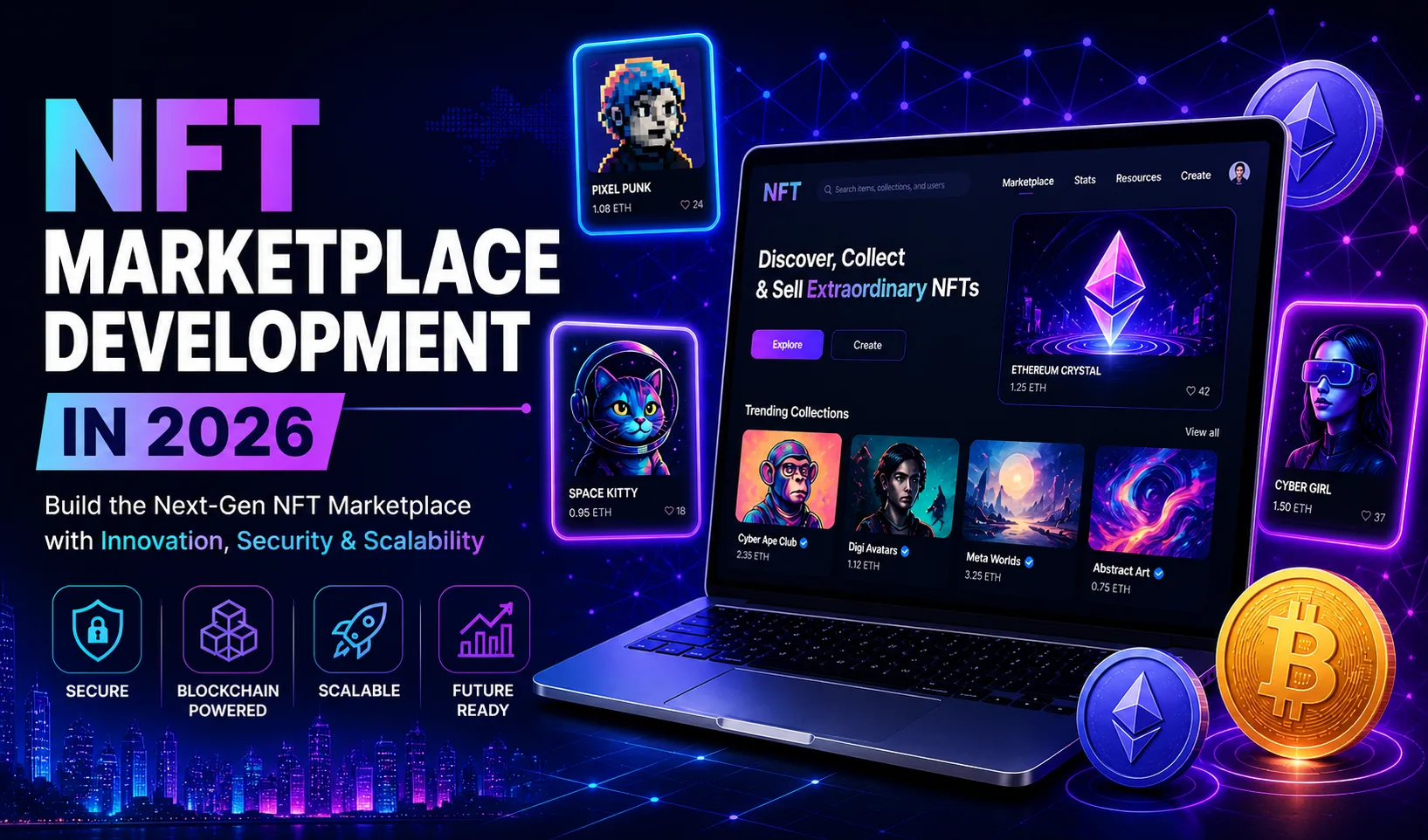
The NFT market isn't just a trend — it's a fundamental shift in how digital ownership works. According to recent market data, the global NFT sector generated approximately USD 26,982 million in 2023, and projections suggest it could reach USD 211,719 million by 2030. That's a staggering growth trajectory that businesses across art, gaming, real estate, and entertainment simply cannot ignore.
But here's the thing: building an NFT marketplace is not the same as listing your digital art on OpenSea. It's a full-stack technical endeavor — one that requires smart contract expertise, blockchain integration, wallet support, UX design, and long-term maintenance. If you're a founder, investor, or enterprise leader considering your own NFT platform, this guide will walk you through everything you need to know.
What Is an NFT Marketplace?
An NFT marketplace is a decentralized or semi-centralized platform where users can mint, buy, sell, and trade non-fungible tokens (NFTs). Unlike traditional e-commerce, every transaction on an NFT marketplace is recorded on a blockchain, making ownership transparent, verifiable, and permanent.
Think of it like eBay — but for digital assets that can never be duplicated, and every sale is publicly verified on-chain.
Popular examples include OpenSea, Rarible, Magic Eden, and Foundation. What makes these platforms successful isn't just design — it's the underlying architecture, smart contract logic, and multi-blockchain support that powers the user experience.
Types of NFT Marketplace Development
Before you build, you need to decide what kind of marketplace you want. Here are the main types:
1. White-Label NFT Marketplace
A white-label solution gives you a pre-built, brandable platform that you can customize and deploy quickly. This is ideal for businesses that want speed-to-market without starting from scratch. You get the core functionality — minting, buying, selling, wallets — and simply add your branding on top.
2. Custom NFT Marketplace
A fully custom platform gives you complete control over features, architecture, and user experience. It takes longer and costs more, but it's the right choice if you have a unique use case — like a platform for tokenized real estate or an industry-specific NFT exchange.
3. Decentralized NFT Marketplace
In a fully decentralized marketplace, there's no central authority. Smart contracts handle everything — from listing to payment — without any intermediary. This offers maximum transparency and user control.
4. Multi-Chain NFT Marketplace
A multi-chain marketplace supports NFTs across different blockchains — Ethereum, Solana, Polygon, BNB Chain, and more. This expands your user base significantly, as buyers aren't locked into one ecosystem.
Key Features of a Successful NFT Marketplace
When planning your NFT marketplace development, here are the core features your platform must include:
- User Registration & KYC Verification — Onboard users securely with identity verification built in.
- NFT Minting (Single & Collections) — Let creators mint NFTs directly on your platform without needing external tools.
- Storefront & Listings — A clean, browsable interface where users can explore NFTs by category, price, and rarity.
- Auction & Fixed-Price Sales — Give sellers flexibility in how they price and list their NFTs.
- Crypto Wallet Integration — Support for MetaMask, WalletConnect, Trust Wallet, and others.
- Smart Contract Automation — All transactions — sales, royalties, transfers — handled by secure on-chain contracts.
- Creator Royalties — Automatic royalty payments every time an NFT is resold on the secondary market.
- Advanced Search & Filters — Help buyers find exactly what they're looking for by price, type, blockchain, and more.
- Push Notifications & Alerts — Real-time updates on bids, sales, and new listings.
- Admin Dashboard & Analytics — Track sales volume, user activity, and platform health in real time.
NFT Marketplace Tech Stack: What Powers These Platforms?
The technology behind an NFT marketplace is just as important as the features. Here's what a modern NFT platform is typically built on:
Blockchain Networks:
- Ethereum — Most established, largest NFT ecosystem
- Polygon — Low gas fees, Ethereum-compatible
- Solana — Fast, low-cost, growing NFT community
- BNB Chain — Cost-efficient, popular in Asia
- Cardano, Polkadot, Tezos — Emerging alternatives
NFT Token Standards:
- ERC-721 — The original NFT standard (unique tokens)
- ERC-1155 — Supports both fungible and non-fungible tokens
- TRC-721 / TRC-1155 — Tron-based NFT standards
- SLP (Solana), CIP-25 (Cardano), PSP-34 (Polkadot)
Frontend:
- React.js / Next.js for responsive UI
- Web3.js / Ethers.js for blockchain connectivity
Backend:
- Node.js, Python (Django/FastAPI)
- IPFS or Arweave for decentralized file storage
Smart Contracts:
- Solidity (Ethereum/Polygon)
- Rust (Solana)
- Audited and gas-optimized before deployment
How Much Does NFT Marketplace Development Cost?
This is the question every founder asks — and the honest answer is: it depends.
Development TypeEstimated CostWhite-Label NFT Marketplace$10,000 – $40,000Custom NFT Marketplace (Mid-range)$40,000 – $100,000Enterprise-Grade NFT Platform$100,000 – $300,000+Factors that affect cost include:
- Number of blockchain networks supported
- Custom smart contract logic
- UI/UX complexity
- Mobile app development (iOS/Android)
- Security audits and KYC integration
- Ongoing maintenance and support
Real-World Use Cases: Who Needs an NFT Marketplace?
NFT marketplaces are no longer limited to digital art. Here's where they're making a real impact:
Digital Art & Collectibles — Artists sell unique works directly to collectors, cutting out middlemen and earning royalties on resales.
Gaming & Virtual Assets — Game developers let players own in-game items as NFTs — tradeable both in-game and on secondary markets.
Music & Entertainment — Musicians release exclusive tracks or albums as NFTs, giving fans access to premium content and perks.
Metaverse & Virtual Real Estate — Virtual land, buildings, and spaces are bought and sold as NFTs within metaverse ecosystems.
Fashion & Luxury Goods — Brands mint digital twins of physical items to prove authenticity and create new collector experiences.
DeFi & Tokenized Assets — Real-world assets like real estate and commodities are tokenized as NFTs, making them tradeable on blockchain.
How to Choose the Right NFT Marketplace Development Company
Your choice of development partner will make or break your project. Here's what to look for:
1. Blockchain-Specific Expertise Not all developers understand NFTs at the smart contract level. Look for teams with deep experience in Solidity, Rust, or whichever language powers your target blockchain.
2. End-to-End Services You don't want three different vendors for design, development, and maintenance. A single partner who handles the full lifecycle — from wireframes to post-launch updates — is far more efficient.
3. Security-First Approach Smart contract vulnerabilities are irreversible. Make sure your partner conducts thorough audits, gas optimization, and anti-fraud testing before going live.
4. Proven Track Record Ask for portfolio projects, client references, and industry recognition. Reputable agencies will have verifiable reviews on platforms like Clutch, GoodFirms, or similar.
5. Post-Launch Support An NFT marketplace isn't a set-and-forget product. You'll need ongoing maintenance, feature updates, and security patches. Choose a team that stays with you.
One company that ticks all these boxes is Technoloader, a Jaipur-based blockchain development firm with 8+ years of experience and 450+ completed blockchain projects. They offer end-to-end NFT marketplace development — from custom smart contracts and multi-chain support to UI/UX design and 24/7 maintenance. If you're evaluating development partners, their NFT practice is worth a close look.
The NFT Marketplace Development Process (Step by Step)
Wondering what the actual build process looks like? Here's a typical roadmap:
- Discovery & Ideation — Define your use case, target audience, revenue model, and core features.
- Prototyping — Build clickable mockups to visualize the UX before writing a single line of code.
- UI/UX Design — Design the full interface — responsive, intuitive, and conversion-optimized.
- Smart Contract Development — Write, test, and audit on-chain logic for minting, transactions, and royalties.
- Frontend & Backend Development — Build the actual platform with wallet integrations and blockchain connectivity.
- Quality Assurance & Testing — Functional, performance, and security testing across devices and networks.
- Deployment — Launch on mainnet with monitoring in place.
- Post-Launch Maintenance — Regular updates, security patches, and feature additions.
Common Mistakes to Avoid in NFT Marketplace Development
Learning from others' mistakes saves time and money. Avoid these pitfalls:
- Skipping smart contract audits — One vulnerability can drain your users' funds and destroy trust overnight.
- Building on a single blockchain — Locking users into one chain limits your market reach significantly.
- Ignoring mobile UX — A large portion of NFT traders use mobile. Your platform must be responsive and fast.
- No gas optimization — High transaction fees drive users away. Audit for gas efficiency before launch.
- Underestimating maintenance — Blockchain ecosystems evolve constantly. Your platform needs regular updates to stay secure and relevant.
Final Thoughts
The NFT space is maturing fast. What started as a novelty is now becoming critical infrastructure for digital ownership, gaming economies, tokenized assets, and creator monetization. If you're serious about entering this space, the time to build is now — before the competition catches up.
Whether you're launching a white-label marketplace next month or planning a full enterprise-grade NFT platform over the next year, the key is finding the right technology partner with real blockchain depth — not just a web development shop that learned Solidity last year.
Do your research, compare portfolios, and don't cut corners on security. The NFT marketplace you build today could be the foundation of a significant business tomorrow.