
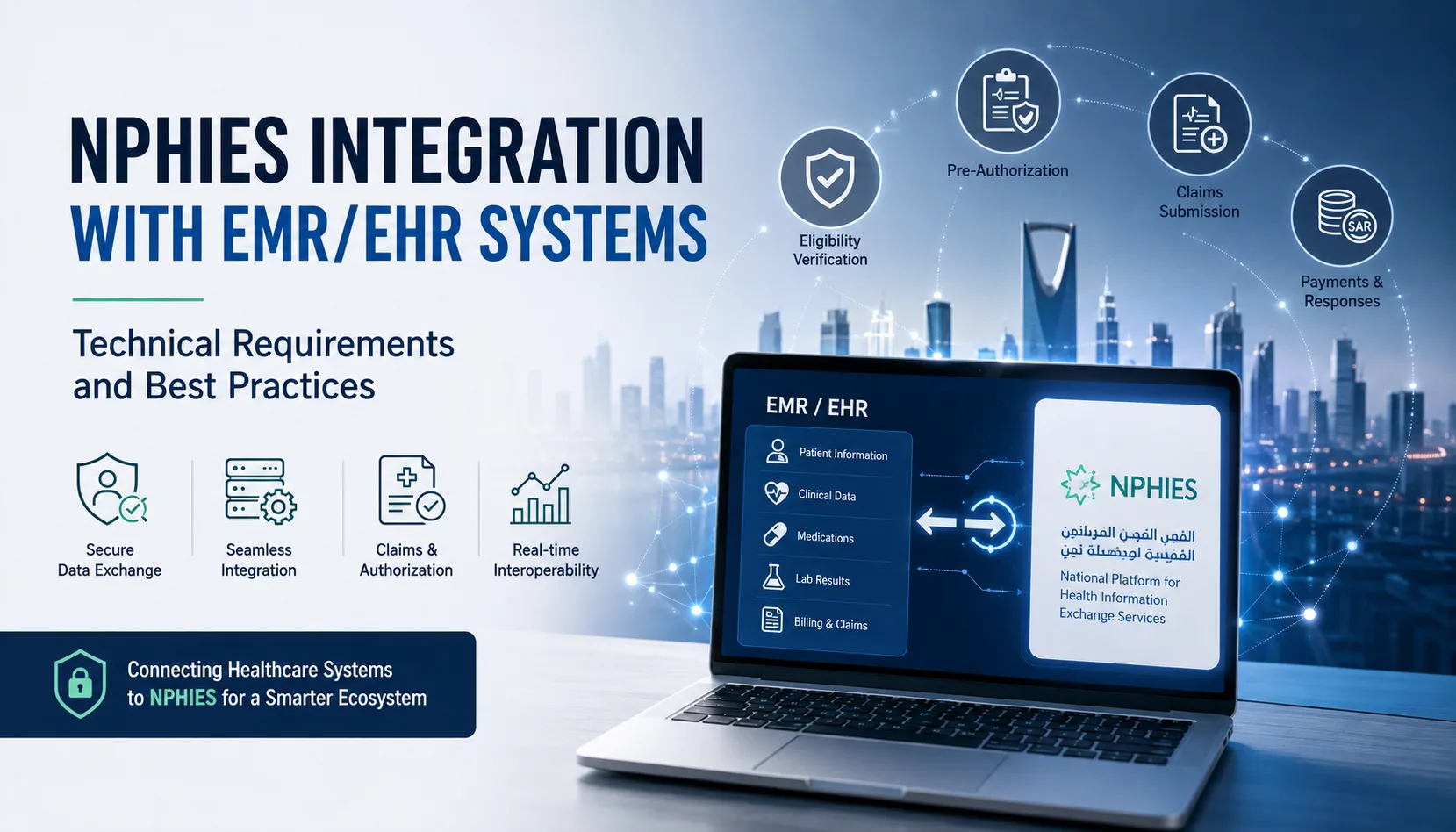
For hospitals, clinics, medical centers, and healthcare software providers in Saudi Arabia, connecting an existing EMR or EHR system with NPHIES is becoming an important part of digital healthcare operations.
But NPHIES integration is not simply a matter of connecting an API and sending patient or insurance information. The EMR/EHR must be capable of exchanging the required healthcare and insurance data, handling NPHIES workflows, mapping information correctly, managing responses, and maintaining reliable transaction records.
This is where careful technical planning becomes important.
In this guide, we explain the key technical requirements, integration architecture, data mapping considerations, testing requirements, and best practices for integrating NPHIES with an EMR/EHR system.
What Is NPHIES Integration With an EMR/EHR?
NPHIES integration connects a healthcare provider's internal EMR/EHR or hospital information system with the National Platform for Health Information Exchange Services (NPHIES).
The purpose is to allow healthcare systems to exchange relevant healthcare and insurance transactions through standardized digital workflows instead of relying heavily on manual processes.
Depending on the healthcare organization's requirements, an integration can support workflows such as:
- Patient and beneficiary information exchange
- Insurance eligibility verification
- Pre-authorization
- Claims submission
- Claims responses
- Payment-related transactions
- Claim status and response handling
- Supporting healthcare information exchange
NPHIES technical documentation includes workflows involving HIS/EMR systems, healthcare providers, payers, and NPHIES, with FHIR samples and implementation guidance for different use cases.
Why Integrate NPHIES With an EMR/EHR?
Many healthcare organizations already have an EMR, EHR, HIS, practice management system, or RCM platform in place.
Replacing the entire system simply to support NPHIES may not be practical.
NPHIES integration allows organizations to extend their existing healthcare software and connect relevant workflows with the national healthcare information exchange environment.
Key benefits can include:
1. Reduced Manual Data Entry
Instead of repeatedly entering patient, insurance, service, and claim information into separate systems, relevant information can be exchanged electronically.
2. Better Insurance Workflow Management
Eligibility, authorization, claims, and response workflows can be incorporated into existing healthcare processes.
3. Improved Data Consistency
Mapping data between the EMR/EHR and NPHIES can help reduce inconsistencies caused by manually transferring information between systems.
4. Faster Transaction Processing
Automated integrations can reduce the time required to initiate and monitor certain healthcare transactions.
5. Better Visibility
Integration can allow users to view relevant request and response statuses from within their existing healthcare workflow instead of constantly switching between systems.
Key Technical Requirements for NPHIES EMR/EHR Integration
Before starting development, healthcare organizations should evaluate whether their existing EMR/EHR is technically ready for integration.
Several areas require particular attention.
1. FHIR-Based Interoperability
FHIR is an important part of modern healthcare interoperability and NPHIES integration.
The EMR/EHR integration layer needs to understand the required NPHIES profiles, resources, elements, identifiers, and transaction structures rather than simply treating NPHIES as a generic REST API.
Development teams should review the applicable NPHIES implementation specifications and FHIR samples before designing the integration.
This is particularly important because different healthcare workflows may require different FHIR resources and message structures.
2. API Connectivity
The integration requires a reliable communication layer between the organization's healthcare system and the NPHIES environment.
The integration architecture should account for:
- API communication
- Authentication and authorization
- Request and response handling
- Error handling
- Timeouts
- Retry mechanisms
- Transaction logging
- Monitoring
- Environment configuration
For example, NPHIES documentation describes mechanisms for handling queued responses, checking transaction status, and retrying certain transactions when technical errors occur.
Therefore, an integration should not be designed around a simple "send request and wait for response" model.
3. EMR/EHR Data Mapping
One of the most important parts of NPHIES integration is data mapping.
Healthcare systems often store information using their own internal database structures, terminology, identifiers, and workflows.
NPHIES expects information in defined structures and formats.
The integration layer therefore needs to map information such as:
- Patient demographics
- Beneficiary identifiers
- Provider information
- Organization information
- Diagnoses
- Procedures
- Services
- Insurance information
- Supporting documentation
- Claim information
- Authorization information
A proper mapping exercise should be completed before development begins.
Poor mapping can result in validation errors, rejected transactions, inconsistent records, and additional manual work.
4. Patient and Beneficiary Identification
The integration needs a reliable approach for identifying patients and beneficiaries.
The EMR/EHR may use an internal patient ID, while healthcare transactions may require specific identifiers recognized within the NPHIES ecosystem.
The integration should therefore maintain clear relationships between internal patient records and the identifiers used for external transactions.
This becomes particularly important when handling eligibility, authorization, claims, and responses.
5. Claims and Pre-Authorization Workflows
NPHIES integration should be designed around complete business workflows rather than individual API calls.
For example, a pre-authorization workflow may involve:
- Creating the request from the healthcare system
- Preparing the required clinical and administrative information
- Mapping the information into the required transaction structure
- Sending the request
- Receiving the response
- Handling queued or pending responses
- Updating the EMR/EHR
- Storing the transaction history
- Linking subsequent related requests where required
NPHIES guidance also describes relationships between subsequent pre-authorization requests and previous requests, highlighting why transaction relationships need to be preserved in the integration.
Claims workflows require similar attention to request status, responses, resubmissions, and error handling.
6. Response and Error Handling
A reliable NPHIES integration must be designed to handle more than successful responses.
The system should be able to distinguish between:
- Successful transactions
- Validation errors
- Business errors
- Technical errors
- Queued transactions
- Pending responses
- Failed transactions
- Resubmission scenarios
For example, NPHIES documentation describes polling and status-check mechanisms for situations where a final adjudication response is not immediately available. It also provides guidance for certain retry scenarios involving technical errors.
The EMR/EHR should therefore have a mechanism for recording transaction status and communicating actionable errors to authorized users.
7. Transaction Logging and Auditability
Healthcare integrations should maintain detailed transaction records.
Useful information can include:
- Transaction ID
- Request timestamp
- Response timestamp
- Transaction type
- Patient reference
- Claim or authorization reference
- Request status
- Response status
- Error details
- Retry attempts
- Related transaction references
This makes troubleshooting easier and gives technical and operational teams better visibility into integration performance.
8. Security and Access Control
Healthcare information is highly sensitive, so security should be considered throughout the integration architecture.
Important areas include:
- Secure API communication
- Authentication
- Authorization
- Role-based access
- Encryption
- Secure credential management
- Audit logs
- Session management
- Controlled access to patient and insurance information
Security should not be added as an afterthought after the integration has already been developed.
NPHIES Integration Architecture for EMR/EHR Systems
A typical integration can be structured into several layers:
EMR/EHR → Integration Layer → NPHIES → Payer/Healthcare Ecosystem
The integration layer acts as the bridge between the organization's internal healthcare application and external NPHIES workflows.
It may be responsible for:
- Data transformation
- FHIR resource creation
- Validation
- API communication
- Authentication
- Request orchestration
- Response processing
- Error handling
- Retry management
- Logging
- Monitoring
This architecture can also make future maintenance easier because NPHIES-specific logic is separated from the core EMR/EHR application.
Should You Modify the EMR or Build Middleware?
This depends on the architecture of the existing healthcare system.
Direct EMR Integration
In a direct approach, NPHIES-related functionality is incorporated directly into the EMR/EHR.
This can work when:
- The EMR has a modern architecture
- APIs are available
- The system is already designed for interoperability
- The development team controls the source code
However, tightly coupling external integration logic with the core EMR can make future maintenance more difficult.
Middleware-Based Integration
A middleware or integration layer sits between the EMR/EHR and NPHIES.
This approach can be useful when:
- Multiple healthcare systems need integration
- The organization has legacy systems
- Different systems use different data structures
- Transformation and orchestration are required
- The organization wants to isolate external integration logic
For larger healthcare environments, middleware can provide a more flexible architecture for managing multiple integrations.
NPHIES Integration Testing
Testing should begin before production deployment.
A comprehensive testing strategy should cover:
Functional Testing
Verify that required transactions can be created, transmitted, received, and recorded correctly.
Data Validation Testing
Check whether patient, provider, service, diagnosis, insurance, and claim information is mapped correctly.
Error Testing
Test invalid, incomplete, rejected, and failed transactions.
Response Testing
Verify that the EMR/EHR correctly handles successful, queued, pending, and error responses.
Retry Testing
Test the integration's behavior when network failures, timeouts, or applicable technical errors occur.
Security Testing
Verify authentication, authorization, access controls, logging, and protection of sensitive information.
Performance Testing
Evaluate the system under realistic transaction volumes, particularly for hospitals and large healthcare networks.
Common Challenges in NPHIES EMR/EHR Integration
Healthcare organizations often underestimate the complexity of integration because the project initially appears to be an API connectivity task.
Common challenges include:
Legacy EMR Architecture
Older systems may not provide modern APIs or structured healthcare data.
Inconsistent Data
Different systems may store the same clinical or insurance information differently.
Complex Data Mapping
Mapping internal data models to required NPHIES structures can require significant analysis.
Incomplete Business Workflows
A system may successfully send a request but fail to properly handle responses, corrections, resubmissions, or related transactions.
Poor Error Handling
Without clear error categorization and monitoring, operational teams may struggle to identify why transactions failed.
Lack of Integration Monitoring
Healthcare organizations need visibility into failed, pending, queued, and successfully completed transactions.
Best Practices for NPHIES EMR/EHR Integration
1. Start With a System Assessment
Review the existing EMR/EHR architecture, APIs, database structure, workflows, and interoperability capabilities before development.
2. Define the Required NPHIES Workflows
Do not attempt to integrate every possible workflow at once.
Identify the transactions required by the healthcare organization and prioritize them.
3. Create a Detailed Data-Mapping Document
Document how every required field moves between the EMR/EHR, integration layer, and NPHIES.
4. Use a Dedicated Integration Layer Where Appropriate
Separating NPHIES-specific logic from the core EMR can improve maintainability, especially for complex healthcare environments.
5. Design for Asynchronous Responses
Do not assume every transaction will receive an immediate final response.
NPHIES documentation includes queued-response and status-check mechanisms, making response-state management an important part of integration design.
6. Build Strong Logging and Monitoring
Make transaction failures visible to technical and operational teams.
7. Test Realistic Scenarios
Testing should include successful transactions as well as rejected claims, pending responses, technical failures, resubmissions, and other real-world scenarios.
8. Plan for Maintenance
NPHIES integration should be treated as an ongoing software capability rather than a one-time development project.
Implementation specifications, workflows, and integration requirements can evolve, so the integration should be maintainable and version-aware.
How Long Does NPHIES EMR Integration Take?
There is no universal timeline.
The implementation time depends on factors such as:
- Existing EMR/EHR architecture
- Availability of APIs
- Number of workflows
- Data quality
- FHIR readiness
- Complexity of data mapping
- Existing healthcare integrations
- Testing requirements
- Number of facilities
- Internal approval processes
A modern EMR with well-documented APIs may require considerably less integration work than a legacy system with limited interoperability capabilities.
How Much Does NPHIES Integration With an EMR Cost?
The cost depends on the technical scope rather than simply the NPHIES connection itself.
Major cost drivers can include:
- EMR/EHR complexity
- Number of NPHIES workflows
- API development
- FHIR implementation
- Data mapping
- Middleware development
- Legacy-system modernization
- Testing
- Security
- Monitoring
- Ongoing maintenance
For healthcare organizations planning a project, the best approach is to assess the existing system and define the required NPHIES workflows before estimating development effort.
Final Thoughts
NPHIES integration with an EMR or EHR is a combination of healthcare interoperability, software engineering, data mapping, workflow automation, and operational readiness.
A successful integration should do more than transmit a request. It needs to manage the complete transaction lifecycle—from creating and validating information to handling responses, errors, status updates, related transactions, logging, and monitoring.
For Saudi healthcare organizations, the right integration strategy starts with understanding the existing EMR/EHR environment and then designing an architecture that can reliably support the required NPHIES workflows.
RowthTech helps healthcare organizations plan and develop custom healthcare software and interoperability solutions, including NPHIES integration, HL7 FHIR integration, EMR/EHR connectivity, healthcare APIs, and related healthcare technology solutions for Saudi Arabia and the GCC.
Looking to integrate your EMR/EHR with NPHIES?
Explore RowthTech's healthcare technology solutions for the GCC or speak with our healthcare software development team about your integration requirements.