The Shift Toward Instant Services
The demand for faster and more convenient services has changed how customers interact with businesses. From ordering food and booking rides to accessing healthcare and fitness services, people increasingly expect solutions to be available whenever they need them. This shift has created strong opportunities across the on-demand economy. On-demand app development helps businesses turn this growing demand into convenient digital experiences by connecting customers with products and services through a few simple taps.
What Makes On-Demand Apps the Future of Services?
On-demand apps are built around one simple idea: giving customers access to what they need without unnecessary waiting. Users can discover a service, place a request, complete payment, and receive updates through a single platform.
The model has become increasingly relevant because it fits modern customer expectations. Instead of visiting a physical location or following fixed schedules, users can access services based on their own time and location. This makes on-demand platforms adaptable to a wide range of business models.
How the On-Demand App Model Works
An on-demand platform typically brings customers and service providers together. A customer places a request, and the platform identifies an appropriate provider based on factors such as availability, location, and service type.
Once the request is accepted, the application can manage payment, notifications, tracking, and communication until the service is completed. This connected workflow creates a smoother experience while helping businesses manage their operations from a centralized digital environment.
Industries Embracing On-Demand Applications
The on-demand model has expanded well beyond food delivery. Food, transportation, entertainment, healthcare, fitness, beauty, and home services are among the areas using digital platforms to provide faster access to customers.
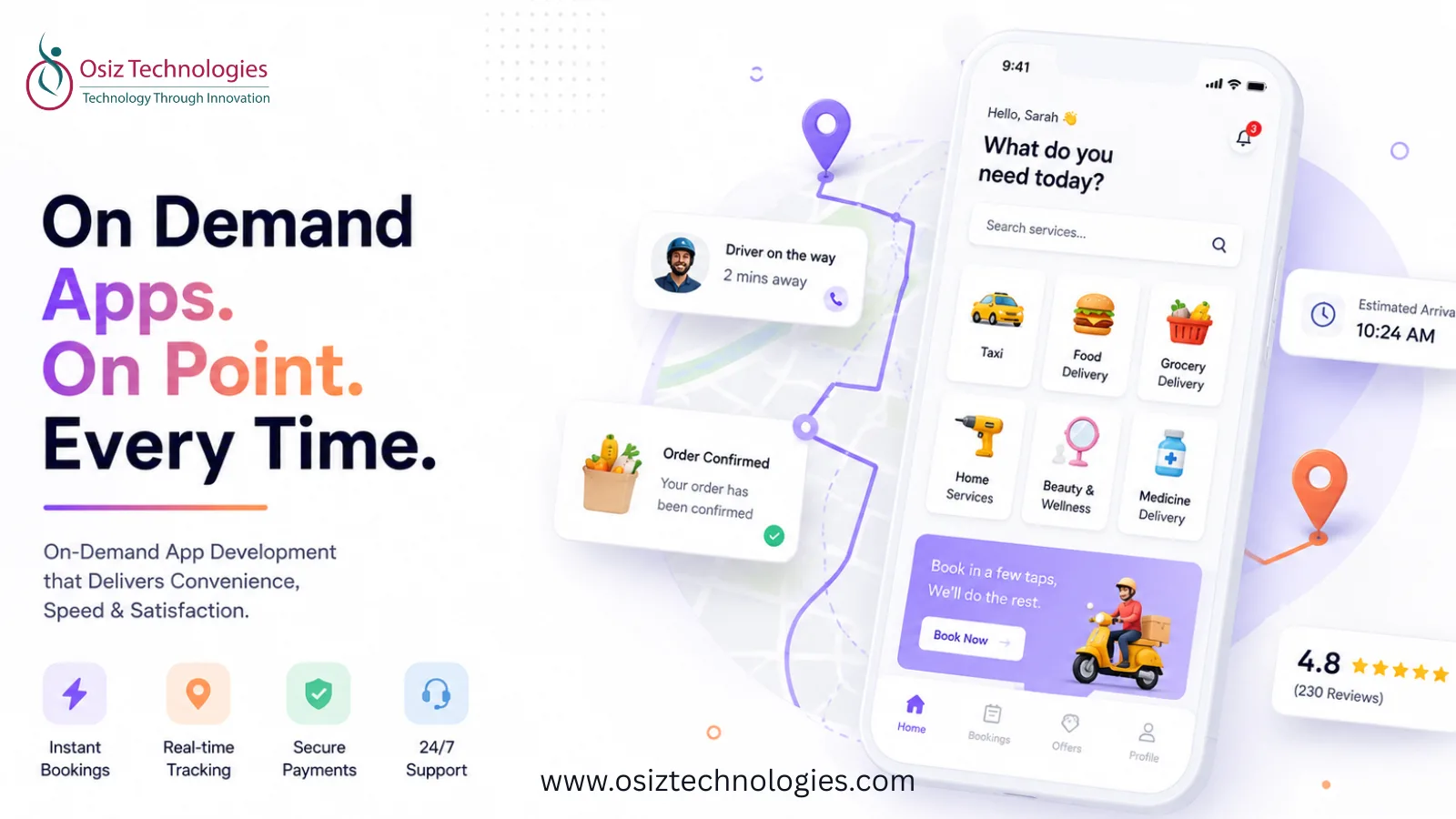
For example, food delivery platforms can combine ordering and real-time tracking, while healthcare applications can support remote consultations and appointments. Fitness and beauty platforms can make personalized services easier to discover and book. This broad adoption shows how flexible the on-demand model can be across different industries.
Technology Powering Modern On-Demand Apps
Behind every reliable on-demand application is a combination of technologies working together. Mobile interfaces connect users to the platform, while backend systems manage requests, customer information, service providers, and transactions.
GPS and geolocation can support nearby service discovery and real-time tracking. Payment gateways simplify digital transactions, while cloud infrastructure helps applications handle growing user demand. AI can further enhance platforms through personalized recommendations, automated support, demand prediction, and smarter service allocation.
The On-Demand App Development Process
Developing an on-demand platform begins with understanding the business model and target audience. From there, teams define the application structure, user journeys, technology architecture, and required integrations.
UI/UX design and application development are followed by API integration, testing, deployment, and ongoing optimization. Choosing an experienced app development company can help businesses manage this process while ensuring the platform is designed for scalability and future expansion.
Creating a Seamless Customer Experience
Convenience should remain at the center of every on-demand application. Customers should be able to search for services, understand pricing, place requests, make payments, and track progress without navigating complicated processes.
Personalized recommendations, multiple payment options, real-time notifications, and simple navigation can make the experience more engaging. When every interaction feels quick and intuitive, businesses have a better opportunity to build long-term customer relationships.
Challenges Businesses Face With On-Demand Apps
Building an on-demand platform also requires businesses to address operational and technical challenges. Managing fluctuating demand, maintaining accurate location tracking, coordinating service providers, and protecting customer information can become increasingly complex as the platform grows.
Competition is another important consideration. Since many industries already have established on-demand platforms, businesses need a clear value proposition and a strong understanding of their target market before entering the space.
On-Demand App Development Cost Considerations
The cost of developing an on-demand application depends on its complexity. Platform selection, UI/UX requirements, backend architecture, payment integration, location services, third-party APIs, security, and advanced technologies can all influence the overall investment.
A simple single-service application will generally require less development effort than a large multi-vendor platform with real-time tracking, AI, analytics, and multiple user roles. Planning for scalability from the beginning can also reduce the difficulty of future upgrades.
The Future of On-Demand App Development
The on-demand economy continues to move toward faster, smarter, and more personalized services. As AI, automation, predictive analytics, and connected technologies develop, applications can become better at understanding customer preferences and anticipating demand.
The opportunity is no longer limited to simply providing services on request. Businesses can build intelligent platforms that create personalized experiences while improving how services are managed and delivered.
Conclusion
On-demand applications are changing the relationship between businesses and customers by making everyday services more accessible, responsive, and convenient. From food and transportation to healthcare, fitness, and beauty, the model continues to expand into new areas.
With the right business strategy, technology foundation, and user experience, an on-demand platform can become a scalable digital business. Osiz Technologies helps businesses transform their on-demand ideas into modern digital solutions built for evolving customer expectations and long-term growth.