
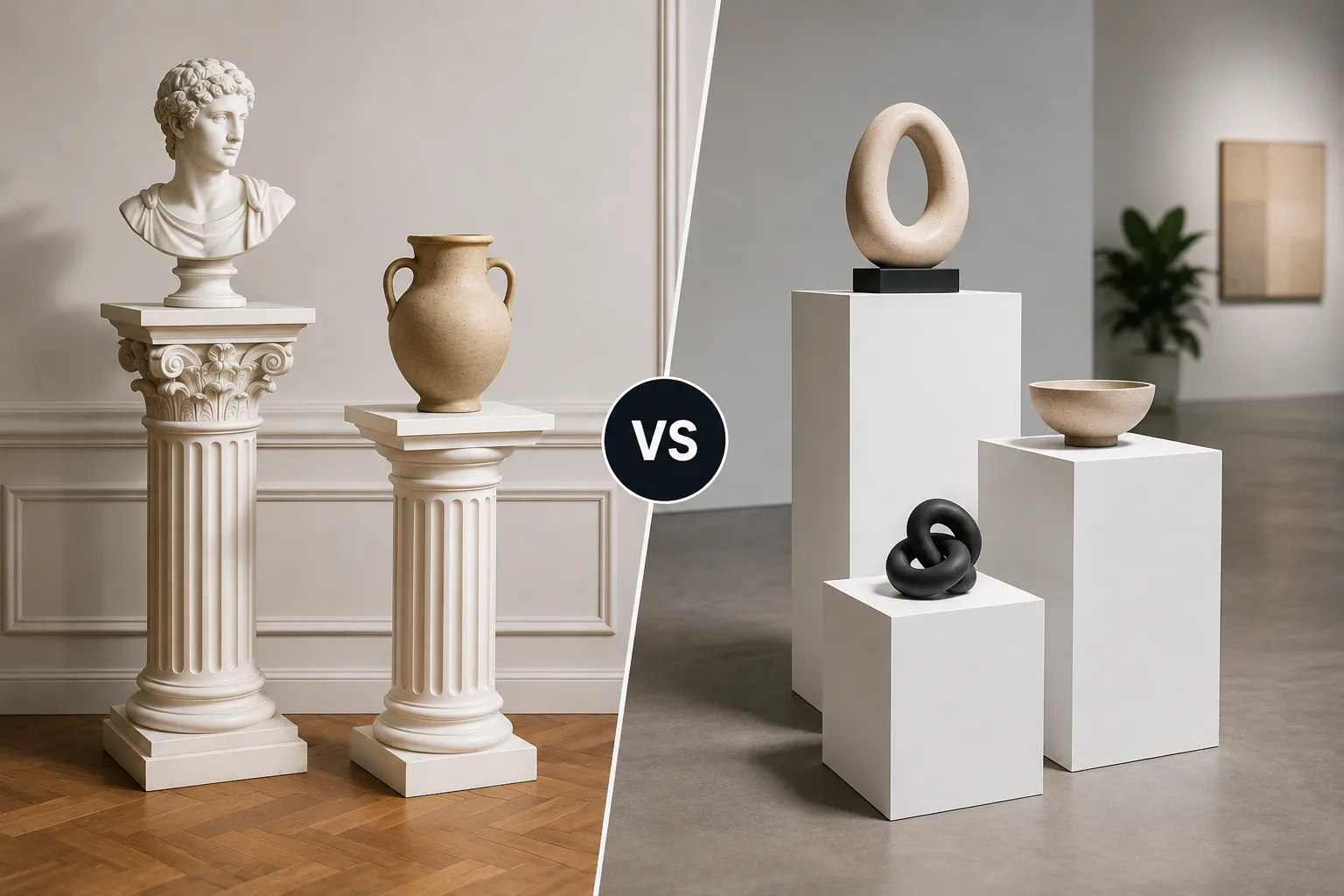
A strong product can still disappear in a busy showroom. The same thing happens to artwork at an exhibition, a prototype at a trade show, or a premium item placed directly on a retail counter.
Presentation changes what people notice and how valuable they believe an object to be.
That brings many retailers, designers, galleries, and exhibition teams to the same question: should we use a pedestal or a plinth?
The terms are sometimes used interchangeably, and there is some overlap. In reality, though, they create slightly different effects. A pedestal usually lifts an object and makes it the centre of attention. A plinth tends to provide a broader, more grounded base that becomes part of the overall display.
That depends on the object, the space, and the response you want from your visitors.
What is the difference between a pedestal and a plinth?
A pedestal is generally tall and narrow, built to lift an object closer to eye level. You'll see them under sculptures, floral displays, awards, and anything that needs to stand apart rather than blend into a wider layout.
A display plinth is usually wider and more visually connected to the floor or display area. It may be low, tall, wide, square, or made to a completely bespoke shape. In commercial interiors, plinths are frequently used beneath merchandise, models, artwork, technology, and branded installations.
The easiest way to remember the difference is this: a pedestal puts an object on a stage, while a plinth helps create the stage itself.
There is no strict rule separating the two in every project. Many designers and suppliers use both names for similar display structures. Buyers should therefore focus less on terminology and more on height, footprint, material, load capacity, and finish.
When should a business choose a pedestal?
Go with a pedestal when the goal is height and separation. You want one object to be the clear focal point, not part of a grouped display. Galleries, hotel receptions, premium retail, and event launches all lean on this for the same reason: lifting something above the surrounding clutter makes people look at it first.
Pedestals are best suited to individual hero pieces. That might be a new watch collection, an award, a sculpture, or a product prototype being unveiled at an industry event.
They are less useful when several large items must be grouped or when the structure needs to support a particularly heavy installation.
Stability also matters. A tall, narrow pedestal must be properly matched to the size, weight, and centre of gravity of the displayed object. In busy public areas, the risk of accidental contact should also be considered.
When should a business choose a plinth?
Go with a plinth when the goal is stability, versatility, or a base that supports the wider display rather than a single hero object. A display plinth works quietly in the background, it's built to hold the composition together, not steal attention from what's sitting on it.
This is the stronger option for retail window displays, exhibition stands, and museum layouts where several pieces need to sit at different levels within one coherent scene. It's also the better choice for heavier or larger items, where a wide, low base gives more stability than a tall, narrow one ever could.
Plinths suit ongoing or repeated use, too. Because the finish tends to be neutral, white, black, or a brand colour, the same units can be reused across different campaigns, products, or events without looking out of place.
They're less useful when the goal is pure emphasis on one small object. In that situation, the wider footprint of a plinth can actually work against you, making the piece look smaller rather than more prominent.
How do you choose the right option for a retail or exhibition project?
Start with the object, not the stand.
Measure its full width, depth, and height. Record its weight, but also think about how that weight is distributed. A delicate sculpture and a tiny machine may weigh the same, but they place very different stresses on the foundation below.
Think about the proper height for viewing. Objects with fine detail will generally need to be at eye level. Larger pieces may look better on a lower stand, giving people enough room to step back and see the whole piece. An acrylic plinth in particular tends to suit this kind of close viewing, since the base itself stays out of the way visually.
Then assess the environment. Will visitors walk around the display? Does it need to fit inside a shop window? Will staff move it between events? Does the finish need to match an existing interior or brand colour?
For B2B rollouts, consistency is just as important as appearance. A one-off design may look great, but a rollout across several stores requires accurate dimensions, repeatable finishes, practical packaging, and reliable delivery schedules.
Should you buy a standard or bespoke plinth?
Standard sizes are useful when the timeline is tight, the display is straightforward, and the units are likely to be reused. They are easier to specify and can often be moved between different campaigns or locations.
Bespoke manufacturing becomes more valuable when the object has unusual dimensions, the finish must follow brand guidelines, or the unit requires lighting, storage, wheels, a rotating platform, or a protective cover.
Working with experienced plinth manufacturers, UK businesses can also reduce the risk of treating the display base as a last-minute purchase. A knowledgeable manufacturer should advise on construction, materials, stability, and weight capacity, not simply request three measurements and provide a price.
Share the wider project context when requesting a quotation. Object weights, photographs, floor plans, colour references, and installation dates will usually produce a better recommendation.
Which should you choose: a pedestal or a plinth?
Choose a pedestal when one object needs height, emphasis, and separation.
Choose a display plinth when you need a stable and versatile base that supports the wider design of a shop, gallery, showroom, or exhibition stand.
There will always be grey areas between the two, and that is not a problem. The product name matters less than the finished result.
A well-chosen base should support the object safely, suit its surroundings, and make the presentation easy to understand at a glance. When all three are right, visitors notice the product or artwork first, which is exactly what the display is meant to achieve.
Not sure which option is right for your display? Speak to our team for expert guidance.
FAQs
Is a plinth the same as a pedestal?
Not quite, though the terms overlap a lot in everyday use. A plinth is generally low and broad; a pedestal is taller and narrower. Most suppliers, including us, use "plinth" loosely to cover both, so it's always worth confirming height requirements rather than relying on the word alone.
What height should a display pedestal be?
It depends entirely on the object and the viewer. Jewellery and small collectables are at their best between 90cms and 110cms, close to natural eye level. Larger items can sit lower. There's no fixed industry standard; it comes down to what you're displaying and who's viewing it.
Can a plinth and display case be ordered together?
Yes, and we'd recommend it. Ordering them as a matched pair means the case fits the plinth precisely, down to the millimetre, rather than leaving a visible gap or overhang that undermines the whole display.
Is acrylic durable enough for repeated exhibition use?
More than people expect. It's lightweight, resistant to knocks that would crack glass, and easy to keep looking presentable between shows. The main thing to watch for is surface scratching from careless handling, which is a packing and transport issue rather than a material flaw.