A blocked drain that keeps coming back is more than an annoyance.
It’s the kind of problem that steals weekends, wrecks confidence in the plumbing, and turns every heavy rain forecast into a mild stress test.
In Sydney, recurring drainage issues are common in older homes, renovated properties with mixed pipework, and areas with established trees.
Pipe relining is one of the reasons the “dig up the yard” option isn’t always the default anymore—but it’s not the right answer for every job.
Why pipe problems keep coming back in older Sydney properties
Many Sydney suburbs have a patchwork of pipe materials and ages.
A property might have older clay or earthenware sections, newer PVC sections from a renovation, and a few “mystery repairs” in between.
Every join, change in material, or slight dip in fall (slope) is a spot where debris can catch and accumulate.
Tree roots are another repeat culprit.
Roots don’t need a huge crack to get started; a tiny opening can be enough, and once they’re in, the pipe becomes a target over time.
Then there’s the slow burn issue: build-up.
Grease, soap scum, hair, lint, and sediment can gradually narrow the pipe, and the symptom shows up as “slow drains” long before the first real overflow.
If a blockage is cleared repeatedly without addressing what’s causing it, you often end up with more frequent call-outs and less predictable performance.
Common mistakes that lead to repeat blockages and bigger damage
The biggest mistake is treating each blockage as a standalone event.
If you’ve had more than one blockage in the same line, it’s usually worth stepping back and asking why it’s recurring instead of just clearing it again.
Another common mistake is relying on harsh chemical cleaners.
Aside from safety concerns, they often don’t solve structural problems like cracks, root intrusion, or damaged joints, and they can complicate later work if residue remains in the pipe.
People also underestimate how quickly damage can worsen.
A small crack can become a bigger break under vibration, ground movement, or repeated pressure changes.
And when leaks are involved, the surrounding soil can wash away or shift, which can create new alignment issues and make the pipe more vulnerable.
Finally, many homeowners don’t realise how much access matters.
Even if relining is a no-dig approach, technicians still need practical access to suitable entry points and enough space to work safely.
Decision factors: relining vs digging, and how to know what fits
What pipe relining is (in plain terms)
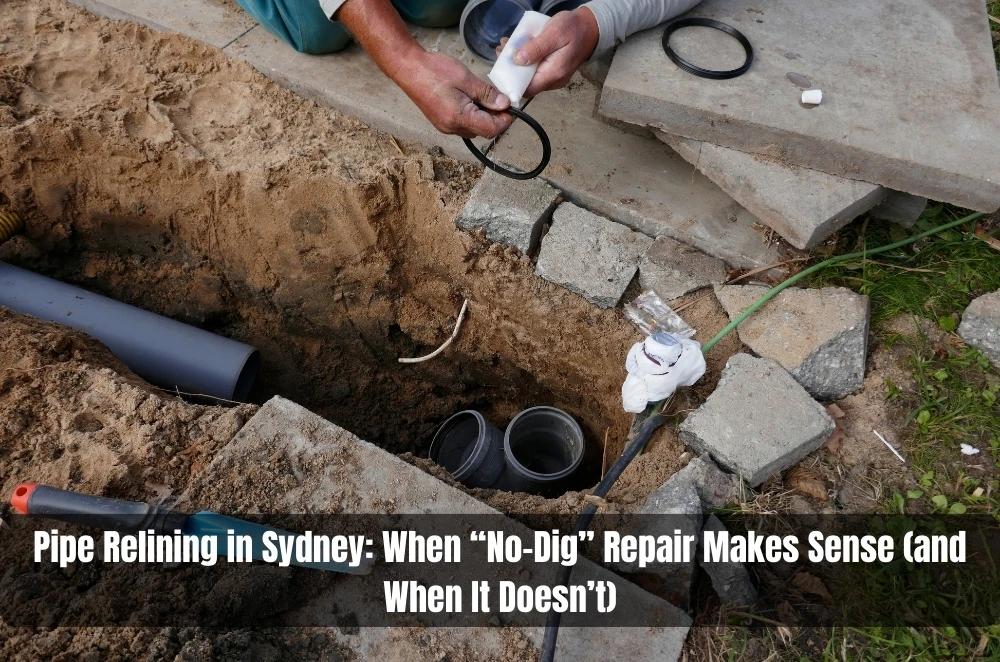
Pipe relining is a trenchless method that repairs a damaged pipe from the inside.
Instead of excavating the full length, the pipe is typically inspected, prepared, and then lined internally so the damaged section is effectively sealed and reinforced.
In the right scenario, it can reduce disruption to landscaping, paving, and structures, and it can shorten the “messy phase” compared with traditional dig-and-replace.
But relining isn’t a magic blanket you can apply to every drain.
Suitability depends on the pipe condition, layout, and whether the line can be properly accessed and prepared.
When relining is often a good fit
Relining is commonly considered when:
- The issue keeps returning in the same line (blockages or intrusion that won’t stay away)
- The pipe is structurally compromised (cracks, joint issues) but still in a condition that can be lined
- Digging would mean major disruption (under slabs, landscaping, tight side access)
- The goal is to stabilise a problem area without rebuilding the entire site around it
The key theme is: repeated symptoms with a known underlying defect.
Relining is typically about addressing the pipe condition, not just clearing the contents.
When digging or replacement may still be the better option
There are scenarios where traditional excavation or replacement can make more sense, such as:
- The pipe has collapsed or is severely deformed
- There are major alignment issues (significant belly/sag) that need physical correction
- Access points don’t allow proper inspection and preparation
- The line layout is too complex for a reliable lining outcome
- You’re already doing major works on the site where excavation is planned anyway
Relining can reinforce a pipe, but it can’t always “rebuild” a badly misaligned system.
If the problem is structural in a way that needs physical repositioning, digging may be unavoidable.
What “proper diagnosis” looks like before any decision
The most useful next step is to identify:
- Where the issue is (exact section, not just “the back drain”)
- What’s causing it (roots, cracks, collapse, build-up, joint failure)
- How accessible the line is (entry points, length, bends, obstacles)
- Whether the pipe is lineable (condition sufficient for a stable liner)
This is why inspection matters so much: without it, you’re guessing.
If you want a plain-English outline of what relining is, where it works best, and what information is typically needed to assess a job, the Sydney Blocked Drain Service is a helpful starting point.
Disruption trade-offs: “no-dig” doesn’t mean “no work”
Relining can reduce digging, but you may still have:
- Time needed for inspection and preparation
- Temporary downtime on affected fixtures
- Practical requirements around access, safety, and water use
A realistic plan includes where the work happens, how long the line is out of service, and what the household needs to avoid during the process.
A simple first-actions plan for the next 7–14 days
This plan helps you move from “recurring symptoms” to an actual decision you can feel good about.
Days 1–2: Capture the pattern
Write down which fixtures are affected, how often it happens, and whether rain makes it worse.
If there’s overflow, keep people and pets away and avoid running more water.
Days 3–4: Stop feeding the problem
Be strict about what goes down drains (especially fats, wipes, heavy hair and lint loads).
If the line is struggling, avoid running multiple high-flow fixtures back-to-back.
Days 5–6: Identify access points
Find likely inspection openings, gullies, and any visible clean-outs.
Clear the area so access isn’t a last-minute scramble.
Days 7–9: Decide what “recurring” really means
If you’ve cleared the same line more than once, treat it as a diagnosis problem.
If it’s truly one-off and stable, keep notes anyway—repeat events are easier to spot with a baseline.
Days 10–12: Gather the essentials for assessment
Have photos, timing notes, and any relevant property quirks ready (tight access, under-slab sections, recent renovations).
This reduces back-and-forth and speeds up a clear recommendation.
Days 13–14: Choose the least-disruptive “real fix”
Aim for a solution that reduces repeat incidents, not just a temporary clear.
If the assessment points to relining, confirm what sections are being addressed and how outcomes will be checked.
Local SMB mini-walkthrough: Sydney realities that change the call
Terraces and older homes can have pipe runs that sit under paths, courtyards, or extensions, making excavation disruptive.
Established trees can mean root intrusion that returns unless the pipe condition is addressed, not just cleared.
Renovations can introduce junctions where fall isn’t ideal, creating a natural catch point for debris.
Strata and shared services can complicate responsibility and access, so documentation helps from day one.
Tight side access can change what’s practical, even if the “pipe length” seems short on paper.
Rainy weeks can expose defects quickly, especially where soil movement or infiltration is involved.
Operator experience moment
The biggest difference between “endless call-outs” and a stable result is usually the moment someone stops guessing.
I’ve seen recurring blockages disappear once the root cause was identified and the plan matched the pipe condition, not just the symptom.
The fastest jobs are almost always the ones where the homeowner has clear notes, clear access, and a willingness to fix the underlying issue properly.
Practical Opinions
If the same line blocks twice, treat it as a diagnosis problem.
Choose the solution that prevents the next incident, not the one that’s quickest today.
Access planning saves time and reduces disruption more than most people expect.
Key Takeaways
- Relining can be a smart “no-dig” option when pipes are damaged but still suitable for an internal liner.
- Repeated blockages usually mean a repeated cause—roots, cracks, joint failure, or poor fall—not just bad luck.
- Dig-and-replace still makes sense for collapsed, severely deformed, or badly misaligned pipes.
- A short 7–14 day plan (pattern → access → assessment) helps you choose the least disruptive real fix.
Common questions we hear from businesses in Sydney, NSW
How do we know if relining will work for our pipe?
Usually it comes down to whether the pipe can be inspected, prepared, and accessed properly, and whether the structure is sound enough to accept a liner.
A practical next step is to document recurring symptoms and identify access points so an assessment can be done efficiently.
In most cases in Sydney’s older properties, the deciding factor is pipe condition and layout rather than the age of the home alone.
Is relining always cheaper than digging?
It depends on access, pipe length, complexity, and how disruptive excavation would be on your site.
A practical next step is to compare options based on total disruption (landscaping, paving, under-slab work), not just the immediate job cost.
In most cases in Sydney, relining can be cost-effective when excavation would damage finished surfaces or require complex reinstatement.
Will relining stop tree roots from coming back?
In most cases relining can reduce re-entry in the repaired section because it seals defects roots use to enter, but outcomes depend on the broader pipe network and where roots are accessing.
A practical next step is to confirm which sections are being repaired and ask how the repaired line will be checked afterward.
Usually in Sydney suburbs with established trees, preventing repeat intrusion is about fixing defects rather than only clearing roots.
How can we minimise disruption while the work is done?
Usually disruption is lowest when access points are clear, household water use is planned, and the job is scheduled around peak usage times.
A practical next step is to identify which fixtures depend on the affected line and plan short-term workarounds if needed.
In most cases in Sydney homes, clear access and good sequencing reduce downtime more than trying to rush the work.