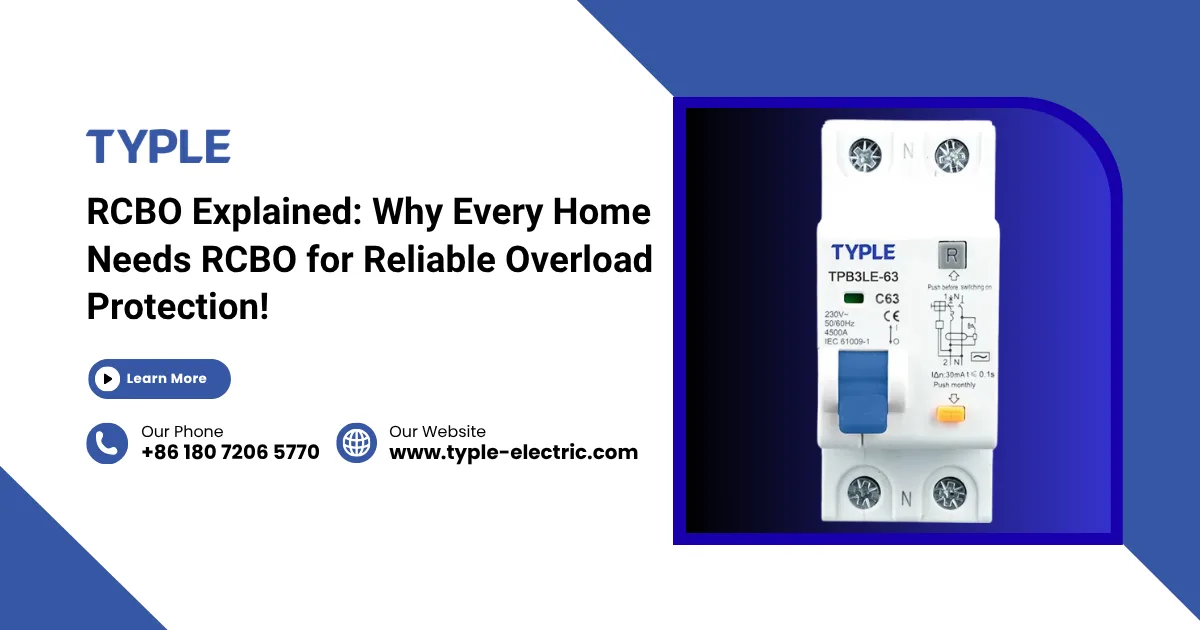
Electrical protection is the cornerstone of every modern home’s safety and comfort. While most homeowners are somewhat familiar with fuses or the classic miniature circuit breakers (MCBs) tucked inside their distribution boards, innovation in circuit protection has delivered a new generation of smarter, safer technology: RCBOs.
An RCBO—Residual Current Circuit Breaker with Overload Protection—combines the functions of two vital protective devices. It guards against both overloads (where too much current flows through a circuit, risking overheating and fire) and earth leakage faults (where electricity escapes its usual path, threatening electrocution or property damage). This dual action makes the RCBO indispensable for today’s households, where electrical complexity and demand for reliability have never been higher.
At Wenzhou Typle New Energy Technology Co., Ltd., we see the front lines of home protection every day. Our engineering teams have witnessed how outdated or poorly specified protection can lead to nuisance tripping, mystery outages, electrical shocks, or even catastrophe. That’s why we strongly recommend every home upgrade from conventional MCBs and RCDs to a modern RCBO solution—ensuring not just peace of mind but true, round-the-clock safety for people and property alike.
1. What Is an RCBO and How Does It Work?
An RCBO is a sophisticated circuit protection device that detects both overcurrent (from overloads or short circuits) and residual (leakage) current caused by faults to earth. When either condition arises, the RCBO immediately disconnects the power—stopping electrical hazards in their tracks.
- Overload Trip: If too many appliances run on one circuit, an RCBO senses the excess current (using a thermal and magnetic release mechanism) and cuts off power, just like an MCB.
- Earth Leakage Trip: If a live conductor touches metal or a person (earth), the RCBO detects the imbalance between live and neutral wires—rapidly disconnecting the circuit within milliseconds, in a way a normal MCB cannot.
This combined protection in one device eliminates the need for separate fuses, MCBs, and RCDs, and dramatically increases safety and convenience.
2. Core Functions: Overload and Earth Leakage Protection
A. Overload and Short Circuit
Excess current, due to too many devices or a short in wiring, risks overheating and fire. The RCBO’s overload protection matches an MCB, providing reliable trip response tuned to the home’s wiring size and expected loads.
B. Earth Leakage (Residual Current)
About 25–30% of household electrical fires start with earth faults—where current escapes the intended wiring to the metal body of an appliance or structure. Alone, an MCB cannot detect this fault. An RCBO’s residual current circuit monitors for these imbalances and disconnects power if they exceed safe levels (commonly 30mA).
This dual protection dramatically reduces risk to both people (preventing electric shocks) and property.
3. Why RCBO Beats MCBs and RCDs for Today’s Homes
Traditional Approach:
Old installations often use standard MCBs for each circuit and a single RCD (earth leakage device) for a group of circuits.
- Drawback 1: If a single earth fault occurs anywhere on a protected group, the entire set of circuits shuts down—possibly causing whole-house blackouts.
- Drawback 2: MCBs miss earth (leakage) faults.
RCBO Approach:
With individual RCBOs on each circuit:
- Only the affected area trips in case of a fault.
- Nuisance tripping is eliminated—you’re unlikely to lose both fridge and home office together.
- Each circuit gets personalized protection for its specific use (kitchen, bath, outdoor, etc.).
- Convenience and uptime increase dramatically.
4. Where Should RCBOs Be Installed?
RCBOs are ideal for vital household circuits, including:
- Lighting circuits (protecting from faulty fixtures or wiring)
- Kitchen and utility outlets (risk of water ingress or overloaded appliances)
- Bathroom power (safety, water proximity)
- Outdoor circuits (gardens, outbuildings, EV chargers)
- Home office or “critical” loads (computers, servers)
- Any circuit with portable or sensitive electronics
Modern best practice is to use RCBOs on all final circuits—whether renovation or new-build.
5. Understanding RCBO Ratings: Current, Sensitivity, and Tripping Curves
When choosing an RCBO, pay careful attention to the following:
- Rated Current (In): Typically matches your wire and load (commonly 6A to 40A)
- Tripping Sensitivity: Earth leakage sensitivity is most often 30mA for household circuits; special cases may need 10mA or 100mA.
- Breaking Capacity: The RCBO’s ability to safely open the circuit during a high fault current—typically 6kA or 10kA.
- Tripping Curve: Indicates how quickly it trips at various overload multiples (usually Type B for homes, Type C for heavier loads).
Wenzhou Typle provides RCBOs in all major ratings, directions, and fitting types.
6. Choosing the Right RCBO: Key Selection Criteria
a. Certified Manufacturing: Look for RCBOs tested to IEC/EN 61009 or equivalent.
b. Physical Size: Ensure your consumer unit or distribution board supports modular RCBOs.
c. Wiring Compatibility: Some RCBOs require specific neutral and earth arrangements.
d. Installation Environment: For wet or high-dust areas, select appropriate ingress protection (IP) ratings.
e. Extra Features: Remote indication, lockability, or combined surge protection can add safety and value.
Ask Wenzhou Typle specialists or your electrician for a tailored selection.
7. Best Practices for RCBO Installation and Testing
- Always Use a Licensed Electrician: Incorrect wiring can disable RCBO protection.
- Regular Testing: Use the “test” button monthly; ensure you and your family know what to expect.
- Clear Labeling: Each RCBO should be labeled by circuit type for easy identification.
- Periodic Inspection: Test for correct trip times and function, especially after electrical storms, surges, or renovations.
8. Mistakes to Avoid When Buying or Using RCBO Devices
- Mixing brands and pole types without professional review can create compatibility and reliability issues.
- Cheap, uncertified RCBOs may not trip reliably—choose only trusted brands like Wenzhou Typle.
- Overloading circuits by doubling outlets or daisy-chaining increases fire risk despite having an RCBO.
Ignoring nuisance tripping: Frequent tripping means either a genuine fault or an RCBO not matched to the circuit.
Protect your investment by making informed, code-compliant decisions at every step.
9. The Wenzhou Typle Advantage: Engineering a Smarter RCBO
At Wenzhou Typle New Energy Technology Co., Ltd., our RCBOs are designed for:
- Precise tripping and fast response for both overload and earth leakage
- All major world standards with robust quality control
- Compact modularity for standard home distribution boards
- Advanced arc suppression and secure terminals, minimizing nuisance tripping
- Dedicated support for electricians, homeowners, and contractors
Our RCBOs are trusted in thousands of installations worldwide.
Electrical safety is no longer about “good enough.” With the demands of modern living, protecting your family, appliances, and property requires the best technology available—RCBOs. By blending overload and earth leakage protection in a single, smart device, RCBOs ensure you’re covered for both everyday mishaps and the worst-case scenarios.
Frequently Asked Questions (FAQ)
Q1: Can I replace my old MCB with an RCBO?
A1: Yes. An RCBO offers all the functions of an MCB plus earth leakage protection. Ensure the RCBO matches your distribution board capacity and circuit requirements.
Q2: How many RCBOs does my home need?
A2: Best practice: one per final circuit. This maximizes protection and minimizes inconvenience if a fault occurs.
Q3: Will RCBOs work in older homes?
A3: Yes, though an electrician may need to update wiring or the distribution board for modern standards.
Q4: My RCBO keeps tripping—what’s wrong?
A4: Frequent tripping could indicate a real fault (e.g., appliance leakage, wiring damage) or a mismatch between RCBO sensitivity and circuit type.
Q5: Are all RCBOs the same?
A5: No. RCBOs vary in current rating, sensitivity, breaking capacity, and standard conformity. Pick only certified devices from a trusted supplier.
Q6: Does an RCBO completely prevent electrical fires?
A6: RCBOs greatly reduce risk but aren’t a substitute for quality wiring, sound installation, and regular inspection.
Q7: Can I install RCBOs myself?
A7: Only qualified professionals should install or replace protective devices. Incorrect handling can leave you unprotected.
Q8: How often should RCBOs be tested?
A8: Use the test button monthly, or after any major work or surge in your home.
Q9: Does having an RCBO increase utility bills?
A9: No. RCBOs use negligible power in stand-by and only act during faults.
Q10: Where can I buy genuine Wenzhou Typle RCBOs?
A10: Contact Wenzhou Typle New Energy Technology Co., Ltd. directly for certified distribution and installation partners.