Managing a business often requires making difficult decisions, especially when it comes to staffing. One such challenge is addressing situations that require employee demotion. Whether due to performance issues, restructuring, or changes in job responsibilities, delivering this message professionally and legally is essential. That’s where a reliable Demotion Letter Template becomes invaluable. At Winslow, we understand that small businesses and self-employed entrepreneurs need clear, customizable tools to maintain professionalism and compliance. In this blog, we’ll explore why demotion letters are important, how to write them effectively, and provide a flexible template to support your business needs.
What Is a Demotion Letter?
A demotion letter is a formal document issued by an employer to inform an employee about a change in their job position, typically involving a decrease in rank, responsibilities, salary, or job title. Unlike a termination, a demotion allows the employee to remain in the company but in a different capacity. It’s crucial that this letter be composed with care, clarity, and respect to maintain morale and avoid potential legal challenges.
Why Small Businesses Need a Demotion Letter Template
For small business owners and self-employed entrepreneurs, managing HR responsibilities internally is common. Without a dedicated HR department, these business owners must rely on professional templates to handle sensitive matters. A Demotion Letter Template ensures the message is delivered consistently, legally, and empathetically.
Using a professionally crafted letter template helps to:
- Maintain documentation for HR records
- Clarify the reasons for demotion
- Outline new expectations and responsibilities
- Protect the business from potential disputes
- Preserve the dignity and morale of the employee
Winslow’s customizable templates are especially designed to support smaller teams with easy-to-edit language and formatting, reducing the time and effort needed for administrative tasks.
Common Reasons for Employee Demotion
Understanding the context behind a demotion helps in communicating the decision properly. Here are a few common scenarios:
- Performance Issues
- When an employee consistently underperforms even after training and feedback, a demotion might offer a second chance in a more suitable role.
- Company Restructuring
- As businesses grow or downsize, some roles may be eliminated or changed, leading to the reassignment of employees to different positions.
- Violation of Company Policy
- If an employee violates rules but termination isn’t deemed necessary, a demotion may act as a corrective measure.
- Voluntary Demotion Request
- Occasionally, employees request to be demoted due to personal reasons like stress, relocation, or desire for a less demanding role.
- Change in Business Strategy
- Sometimes the evolution of a company’s objectives means realigning teams and leadership, resulting in demotions based on strategic fit rather than performance.
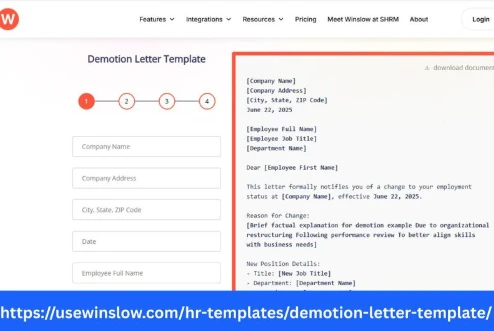
Key Components of a Demotion Letter Template
At Winslow, we recommend that every Demotion Letter Template includes the following key elements:
- Header: Company name, address, date, and employee information
- Subject Line: Clearly state the purpose (e.g., “Notice of Position Change”)
- Opening Statement: Direct and respectful explanation of the demotion
- Reason for Demotion: Clearly stated facts or business needs
- Effective Date: When the demotion takes effect
- New Role and Responsibilities: Title, salary, and job description
- Support and Next Steps: Offer training, transition assistance, or performance plan
- Closing Remarks: Express continued support or appreciation for service
- Signature Block: Signature of the manager or business owner
Tips for Delivering the Demotion Letter
- Have a Face-to-Face Conversation
- While the letter provides official documentation, it’s essential to first explain the situation in person or via a virtual meeting.
- Be Clear and Respectful
- Avoid vague language. Employees deserve clarity and dignity when receiving such news.
- Document Everything
- Keep a signed copy of the demotion letter for HR records and future reference.
- Offer Support
- Whether it’s coaching, retraining, or mentoring, providing a path forward can improve retention and morale.
Winslow: Your HR Partner for Growing Teams
Creating formal documents like demotion letters doesn’t have to be stressful or time-consuming. At Winslow, we provide entrepreneurs and small business owners with expertly crafted tools like our Demotion Letter Template to streamline employee communications and enhance professionalism. Whether you're navigating promotions, demotions, or onboarding, Winslow’s resources are designed to scale with your business.
As you build your team, trust Winslow to support your HR needs with reliability and ease. Download your customizable Demotion Letter Template today and take one step closer to a more organized, confident HR process.
Conclusion
Employee demotions are a sensitive but sometimes necessary part of business operations. With the right tools and approach, you can manage these transitions professionally and respectfully. A clear and thoughtful Demotion Letter Template, like the one provided by Winslow, helps you communicate effectively, maintain employee morale, and safeguard your business. Empower your HR processes today—because your team deserves clarity, even in challenging moments.