
Why would a restaurant with genuinely excellent reviews and a loyal local following still get completely skipped when someone asks an AI assistant where to eat nearby tonight? Increasingly, the real answer has surprisingly little to do with food quality and much more to do with which specific AI platforms that restaurant actually shows up on.
A modern, genuinely well-considered restaurant marketing strategy in 2026 can genuinely no longer afford to treat every AI platform as identical. ChatGPT, Gemini, and Perplexity each retrieve and cite information quite differently, and restaurants optimizing only for the single most talked-about platform often miss a meaningful, steadily growing slice of hungry customers asking somewhere else entirely instead.
Why Does Restaurant Marketing Strategy Need to Account for Multiple AI Platforms?
Diners increasingly ask AI assistants directly for recommendations rather than typing a search query and scrolling patiently through ten separate listings themselves. Roughly 63% of all searches now happen inside AI tools rather than traditional search engines, and that traffic certainly doesn't concentrate neatly on just one single platform.
A restaurant that's genuinely well optimized for ChatGPT can still be nearly invisible on Perplexity entirely, since the two systems weigh sourcing, recency, and structure in genuinely different ways when deciding exactly what to recommend.
Treating restaurant marketing strategy as a single, one-size-fits-all effort is exactly how these visibility gaps quietly form, often without anyone on staff noticing until reservations from a specific channel unexpectedly and mysteriously slow down.
What Makes Perplexity Different for Restaurant Discovery?
Ranking on Perplexity for restaurants specifically requires genuinely understanding how the platform actually presents its answers to the user. Perplexity typically shows its sources directly alongside the response, which means it favors content that's clearly attributable and easy to verify at a glance.
For a restaurant specifically, that translates into a few practical priorities: recent, dated mentions in local press or food blogs, a website with clear, structured menu and hours information, and consistent details across every single listing a customer might come across online.
Generic descriptions like "amazing food, great atmosphere" carry remarkably little weight in this particular citation-forward format. A specific, genuinely verifiable detail, like a recent feature in a named local publication, gives Perplexity something concrete to cite with real confidence.
What Mistakes Do Restaurants Make With AI-Driven Discovery?
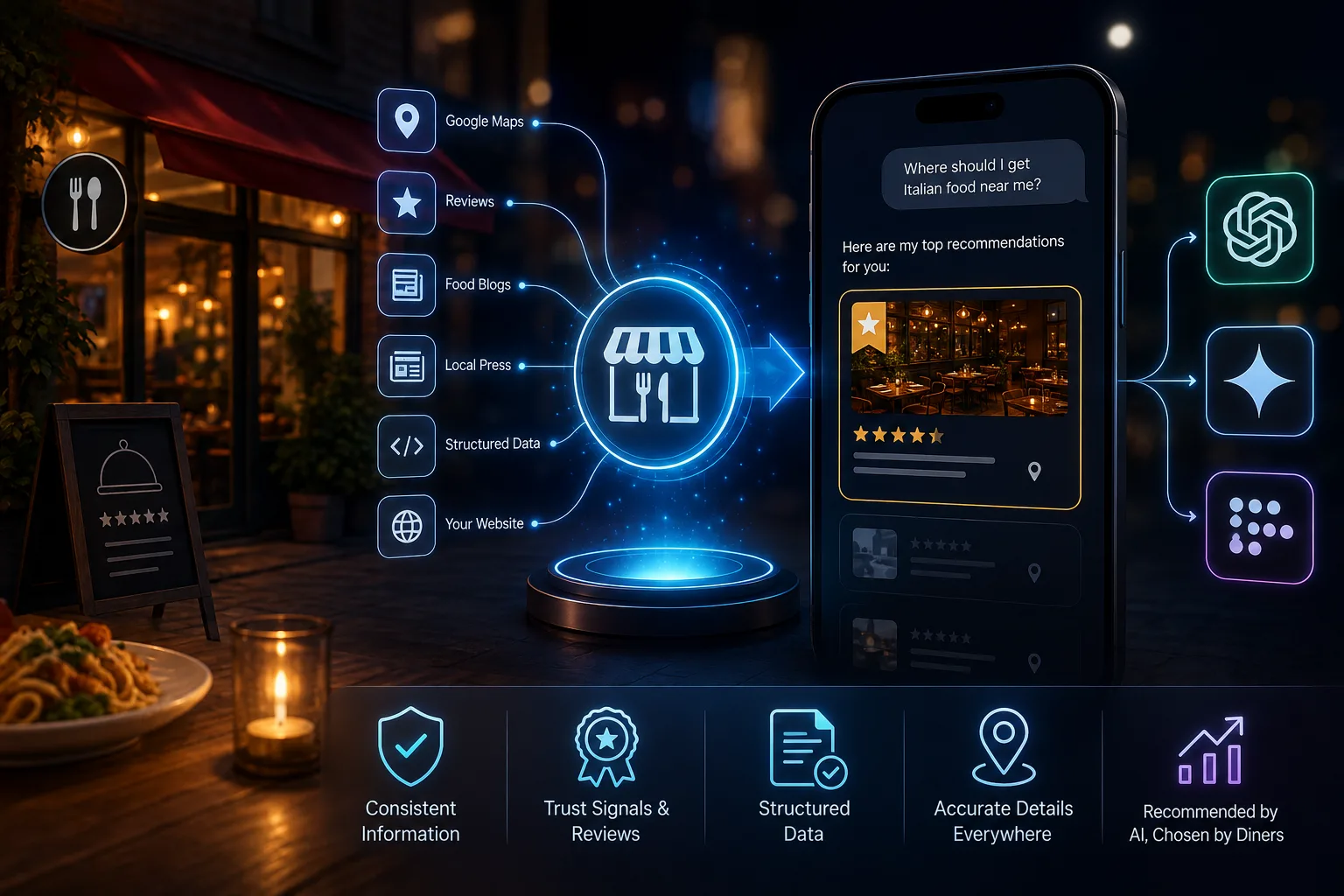
The most common mistake by far is simply assuming a strong Google Business Profile alone covers everything a restaurant needs. It doesn't, since AI models pull from review platforms, food blogs, local press, and structured website data, not just one single listing a restaurant might have already carefully polished.
The second common mistake is letting core information quietly drift out of date over time. An old menu still listed prominently, discontinued hours, or a stale press mention can quietly reduce how confidently an AI model recommends a restaurant, even when the actual dining experience itself has genuinely improved quite a bit since then.
What Elements Should a Modern Restaurant Marketing Strategy Include?
A genuinely well-rounded approach in 2026 typically combines several connected pieces working together in tandem:
- Consistent core information across your website, Google Business Profile, Yelp, and delivery apps, since conflicting hours or menu details actively confuse AI systems
- Structured, specific content that states cuisine type, price range, and specialty dishes clearly rather than burying them in narrative descriptions
- Fresh, dated mentions in local press, food blogs, or review roundups, since recency carries real weight on citation-forward platforms like Perplexity
- Active social proof through reviews and social media that reinforces the same consistent story about your restaurant
- Ongoing monitoring of how different AI platforms describe your restaurant, since that description can drift or become outdated without anyone noticing
Restaurants tackling only one or two of these pieces at a time tend to see partial, genuinely inconsistent results, strong on one platform while remaining largely invisible on another entirely.
How Do You Build a Restaurant Marketing Strategy That Works Across Platforms?
Start with a genuinely simple audit: ask ChatGPT, Gemini, and Perplexity the exact question a hungry customer nearby would realistically ask, and note carefully where your restaurant appears, how it's described, and which specific competitors get mentioned instead.
From there, fix existing consistency issues thoroughly before adding any new content at all. A restaurant with accurate, matching information across five platforms will typically outperform one with beautifully written descriptions scattered across mismatched, conflicting sources.
Layer platform-specific adjustments carefully on top of that shared foundation once it's solidly established. For Perplexity specifically, that means emphasizing clear, visible sourcing and genuinely recent mentions. For ChatGPT, it often means reinforcing the exact same consistent story across many independent listings, since that platform doesn't display its sources the same way Perplexity does.
How Long Does This Kind of Restaurant Marketing Strategy Take to Show Results?
Early visibility signals typically appear within roughly 60 to 90 days of cleaning up consistency issues and strengthening structured, verifiable information across key platforms. That's noticeably faster than the months traditional marketing efforts often take to produce any clear, measurable movement.
Full, sustained visibility across multiple AI platforms simultaneously tends to take somewhat longer, often three to four months, since each platform's trust signals need to be earned somewhat independently rather than transferring automatically from one system directly to another.
Restaurants located in competitive dining neighborhoods often notice the clearest early impact of this work, simply because the gap between visible and invisible restaurants tends to be exactly where AI models draw the sharpest distinctions between otherwise similar options.
Restaurant marketing strategy in 2026 genuinely hasn't abandoned its core fundamentals, good food, consistent service, genuine local relationships still matter just as enormously as they always have. It's simply expanded to include a new, platform-aware layer on top, and the restaurants building that layer deliberately and consistently are the ones quietly filling more tables, while others wonder why their usual approach has quietly stopped working as well as it used to.