
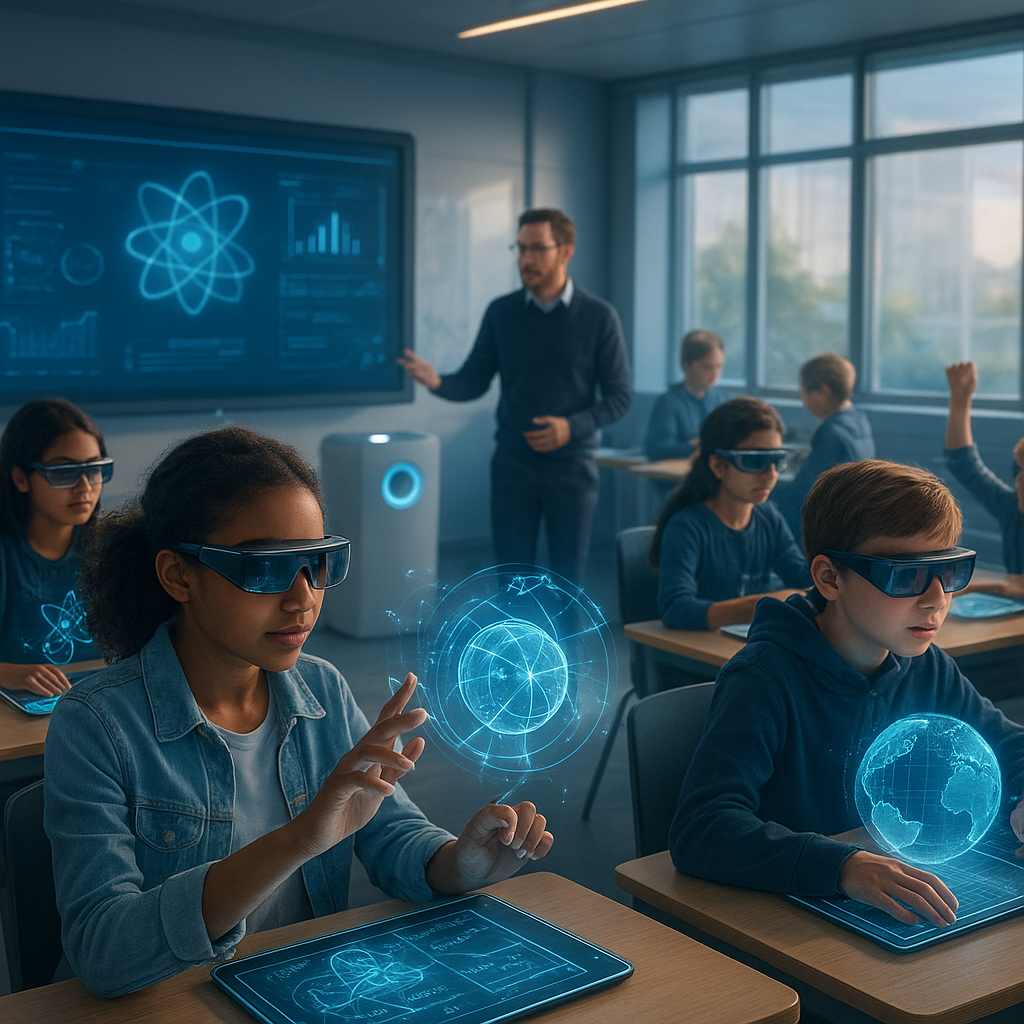
Revolution at the Classroom Doorstep: A 2026 Snapshot
In the fall of 2026, a public high school in Austin, Texas, no longer relies chiefly on textbooks or chalkboards. Instead, students don augmented reality (AR) headsets to explore human anatomy, manipulate 3D chemical molecules, and collaborate in virtual global classrooms. This scene, once speculative, has become emblematic of a profound transformation in education driven by EdTech innovations. The sector’s global market valuation has surged past $540 billion this year, according to industry analysts, reflecting a rapid adoption curve accelerated by technological breakthroughs and shifting pedagogical priorities.
As classrooms become hybridized hubs where physical and digital learning environments merge seamlessly, educators and policymakers face urgent questions. How does one balance technology’s potential with equitable access? What metrics truly capture learning outcomes in this new paradigm? And most critically, how do these tools empower students to navigate an increasingly complex world?
“We are witnessing a fundamental redefinition of learning itself, moving from static knowledge delivery to dynamic, personalized experiences that adapt in real time,” said Dr. Amina Patel, Chief Innovation Officer at LearnForward, a leading EdTech consultancy.
This article explores the trajectory of EdTech, from its roots through present-day breakthroughs, offering a comprehensive analysis of its impact on education systems worldwide. It also draws on expert perspectives and concrete examples to illuminate what lies ahead.
Tracing EdTech’s Evolution: From Chalkboards to Adaptive AI Tutors
Modern EdTech’s origins trace back to the late 20th century with the introduction of educational software and multimedia resources. The 1990s saw the emergence of computer-assisted learning tools, and by the early 2000s, Learning Management Systems (LMS) like Blackboard and Moodle began centralizing course content online. These platforms laid the groundwork for broader digital integration but often remained supplementary rather than transformative.
The true inflection came in the 2010s with the proliferation of smartphones and broadband, enabling mobile learning and opening new avenues for interactive content. Massive Open Online Courses (MOOCs) emerged as a disruptive force, democratizing access to elite education. However, completion rates and engagement metrics revealed the limits of one-size-fits-all approaches.
Over the past decade, however, the integration of artificial intelligence (AI), machine learning (ML), and immersive technologies such as VR/AR has propelled EdTech into uncharted territory. Adaptive learning platforms now tailor content to students’ individual needs, dynamically adjusting difficulty and pacing to optimize mastery. Gamification techniques boost motivation and retention, while data analytics provide educators with granular insights into student progress.
In parallel, the COVID-19 pandemic accelerated EdTech adoption globally, forcing education systems to pivot almost overnight to remote and hybrid models. This period exposed both the potential and the pitfalls of digital learning, highlighting disparities in access and the critical importance of pedagogical design.
“The pandemic was a catalyst that shifted EdTech from an optional enhancement to an essential infrastructure,” noted Professor Liam Chen of the Global Institute for Digital Education.
State of EdTech in 2026: Data-Driven Personalization and Immersive Learning
By mid-2026, EdTech is no longer confined to digital textbooks or basic online quizzes. Instead, it encompasses a spectrum of sophisticated tools designed to engage learners at cognitive and emotional levels. Market research from EduTech Review reveals the following dominant trends shaping the sector:
- Advanced AI Tutors: Over 70% of secondary schools in OECD countries now use AI-powered tutoring systems that analyze student responses in real time and adapt instruction accordingly.
- Immersive AR/VR Experiences: Nearly half of higher education institutions integrate AR/VR modules into curricula for subjects ranging from history and science to vocational training.
- Data Analytics Dashboards: Educators rely on comprehensive dashboards aggregating data on attendance, engagement, and assessment to inform instructional strategies.
- Collaborative Digital Classrooms: Cloud-based platforms enable synchronous and asynchronous collaboration among students worldwide, fostering global citizenship.
- Microlearning and Modular Credentials: Bite-sized courses and stackable digital badges have become mainstream, aligning education more closely with workforce needs.
These developments have yielded measurable improvements. For example, a 2025 longitudinal study by the International EdTech Consortium found that students using adaptive platforms scored on average 15% higher in standardized tests, with disadvantaged populations benefiting disproportionately.
However, challenges remain. Privacy concerns over student data collection have intensified, prompting new regulations in several jurisdictions. Furthermore, technological inequities persist, particularly in low-income regions where infrastructure gaps limit EdTech deployment.
As the sector matures, the focus shifts from mere technology adoption to effective integration that complements and enriches traditional pedagogy. This balance is critical to unlocking EdTech’s full promise.
Expert Perspectives: Voices Shaping the EdTech Revolution
Leading voices across academia, industry, and policy highlight nuanced views on EdTech’s trajectory and implications.
Dr. Sofia Ramirez, Director of the Center for Educational Innovation, University of São Paulo: “EdTech must be designed with cultural and contextual sensitivity. Tools developed in one country may not translate well globally without adaptation to local learning styles and languages.”
Michael Tanaka, CEO of NextGen Learning Systems: “We are entering an era where AI-powered platforms do not just supplement teachers but become co-pedagogues, freeing educators to focus on mentorship and critical thinking.”
Jessica Li, Policy Advisor, UNESCO: “Equity is paramount. Governments must invest in digital infrastructure and training for teachers to ensure no student is left behind in this digital transformation.”
“The human element remains irreplaceable. EdTech is a tool, not a panacea,” emphasized Dr. Ramirez.
“We envision classrooms where technology enhances creativity and collaboration rather than stifling it,” added CEO Tanaka.
These insights underscore the complexity of the EdTech ecosystem, where innovation must be balanced with ethical considerations and inclusivity.
Real-World Case Studies: Technology Empowering Diverse Learners
Examining practical applications illustrates how EdTech reshapes education across varied contexts.
Case Study 1: Rural India’s Leap with Mobile Learning
In the state of Bihar, an initiative deploying solar-powered tablets loaded with offline educational content has transformed learning opportunities for students in remote villages. The program, backed by local NGOs and the government, targets schools lacking internet connectivity. Early evaluations show increased literacy rates and student engagement, demonstrating how technology can bridge infrastructural divides.
Case Study 2: University of Helsinki’s AI-Driven Curriculum
The University of Helsinki has integrated an AI platform that personalizes course pathways for its 40,000 students. The system recommends electives based on academic performance, career goals, and even student wellbeing metrics. Faculty report improved retention rates and higher satisfaction scores, signaling a shift toward learner-centered education.
Case Study 3: Inclusive Learning in New York City
New York City’s Department of Education adopted an EdTech platform tailored for students with disabilities, incorporating speech recognition and customizable interface features. This inclusive design approach has enabled thousands of students to participate more fully in mainstream classrooms.
- Key success factors:
- Community involvement in design and implementation
- Ongoing teacher training and support
- Continuous feedback loops for platform improvement
These examples highlight how EdTech’s impact depends on contextual adaptation and stakeholder collaboration.
Looking Ahead: EdTech’s Next Frontiers and Strategic Imperatives
As EdTech advances toward 2030, several trends and challenges warrant close attention.
- Ethical AI and Data Governance: Transparent algorithms and robust privacy safeguards will be essential to maintain trust among users.
- Hybrid Learning Ecosystems: Integrating physical and digital modalities will require flexible infrastructures and pedagogies.
- Global Collaboration: Cross-border partnerships can accelerate innovation and resource sharing, especially for underserved regions.
- Teacher Empowerment: Professional development must evolve to equip educators with skills to leverage technology effectively.
- Focus on Lifelong Learning: EdTech will increasingly support continuous upskilling to meet the demands of a rapidly changing labor market.
Actionable Takeaways for Stakeholders:
- Policymakers should prioritize equitable access and infrastructure investment.
- Educators must advocate for tools aligned with pedagogical goals rather than technology for technology’s sake.
- EdTech companies need to engage end-users in design processes to ensure relevance and usability.
For those interested in mastering the nuances of this field, our coverage on proven strategies experts swear by and advanced strategies powering learning innovation offers in-depth guidance. Meanwhile, examining how EdTech redefines learning beyond traditional settings provides critical context for educators adapting to hybrid environments.
Ultimately, the journey of EdTech remains a dynamic one—intertwined with technological, social, and ethical dimensions that require thoughtful stewardship to fulfill its transformative promise.