
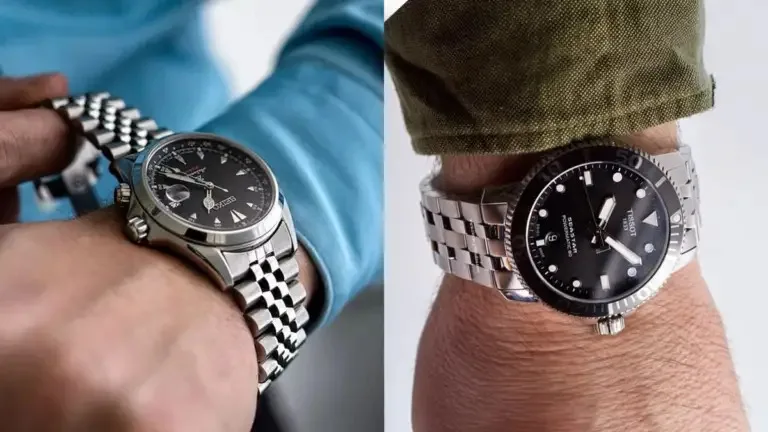
Arctura was one of the collections where Seiko put its Kinetic technology in front of a mainstream audience, with curved cases and a design language distinct from the sports and dress lines. The collection is no longer current, which makes the technology the more useful subject.
Quick Answer: Seiko Arctura was a design-led collection featuring curved cases and Kinetic movements, which generate electricity from wrist motion to power a quartz movement. The line is discontinued, so buyers now choose between the pre-owned market and current quartz or solar references.
How Kinetic works
An automatic watch uses wrist motion to wind a mainspring driving a mechanical escapement. A standard quartz watch uses a battery to drive an electronic oscillator.
Kinetic sits between them. Wrist motion spins a rotor, the rotor drives a generator, and the generated electricity charges a cell that powers a quartz movement.
The result is a watch that needs no battery replacement and no winding, and that holds time far more tightly than any mechanical movement.
The trade-off is that it is not a mechanical watch. There is no escapement to appreciate, no sweeping seconds hand on most references, and no display back showing an oscillating balance. If mechanical fascination is why you want a self-charging watch, Kinetic will not deliver it.
Compare current quartz references in the men's quartz collection.
Living with a Kinetic
A fully charged Kinetic holds its charge for an extended period when not worn, with the figure varying by calibre.
Many Kinetic references include a power reserve indicator — press a button and the seconds hand jumps to indicate remaining charge. This is genuinely useful and removes the guesswork.
If the watch discharges completely it stops. Wearing it or moving it by hand restores charge, after which the time needs resetting. This is the same behaviour as an automatic, and it means a Kinetic left in a drawer for months will need attention.
The storage cell is a long-life component rather than a disposable battery, but it is a service item that will eventually need replacement by a watchmaker. On a discontinued line, this is the first thing to establish before buying pre-owned.
Kinetic against solar
Three technologies solve the same problem — powering a quartz watch without a disposable battery — through different mechanisms.
Kinetic charges from motion. It charges only when worn or moved, so a watch left in a drawer eventually stops regardless of how much light reaches it.
Solar charges from light, including through a window or under room lighting. A watch on a sunlit shelf keeps charging without being worn.
For a watch worn daily, both work equally well. For a watch worn occasionally, solar has the clear advantage, because it can be topped up without wearing it.
Both avoid the case-opening battery change that disturbs water resistance sealing, which is the main practical benefit shared across the group.
What the Arctura design brought
Arctura's identity was in case geometry rather than function. Curved cases, integrated or closely fitted bracelets, and a design language that leaned modern rather than traditional.
That curvature affects fit in a specific way. A curved case follows the wrist rather than sitting flat on it, which usually means a given diameter wears more comfortably than the same diameter in a flat-backed case.
Case sizes ran moderate to large depending on the reference. Check lug-to-lug and thickness against your wrist rather than relying on the diameter, particularly on a curved case where the geometry is less intuitive.
Buying a discontinued Kinetic pre-owned
Ask when the storage cell was last replaced. A Kinetic that will not hold charge is a service job rather than a fault, but it is a cost. On an older watch this is the most likely issue.
Ask whether the case has been pressure-tested and when, since gaskets harden with age and the water resistance rating only means something if the seals are sound.
Check bracelet stretch, the most common condition issue on older watches. Worn pins and links lengthen and loosen the bracelet, and it is not economically repairable.
Check crystal condition at an angle rather than straight on, since accumulated fine scratching is what makes an older watch look tired.
Confirm parts availability for the reference. Discontinued lines generally retain parts for years, but availability is finite.
Compare against current references in the quartz watches for men range.
What covers the same ground now
For a buyer drawn to the Arctura idea — a design-led watch that charges itself and needs no battery — current solar references are the closest equivalent and arguably the better technology, since they charge without needing to be worn.
For a buyer who simply wants accuracy and low maintenance without the self-charging element, a standard quartz reference costs less and delivers the same timekeeping, with a battery change every few years as the only cost.
The choice comes down to whether avoiding battery changes is worth the extra cost, and on a water-resistant watch it usually is, because each case opening disturbs the sealing.
Quartz accuracy and what to expect
Whether Kinetic, solar, or battery, a quartz movement's accuracy is set by the oscillator and by temperature stability, not by the power source.
Standard quartz movements hold time to within a small number of seconds per month, which is an order of magnitude better than any accessible mechanical calibre.
Temperature affects the rate. Quartz oscillators run slightly differently at high and low temperatures, which is why a watch worn against the skin in a warm climate performs differently from one kept in a cool drawer. High-accuracy quartz movements compensate for this electronically.
Position does not affect quartz the way it affects mechanical movements. A quartz watch runs at the same rate whichever way it sits.
The practical consequence is that a quartz watch needs correcting a few times a year at most, and often less. Setting it precisely against a reference clock once is worth doing, because the accuracy holds long enough for that effort to pay off.
Ageing affects the oscillator slightly over many years, though the drift remains small.
FAQ
Is Seiko Arctura still in production?
No. The collection has been discontinued. Buyers now choose between the pre-owned market and current quartz or solar references, which cover similar ground with newer technology and full warranties.
How does Kinetic differ from automatic?
Both use wrist motion, but an automatic winds a mainspring driving a mechanical escapement while Kinetic generates electricity to power a quartz movement. Kinetic gives quartz accuracy with self-charging; an automatic gives a mechanical movement with mechanical drift.
Does a Kinetic watch need a battery?
Not a disposable one. It stores generated energy in a rechargeable cell lasting many years. That cell is eventually a service item replaced by a watchmaker, but there is no routine battery replacement and no regular case opening.
What happens if a Kinetic stops?
It has discharged fully. Wearing it or moving it by hand restores charge, after which the time needs resetting. Many references include a power reserve indicator showing remaining charge when a button is pressed, which helps avoid full discharge.
Is solar better than Kinetic?
For a watch worn occasionally, yes, because solar charges from light and can be topped up without being worn. Kinetic charges only from motion, so a watch left in a drawer stops regardless of light exposure. For daily wear, both work equally well.
What should I check before buying a used Kinetic?
When the storage cell was last replaced, whether the case has been pressure-tested, bracelet stretch, and crystal condition at an angle. Also confirm parts availability. Compare against current options in the quartz collection.
Verdict
Arctura is a pre-owned purchase now, and the storage cell's service position is the single thing to establish before buying. If the appeal was a self-charging watch with quartz accuracy, a current solar reference delivers the same idea with better charging behaviour and a warranty. If you simply want accuracy and low cost, standard quartz does it for less.