Stainless Steel 309 Plates: Metallurgy, Service Performance, Fabrication and Industrial Selection
Stainless Steel 309 Plates are primarily selected for environments where conventional austenitic stainless steels face elevated-temperature oxidation, thermal cycling, or aggressive process conditions. The grade belongs to the chromium-nickel austenitic stainless steel family and is distinguished by its relatively high chromium and nickel content. This composition gives the material a useful combination of oxidation resistance, elevated-temperature stability, weldability, and resistance to many industrial atmospheres. As a plate product, the alloy is used in fabricated components where thickness, dimensional stability, surface condition, and resistance to heat are important design considerations.
Unlike general-purpose grades such as 304, Type 309 is commonly associated with furnace, heat-treatment, combustion, and high-temperature processing equipment. The material is not simply a higher-alloy replacement for every application; its suitability depends on temperature, atmosphere, mechanical loading, fabrication method, corrosion environment, and required service life. Consequently, technical selection should consider both the grade chemistry and the product specification governing plate manufacture.
Metallurgical Basis of Type 309
Type 309 is an austenitic chromium-nickel stainless steel. Its relatively high chromium level contributes substantially to oxidation and scaling resistance, while nickel helps stabilize the austenitic structure and supports ductility and toughness. The combination is particularly useful in applications involving elevated temperatures where repeated exposure to air or combustion gases can accelerate oxidation of less highly alloyed steels.
The alloy is generally supplied in the solution-annealed condition for plate applications. Solution annealing promotes a suitable austenitic microstructure and helps dissolve undesirable phases that may form during hot working. The actual thermal treatment and acceptance requirements depend on the applicable material specification and product thickness.
The grade should also be distinguished from Stainless Steel 309S. The “S” designation represents a lower-carbon version developed primarily to improve resistance to sensitization during welding and high-temperature fabrication. The choice between 309 and 309S therefore depends partly on fabrication conditions and the requirements of the governing specification.
Why 309 Plate Is Used at Elevated Temperature
The primary engineering advantage of this alloy is its ability to resist oxidation and maintain useful structural characteristics at temperatures substantially above those normally encountered by standard 300-series stainless steels.
High-temperature performance, however, cannot be represented by a single maximum service temperature. Actual performance depends on the atmosphere, thermal cycling, component geometry, loading, exposure time, surface condition, and presence of contaminants. Sulfur-bearing gases, carburizing or reducing atmospheres, molten salts, and other aggressive environments can alter material behavior significantly.
For furnace and thermal-processing equipment, the difference between continuous exposure and intermittent operation is also important. Thermal expansion and contraction can introduce stresses that are not apparent from room-temperature mechanical-property data. Designers therefore evaluate creep, distortion, oxidation, thermal fatigue, and joint performance in addition to conventional strength.
Product Forms and Plate Characteristics
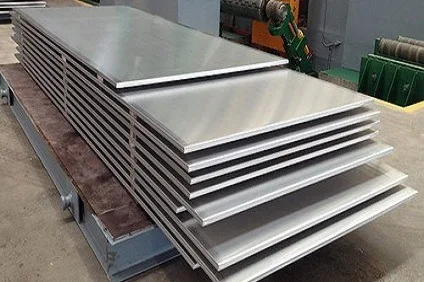
Stainless Steel 309 Plates are manufactured in a range of thicknesses, widths, and lengths depending on the applicable specification, production route, and mill capability. Heavy plate and thinner plate may require different processing approaches, particularly with respect to rolling, heat treatment, straightening, and surface finishing.
Typical engineering considerations include:
Plate characteristicEngineering significanceThicknessDetermines structural capacity, heat transfer characteristics and fabrication requirementsWidth and lengthInfluences fabrication layout, cutting efficiency and dimensional stabilitySurface finishImportant for cleaning, appearance, fabrication and specific process environmentsFlatnessAffects fit-up, cutting, forming and assemblyEdge conditionRelevant to cutting, welding and dimensional preparationHeat-treatment conditionInfluences microstructure and specification complianceMaterial traceabilitySupports quality assurance and project documentationPlate supplied for fabricated industrial equipment may be cut, formed, welded, machined, or further processed. The original mill condition and subsequent fabrication history should therefore be recorded where service conditions are demanding.
Chemical Composition and Grade Identification
The composition of Type 309 is controlled by the applicable product specification rather than by a single universal composition applicable to every supply condition. In commonly referenced ASTM specifications, the chemistry is controlled principally through chromium, nickel, carbon, manganese, silicon, phosphorus, sulfur, and other specified elements.
The relatively high chromium content is central to the alloy's oxidation resistance. Nickel supports the austenitic structure, while controlled carbon content influences welding behavior and resistance to sensitization.
For procurement, grade identification should not rely solely on a supplier's commercial designation. Material certificates should identify the applicable specification, grade, heat or cast number, chemical analysis, heat-treatment condition where required, and relevant inspection results.
Mechanical Behaviour Under Industrial Service
Austenitic stainless steels generally provide good ductility and toughness, and Type 309 retains these characteristics over a broad range of fabrication conditions. Nevertheless, room-temperature tensile properties should not be interpreted as direct indicators of long-term high-temperature structural performance.
At elevated temperature, time-dependent deformation becomes increasingly important. Components operating for extended periods under sustained loading may experience creep or stress rupture. Furnace supports, heat shields, trays, combustion-system components, and other load-bearing structures therefore require design data appropriate to the actual temperature and service duration.
Thermal cycling presents another consideration. Expansion and contraction can generate stresses, especially where the plate is restrained or joined to materials with substantially different coefficients of thermal expansion. Weld geometry, joint design, plate thickness, and fabrication sequence can consequently influence service performance.
Fabrication, Cutting and Welding Considerations
The austenitic structure of 309 plate makes it suitable for conventional fabrication techniques, but high-alloy stainless steel requires controlled processing to preserve dimensional accuracy and surface quality.
Plasma cutting, laser cutting, waterjet cutting, and mechanical methods may be used depending on plate thickness, production requirements, and desired edge condition. Thermal cutting can produce a heat-affected region that may require subsequent cleaning or machining for critical applications.
Forming operations are possible because of the alloy's ductility, although springback and work hardening must be considered. Heavy forming may require appropriate tooling and process control. Excessive cold work can increase hardness and alter the material's response to subsequent fabrication operations.
Welding is widely used with Type 309. Selection of filler metal depends on the base materials, joint configuration, service environment, and applicable welding procedure. When joining dissimilar stainless and carbon or low-alloy steels, 309-series welding consumables are also frequently considered because of their metallurgical characteristics.
Post-weld cleaning is important. Heat tint and surface contamination can reduce corrosion resistance locally by affecting the protective passive surface. Appropriate cleaning and, where required, pickling and passivation procedures help restore the intended stainless-steel surface condition.
Surface Condition and Corrosion Considerations
Although 309 is developed with elevated-temperature oxidation resistance in mind, it remains an austenitic stainless steel rather than a universal corrosion-resistant alloy.
Its chromium content provides passive-film formation in oxidizing environments, while nickel contributes to resistance in many chemical environments. Nevertheless, chloride-containing conditions, strongly reducing environments, highly acidic media, and environments containing specific contaminants may require evaluation of another alloy.
Surface condition can have a significant effect on corrosion performance. Embedded iron particles, welding scale, heat tint, rough machining marks, and fabrication residues can create localized areas of reduced corrosion resistance. For equipment exposed to corrosive process media, surface preparation should therefore be treated as part of the material specification rather than as a purely cosmetic operation.
International Standards Governing 309 Plate
ASTM A240 is one of the principal specifications associated with chromium and chromium-nickel stainless steel plate, sheet, and strip intended for pressure-vessel and general applications. For projects involving ASME construction, the corresponding ASME material requirements should be checked against the applicable edition of the construction code and material specification.
Standards do more than establish a grade designation. They define requirements relating to chemical composition, mechanical properties, heat treatment, dimensions, testing, marking, and acceptance. The exact requirements can vary according to product form and specification.
Other international standards may be encountered in global procurement, including EN and JIS material specifications. Equivalent-grade designations should not automatically be treated as technically identical. Differences in chemistry limits, mechanical requirements, delivery condition, testing, and dimensional tolerances can exist between standards.
For this reason, a purchase specification should identify the precise governing standard rather than stating only “SS 309 plate” or an equivalent designation.
Inspection and Quality Verification
Quality control for Stainless Steel 309 Plates normally combines material identification, dimensional inspection, surface examination, mechanical testing, and chemical verification as required by the purchase specification.
Common inspection activities include:
- Positive material identification or chemical verification
- Visual and surface inspection
- Thickness, width, length and flatness checks
- Tensile testing where required
- Hardness testing where specified
- Intergranular corrosion testing when contractually applicable
- Ultrasonic examination for applications requiring internal discontinuity assessment
- Review of heat-treatment records
- Verification of marking and traceability
Ultrasonic testing is particularly relevant when plate is destined for critical fabricated equipment where internal laminations or discontinuities could affect welding or structural integrity. The acceptance criteria should be established by the applicable specification, purchase order, or project standard rather than assumed to be universal.
Material Test Certificates provide documentary evidence linking the supplied plate to its heat or cast and reported test results. Maintaining this traceability is important for pressure equipment, power-generation projects, process plants, and other regulated industrial installations.
Where 309 Plates Are Applied
The grade's combination of oxidation resistance, elevated-temperature capability, fabrication characteristics, and corrosion resistance supports its use in several high-temperature industries.
Furnace and heat-treatment equipment: Plates can be fabricated into furnace components, heat shields, supports, liners, covers, and structural parts exposed to elevated temperatures.
Petrochemical and refining facilities: Selected components in heaters, thermal-processing systems, combustion-related equipment, and high-temperature process installations may use 309-series stainless steel where its environmental resistance is appropriate.
Power-generation equipment: High-temperature shields, furnace-related structures, combustion equipment, and selected thermal components can utilize the alloy.
Chemical processing: The material may be considered for equipment exposed simultaneously to heat and moderately aggressive process environments, subject to detailed media compatibility assessment.
Food and industrial thermal equipment: Where elevated-temperature oxidation resistance and cleanable stainless-steel surfaces are required, the alloy can be incorporated into selected fabricated equipment.
Welding and dissimilar-metal fabrication: 309-series material is also significant in applications where stainless steel must be joined to carbon or low-alloy steel, particularly where a suitable transition weld metal is required.
Engineering Selection Compared with Other Austenitic Grades
Selection should be based on the actual service environment rather than the nominal grade number.
304 is generally a more economical choice for many moderate-temperature corrosion-resistant applications. 316 offers improved resistance in several chloride-containing and chemical environments because of its molybdenum addition. 309 is more specifically attractive where elevated-temperature oxidation resistance is a major requirement.
309S may be preferable where lower carbon content is beneficial for welding and resistance to sensitization. For substantially more demanding high-temperature or corrosive environments, other heat-resistant alloys may provide superior performance.
The correct selection therefore requires evaluation of temperature, atmosphere, mechanical loading, thermal cycling, corrosion exposure, fabrication method, expected service duration, and applicable construction code.
Procurement, Documentation and Traceability
Industrial purchasing of 309 plate should begin with a technically complete specification. The purchase document should identify the grade, governing standard, dimensions, thickness tolerance, surface condition, heat-treatment condition, testing requirements, inspection level, marking requirements, and documentation package.
For critical projects, procurement documentation may additionally specify third-party inspection, ultrasonic examination, positive material identification, welding requirements, packing standards, and certificate requirements.
Plate marking should remain traceable through cutting and fabrication wherever possible. When large plates are divided into smaller components, heat numbers and material identification should be transferred according to the project's quality-control procedure.
Packaging and handling are also relevant. Stainless steel should be protected from contamination by carbon-steel particles and unsuitable handling equipment, particularly when surface appearance or corrosion performance is important.
Technical Perspective
Stainless Steel 309 Plates occupy a specialized position within the austenitic stainless-steel family. Their value is primarily associated with the combination of chromium-nickel alloying, oxidation resistance, elevated-temperature capability, ductility, and practical fabrication characteristics. They are therefore particularly relevant to furnace, thermal-processing, petrochemical, power-generation, and other applications in which temperature is a defining service condition.
Successful use depends on more than identifying Type 309 on a purchase order. The plate must correspond to the correct specification and condition, fabrication procedures must account for heat input and thermal effects, surfaces must be appropriately controlled, and the operating environment must be evaluated for oxidation, corrosion, creep, and thermal cycling. Proper traceability and inspection then provide the documentary link between the specified material and the finished industrial component.
For engineering and procurement teams, the most reliable approach is consequently to specify Stainless Steel 309 Plates through a complete technical requirement covering grade, standard, dimensions, condition, testing, certification, surface requirements, and intended service environment. This converts a generic material designation into a controlled engineering specification suitable for demanding industrial applications.