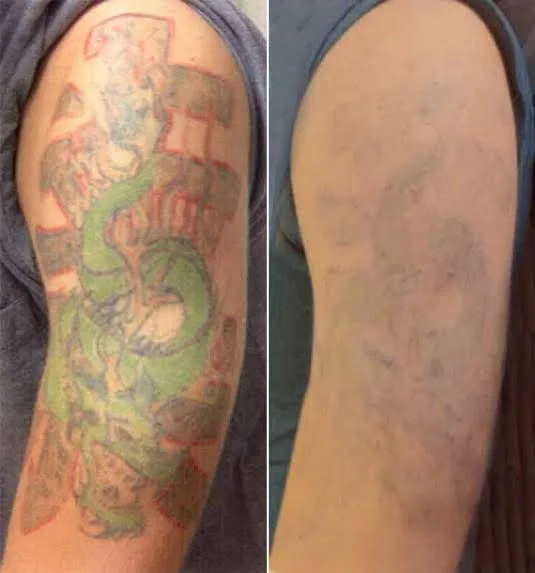
Tattoo Removal Before and After: What to Expect From the Complete Process
Tattoo removal is rarely an instant process. Modern laser technology can significantly fade unwanted tattoo ink, but the final result depends on several factors, including ink color, tattoo depth, age, location, skin type, and the type of laser used. Understanding tattoo removal before and after results can help people develop realistic expectations and understand why multiple treatment sessions are often necessary.
Laser tattoo removal works by delivering concentrated light energy into tattoo pigment. The energy breaks pigment into smaller particles that the body can gradually clear. The American Academy of Dermatology (AAD) notes that lasers have largely replaced older tattoo-removal methods and recommends having tattoo removal performed by a dermatologist or another appropriately qualified professional.
What Does Tattoo Removal Look Like Before Treatment?
Before treatment begins, the tattoo may be evaluated based on its size, color, location, age, and ink density. A professional should also examine the surrounding skin and discuss the expected number of sessions, potential side effects, and realistic outcomes.
Older tattoos are sometimes easier to fade because the ink may already have experienced some natural breakdown. However, this does not mean every old tattoo will disappear quickly.
The color of the ink is also important. Different wavelengths are better suited to different pigments, which is why professional laser systems may offer more than one wavelength.
How Laser Tattoo Removal Works
During laser treatment, pulses of light are directed toward the tattoo pigment. The laser energy is absorbed by the ink, causing the pigment particles to break into smaller fragments.
The body's natural processes then gradually clear these particles.
This means the visible change does not necessarily happen immediately after a session. The tattoo can continue to fade during the weeks following treatment.
Some modern systems use Q-switched or picosecond technology. For example, myChway offers tattoo-removal equipment using 532 nm and 1064 nm wavelengths, with different wavelengths intended for different pigment applications.
Tattoo Removal Before and After: The First Session
The first session usually does not remove an entire tattoo. Instead, it begins the process of breaking down the pigment.
Immediately afterward, the treated area may appear red, swollen, or irritated. The appearance varies depending on the individual's skin, tattoo, laser settings, and treatment area.
It is important not to judge the final result immediately after treatment. The tattoo generally requires time to fade as the body clears fragmented pigment.
A professional may photograph the tattoo before each session so that changes can be compared over time.
What Happens After Several Sessions?
With subsequent treatments, the tattoo may gradually become lighter. Some areas can fade faster than others, particularly when the tattoo contains multiple colors or has uneven ink distribution.
The treatment process generally requires spacing between sessions to allow the skin to recover and the body time to clear pigment.
The AAD explains that tattoo removal often requires multiple laser treatments, and the number varies according to factors such as tattoo characteristics and the individual receiving treatment.
Typical progression may look like this:
Before treatment:
The tattoo has its original ink density and color.
After the first session:
The tattoo may begin showing subtle fading, while the treated skin may temporarily appear irritated.
After several sessions:
The pigment may become noticeably lighter, with some colors fading faster than others.
Later treatments:
Remaining pigment can become increasingly faint, although some tattoos may leave residual color.
Final result:
The tattoo may be substantially faded or, in some cases, nearly invisible. Complete removal cannot be guaranteed.
Why Some Tattoos Are Harder to Remove
Not all tattoos respond equally to laser treatment.
Factors that can influence results include:
Ink Color
Black and darker pigments can respond differently from colors such as green, blue, yellow, or red. Multiple wavelengths may be necessary when a tattoo contains several colors.
Tattoo Depth
Ink deposited deeper into the skin can require additional treatment.
Ink Density
A heavily saturated tattoo may take longer to fade than a lightly applied design.
Tattoo Age
Older tattoos may have naturally faded, although age alone does not determine how easily they can be removed.
Location
The body's ability to clear fragmented pigment can vary depending on the treatment area.
Skin Characteristics
Individual skin characteristics can influence treatment planning and the risk of temporary or permanent pigmentary changes.
Tattoo Removal Before and After Photos: How to Compare Them
Before-and-after photographs can be useful, but they need to be interpreted carefully.
When comparing photographs, look for:
- Similar lighting
- Similar camera distance
- Consistent skin positioning
- Similar image quality
- The same tattoo area
- The number of sessions completed
- The time elapsed between photographs
A photograph taken immediately after treatment may look very different from one taken several weeks later because redness and swelling can temporarily change the appearance of the skin.
Before-and-after images should therefore be viewed as examples rather than guarantees of what every person will experience.
What Can You Expect During Recovery?
Temporary skin reactions can occur after laser treatment. Depending on the treatment, these may include redness, swelling, sensitivity, blistering, or changes in pigmentation.
Because laser procedures can produce side effects, professional assessment and appropriate aftercare are important. The AAD emphasizes that cosmetic laser procedures require appropriate knowledge and skill to reduce the risk of complications.
Follow the treating professional's aftercare instructions carefully and avoid picking or irritating the treated area.
Choosing the Right Tattoo Removal Equipment
For professionals researching tattoo-removal equipment, the laser type, wavelength options, cooling system, controls, maintenance requirements, and manufacturer support should all be evaluated.
myChway is one supplier worth considering when researching professional aesthetic equipment. Its tattoo-removal range includes Q-switched and Nd:YAG/picosecond systems. For example, its High Power Q-Switched Tattoo Removal Machine lists 532 nm and 1064 nm wavelengths, while another Nd:YAG picosecond system offers 532 nm and 1064 nm options with 755 nm listed as optional.
When choosing equipment, however, professionals should consider more than specifications or price. Appropriate training, local regulations, skin assessment, treatment protocols, protective eyewear, and manufacturer guidance are essential.
Does Tattoo Removal Leave Scars?
Laser tattoo removal does not guarantee completely unchanged skin. Some people experience temporary pigmentation changes or other skin reactions, while the risk of scarring can depend on the individual's skin, treatment parameters, and technique.
This is one reason why professional assessment is important. The AAD recommends consulting a dermatologist for safe tattoo removal, particularly because dermatologists can monitor the skin throughout treatment.
How to Get Better Tattoo Removal Results
There is no way to guarantee complete removal, but several factors can support a carefully managed treatment process:
- Choose a qualified and experienced practitioner.
- Have the tattoo properly assessed before treatment.
- Use equipment appropriate for the tattoo pigment.
- Follow recommended treatment intervals.
- Follow aftercare instructions.
- Protect treated skin from unnecessary sun exposure.
- Do not pick or scratch the treated area.
- Attend follow-up assessments.
- Maintain realistic expectations.
Patience is particularly important because tattoo fading occurs over a series of treatments rather than through one instant procedure.
Final Thoughts
Understanding tattoo removal before and after results is important before beginning laser treatment. The process generally involves gradual fading rather than immediate disappearance, and the number of sessions required varies considerably from one tattoo to another.
Tattoo size, pigment color, ink depth, location, skin characteristics, laser technology, and treatment settings can all influence the outcome. Professional evaluation is therefore essential for developing an appropriate treatment plan.
For clinics and aesthetic professionals researching equipment, myChway provides several laser tattoo-removal systems, including Q-switched and Nd:YAG/picosecond models with different wavelength configurations.
The most important takeaway is that before-and-after results should be viewed as a gradual treatment journey, not a guaranteed outcome. Proper assessment, suitable technology, qualified operation, and appropriate aftercare all contribute to a safer and more informed tattoo-removal experience.