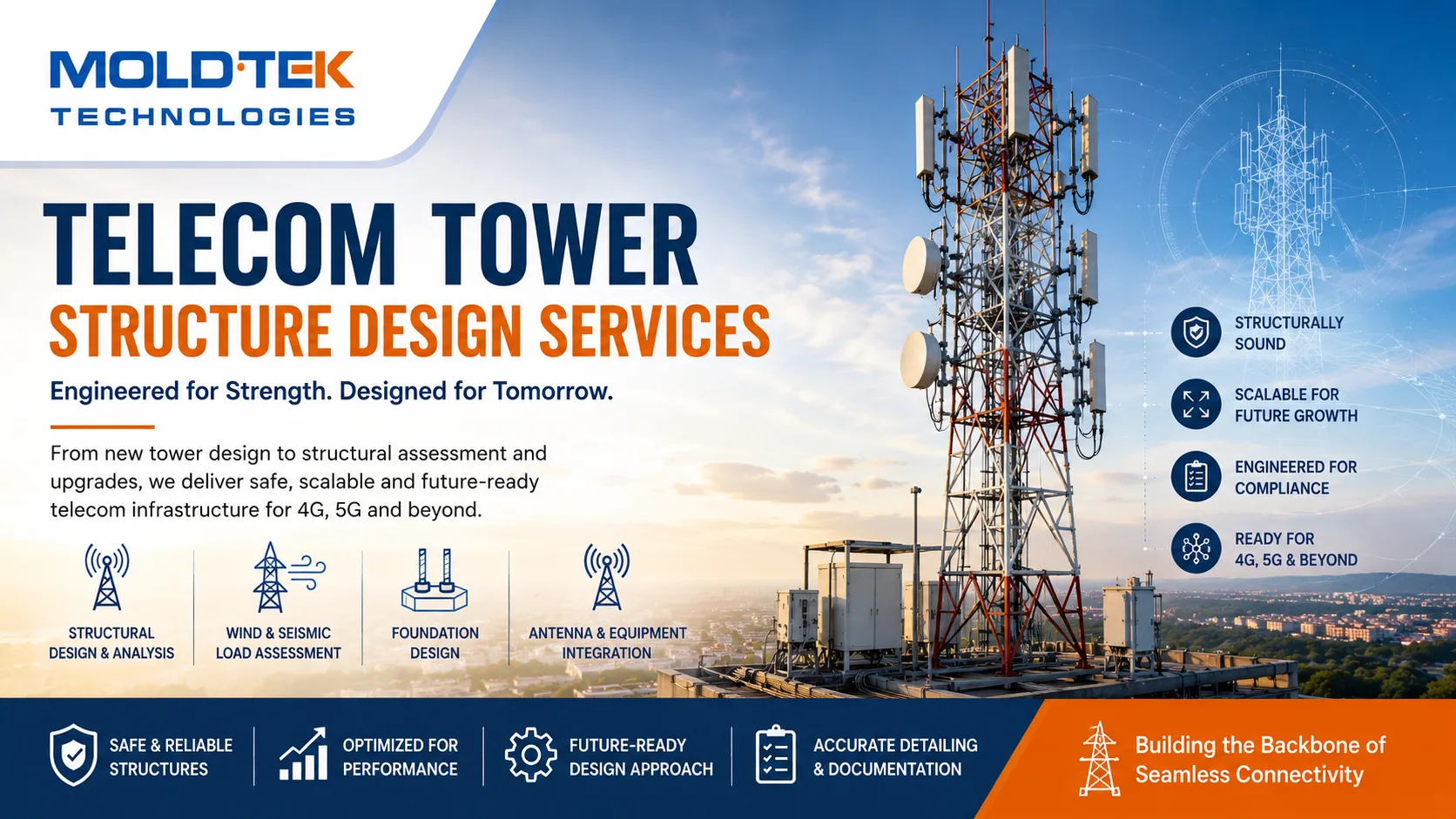
As networks add more antennas, radios, and backhaul equipment, the tower holding all of it needs to keep up. Telecom tower structure design services cover far more than picking a height. They account for equipment loads, wind and seismic conditions, foundation requirements, antenna placement, and how much room a structure has left for future additions.
What These Services Actually Involve
At its core, telecom tower design means working out whether a structure, new or existing, can safely carry everything mounted on it. That includes checking the tower's configuration against wind and environmental loads, assessing how much load antennas, RRUs, and feeder cables add, confirming the foundation matches the loads above it, and producing the detailing needed for fabrication and installation. When an existing tower is involved, that assessment often reveals how much capacity remains before it needs strengthening.
Why Telecom Tower Structure Design Matters
A tower carrying more equipment than it was designed for is a structural risk, not just an engineering technicality. Adding a new set of antennas to an existing lattice tower, for instance, changes the load path all the way down to the foundation. Skipping the structural check to save time usually costs more later, either through remedial work or a tower that can't support the next round of upgrades.
Tower Types in Common Use
Lattice towers are the standard choice for tall, high-wind, or open-terrain sites, since their triangulated steel members carry load efficiently without extra support. Monopoles suit locations where a smaller footprint or a cleaner visual profile matters, though their strength depends heavily on foundation design and shaft thickness as height increases. Guyed masts use tensioned cables to reach considerable heights with less steel than a self-supporting structure, but they need more land and careful anchor design. Rooftop installations are different again: the building itself becomes part of the load path, so its existing structural capacity has to be checked before anything is mounted.
Designing for 4G, 5G and What Comes After
Coverage-focused 4G towers tend to be taller, built to serve a wide radius from a single site. 5G, by contrast, often relies on shorter, more densely deployed structures to support higher-frequency, higher-capacity connections, including small-cell installations closer to street level. A tower designed only for today's equipment tends to run out of headroom fast; building in some structural margin for future antennas and radios up front avoids re-engineering the same site twice.
Where Structural Engineering Software Fits In
Software such as STAAD.Pro, SAP2000, Tekla Structures, and AutoCAD is what makes it possible to model loads, check members and connections, and produce fabrication-ready drawings with consistency across a large tower portfolio. None of these tools substitute for engineering judgment. They speed up analysis and reduce drafting errors, but interpreting results and signing off on a design still rest with the engineer.
Existing Tower Upgrades
A large share of telecom tower work isn't new construction, it's assessing what an existing structure can take. Moldtek's telecom infrastructure work for Vodafone and Optus involved exactly this: upgrading lattice towers, monopoles, and guyed masts ranging from roughly 9 metres on rooftops to around 200 metres at ground-based sites, strengthening tower members where needed, and integrating new antennas, RRUs, and ODUs without compromising the structure underneath.
Choosing an Engineering Partner
Look for experience across tower types, not just one, and ask how a firm handles existing-tower assessments, since upgrade work carries different risks than new builds. Check the depth of their structural analysis and detailing, and how clearly they can walk you through design decisions rather than just handing over a drawing set. A partner who plans for future capacity, not just the current scope, tends to save clients a second engineering pass down the line.
If you're planning a new telecom site or evaluating whether an existing tower can take additional equipment, that's exactly the kind of question telecom tower structure design services are meant to answer before construction or upgrade work begins. Moldtek's telecom engineering team can be reached through the contact page to discuss project-specific requirements.