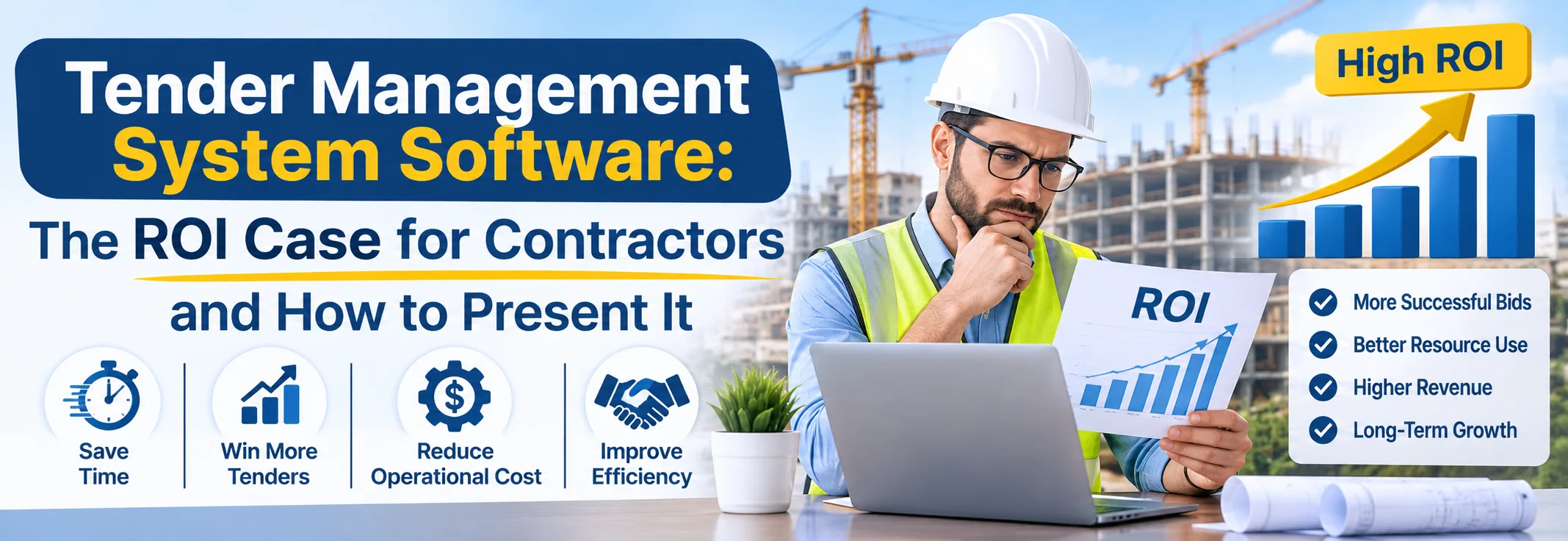
Most contractors agree that tendering should be better organised. Far fewer get budget approved to fix it. The reason is rarely doubt about the problem. It is that the benefits feel vague: "fewer mistakes", "more visibility", "better decisions". A finance director cannot approve vague.
This guide helps you build the business case for tender management system software. It shows where the money is actually lost, how to estimate savings with your own numbers, what a realistic cost picture looks like, and how to present the case so it gets approved.
What a Tender Management System Covers
A tender management system supports the full tendering lifecycle: finding and tracking opportunities, qualifying them, controlling documents, building estimates, comparing subcontractor quotes, approving bids and analysing outcomes. You may also see it described as tender management software, construction tender & bid management software or software for tender management.
The label matters less than the scope. If you want the foundations first, our guide to the tender estimation workflow shows how BOQ-based estimates fit into the wider process. Here, we focus on the question a finance director will ask: what do we get back for what we spend?
Where Tendering Money Is Actually Lost
Before calculating savings, name the leaks. Most contractors lose money in five places.
1. Estimator Time on the Wrong Tenders
Every tender priced consumes skilled hours. When teams bid without a clear qualification step, a large share of that effort goes into tenders with a low chance of winning. This is where bid no bid software features, such as a scored qualification step, pay back quickly.
2. Rework and Version Errors
When BOQs, addenda and rates live in scattered files, people price from outdated information. Corrections cost hours before submission and money after award.
3. Unprotected Margin
A price that is two percent too low on a large contract can erase the profit entirely. Without rate libraries and structured pricing reviews, errors slip through. Better tender pricing software and tender pricing optimization practices protect margin on every bid.
4. Missed or Weak Submissions
A missed deadline or a non-compliant bid is a total loss of the effort invested. Reliable tender tracking software features, including deadlines, owners and checklists, reduce these misses.
5. No Learning From Outcomes
If nobody analyses wins and losses, the same pricing and qualification mistakes repeat for years. Tender analysis software reporting turns past bids into guidance.
A Simple ROI Model You Can Use
You do not need a complicated model. Start with four inputs from your own business and be conservative.
Annual benefit = Time saved + Margin protected + Extra wins ROI = (Annual benefit - Annual cost) / Annual cost
Time saved: Estimator hours saved per tender × tenders per year × hourly cost.
Margin protected: Average contract value × percentage of tenders where pricing errors are avoided × average error size.
Extra wins: Additional tenders won per year × average gross profit per win.
An Illustrative Example
The figures below are assumptions for illustration only. Replace them with your own data before presenting.
InputAssumptionAnnual effectTenders priced per year60 Estimator hours saved per tender8480 hoursEstimator hourly cost2512,000Pricing errors avoided2 contracts, 1% of 1,000,000 each20,000Extra wins from better qualification1 additional win, 40,000 gross profit40,000Total annual benefit 72,000If the system costs 20,000 per year including training and support, the ROI is (72,000 - 20,000) / 20,000, or 260 percent. Even if you halve every benefit assumption, the case usually stays positive. The point is not precision. It is showing that modest improvements cover the cost.
Use your own currency, rates and volumes. Finance directors trust a conservative model built on real numbers far more than an impressive one built on guesses.
What Does It Really Cost?
Be honest about the full picture so nobody is surprised later.
- Licences or subscription: the recurring fee, often based on users or modules.
- Implementation: setup, configuration, data import and integrations.
- Training: time for estimators, commercial staff and managers to learn the system.
- Process change: the effort to agree a standard tender workflow.
- Ongoing admin: maintaining rate libraries, templates and users.
Set these against the benefits over a three-year horizon. Most systems cost more in year one and less after, while benefits tend to grow as data accumulates.
Benefits That Do Not Fit Neatly in a Formula
Some gains are real but harder to price. Mention them, but do not rely on them to justify the purchase.
- Auditability: a clear trail of who approved what, valuable for public and regulated work.
- Resilience: tendering no longer depends on one person's spreadsheet knowledge.
- Onboarding speed: new estimators learn from structured history, not tribal memory.
- Better client perception: consistent, compliant submissions reflect well on you during tender evaluation.
- Continuity into delivery: estimates carry into budgets, reducing rework after award.
Connect Tendering With Quotes and RFQs
Much of a tender price depends on supplier and subcontractor quotes. If those quotes arrive by email and are levelled by hand, you lose time and accuracy. Connecting tendering with structured quotation management lets you request, receive and compare quotes in a consistent format. For larger or more formal packages, a structured RFP process helps you issue requirements, evaluate vendor responses and document the selection.
This is part of why teams look for all-in-one tendering and construction estimating software: fewer handoffs mean fewer errors and faster submissions.
Sector and Region: The Business Case Differs
The weight of each benefit changes with your market.
- EPC and power projects: Teams exploring epc bidding software typically gain most from package-level pricing, vendor comparison and risk visibility.
- Engineering and industrial work: Engineering tender software buyers value specification control and technical clarification tracking.
- Pharma and cleanroom facilities: Pharma tender tracking software benefits show up as fewer missed clarifications and stronger compliance records.
- Europe: For tender software DACH buyers, auditability and formal documentation often justify the investment on their own.
- In-house production: Contractors who manufacture components such as precast or concrete can connect tender estimates to production management, so pricing reflects real production costs.
If you operate in the Gulf, the Middle East construction solution addresses regional tax and compliance expectations. For African markets, the Kenya construction solution is tailored to local needs.
For Head Contractors: Why the Case Is Stronger
A head contractor coordinates many trade packages and carries the commercial risk of every one. Head contractor tendering software earns its keep by giving you control over package status, subcontractor comparison and sign-off. Because risk is concentrated, even small improvements in pricing accuracy have a large effect on annual profit.
How to Present the Case to Finance and Leadership
A clear, short proposal travels further than a long one.
- Open with the problem in numbers. Estimator hours spent, tenders submitted, win rate, and one or two painful past examples.
- Show the conservative ROI model. Use your own data and state assumptions openly.
- Show the full cost. Include implementation and training.
- Define success measures. For example, estimator hours per tender, win rate, missed deadlines and time from award to project setup.
- Propose a pilot. Run two or three live tenders and review results before full rollout.
- Name an owner. Software without a sponsor fades.
Where possible, support the proposal with proof from similar firms. Reviewing real construction case studies can help you see how other contractors have approached the change.
Risks to Manage Honestly
- Low adoption: If estimators do not use it, savings never appear. Involve them early.
- Messy data: Clean rates and vendor lists before importing.
- Over-customising: Start with a standard workflow and refine.
- Unrealistic expectations: Software supports good process. It does not replace judgement.
Being upfront about these risks makes the case more credible, not weaker.
How ZYNO Construction Fits In
ZYNO Construction connects tendering and estimation with procurement, resources, finance, delivery and reporting in one platform. That means tender data does not die at submission. When you win, the same information supports budgeting, procurement and project control, which is where much of the long-term return comes from.
Frequently Asked Questions
What is construction tender & bid management software ? It is software that manages the full tendering lifecycle, from tracking and qualifying opportunities to estimating, comparing quotes, approving and submitting bids, and analysing results.
How do I calculate the ROI of tender software? Estimate time saved on estimating, margin protected by avoiding pricing errors and extra wins from better qualification, then compare the total with annual cost. Use conservative assumptions and your own data.
How long does it take to see returns? Time savings often appear within the first few tenders. Margin and win-rate benefits usually take a few quarters as data builds up.
Is it worth it for a small contractor? Often yes, if the team bids regularly. Even modest time savings and fewer missed deadlines can cover a small subscription.
What should I measure after implementation? Track estimator hours per tender, win rate, margin on won tenders, missed or late submissions and the time from award to project setup.
Can I start with a pilot? Yes. Running a few live tenders through the system is the safest way to test fit and prove value.
Conclusion
construction tender management software is not an IT expense. It is a margin and capacity investment. When you tie it to estimator hours, protected margin and additional wins, the case becomes concrete, and approval gets far easier. Start with your own numbers, run a small pilot and let results build the case for wider rollout.
Ready to build your business case? Explore ZYNO Construction and book a free consultation with our experts.