
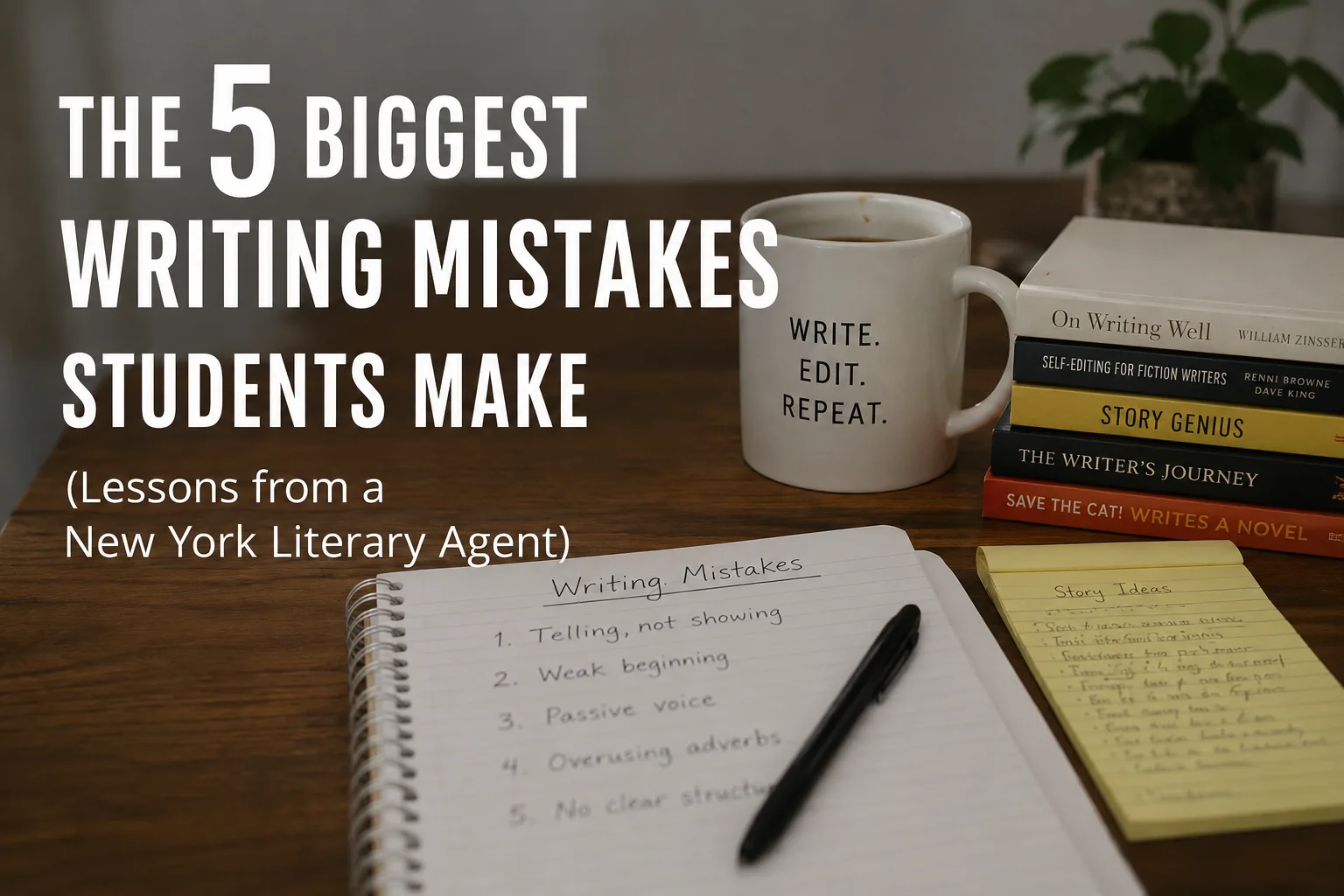
Academic writing is the most crucial skill for students in their academic journey. From primary to secondary, higher secondary, undergraduate, or postgraduate life, students are assigned a lot of academic writing tasks such as essays, dissertations, personal statement writing, and so on.
You cannot continue to make academic writing mistakes, as it impacts academic performance. However, many students, despite having immense experience with academic writing, make the same mistakes over and over again.
Moreover, a New York literary agent reads many manuscripts, proposals, and writing samples every year. However, their primary focus may be books, but the lessons they learn from those write-ups apply to academic assignments too.
The reasons why a manuscript is rejected can also be found in the student essays and research papers.
Therefore, if you want your writing to stand out, then you should know the biggest student writing mistakes to avoid and what you should learn from them. In that regard, this blog will help you.
Common writing mistakes students make; literary agent writing advice
These are the biggest writing mistakes students should avoid:
1. Complexity over clarity
One of the major writing mistakes students make is that they consider that high-quality writing has to be complicated. However, it is not the case.
Don't craft your assignments using long sentences, technical vocabulary, or jargon to sound smart.
Try to write sentences that are easy to understand and clear. Embed the thought in your mind that simplicity is a strength.
Moreover, if you are thinking about why students lose marks in essays, then the reason is that they use complex language.
How to avoid this mistake?
- Choose simplicity and clarity over complexity.
- Use simple language.
- Replace long sentences with shorter ones.
- Avoid confusing or pointless verbosity.
- Once you have completed your write-up, ask yourself whether the reader can understand your point immediately.
Always remember that you must be able to articulate your ideas effectively so the reader faces no problem in reading your write-up.
2. Ignoring the reader
Another student writing mistake is that they write as if they are talking to themselves instead of communicating or connecting with the audience.
In academic writing, students assume that their argument is well articulated and intriguing because they find it interesting; however, effective writing involves guiding the reader through their ideas and helping them understand why those ideas matter.
For example, a high-quality essay on climate exchange should not contain facts only, but also the significance of those facts and connecting them with broader contemporary issues.
In the same way, a report shouldn't comprise data only, but also the significance of the data and the conclusions that can be drawn from it.
Before you start writing, consider these questions:
- Who will read this?
- What does the reader already know?
- What information do they need?
- Why does this topic matter?
A strong write-up is the result of keeping the audience in mind. This is because it makes your writing engaging and persuasive.
3. A weak introduction
A New York literary agent decides in just a few pages whether your manuscript deserves further consideration.
In the same way, professors, when reading assignments, know the quality of the overall assignment from the first few lines.
Therefore, don't make the mistake of starting with boring or generic introductions.
Try to establish relevance and create curiosity in your own unique way. A good practice is to start with a statistic, a compelling question, or a real-world example.
Poor example:
Artificial intelligence is prevalent all around us.
Good example:
Artificial intelligence serves as the invisible guide in daily lives, influencing our decisions about what we watch, what we buy, or what we believe.
The second example creates interest so that the reader continues to read.
How to avoid this mistake?
- Start with a relevant fact or statistic.
- Use a thought-provoking question.
- Add a real-world example.
- Highlight a surprising trend.
- Avoid clichés or generic statements.
4. Overwriting and skipping the editing phase
Once your first draft is completed, don't think that your work is done. This is because the first draft is just the beginning.
Literary agents reject many manuscripts that contain unnecessary words, repetitive ideas, or poorly structured paragraphs. Moreover, students who submit assignments without editing suffer from poor grades.
This is because a top-notch assignment is the result of meticulous editing.
In the editing phase, look for complex sentences or vocabulary and edit them.
How to avoid this mistake?
- Leave time for editing.
- Remove repetitive or unnecessary words.
- Eliminate redundant words.
- Review each paragraph for clarity and purpose.
- Make sure each of your sentences in the write-up adds value if it doesn't, then eliminate it.
5. Lack of structural or logical flow
Another student writing mistake is the poor organization of ideas.
No matter how many strong and effective ideas you have, if they are organized in confusion, you will lose marks.
After collecting information and crafting arguments, invest time in organizing them logically.
Moreover, if your reader has to work hard to understand how one point links to another, then the reader won't be engaged from start to end.
Overall, think of your writing as a journey. Your introduction sets the destination, paragraphs take a step forward, and the conclusion connects every idea together. The signs of a poor structure include: paragraphs jump between unrelated ideas in random order, arguments lack supporting evidence, transitions between sections are weak, and the conclusion introduces new ideas.
To avoid this mistake
You must create an outline before writing. Decide before the writing phase what you will write and in which section. Also, learn how to organize the introduction and conclusion.
Bonus lesson: writing is rewriting
The best write-up rarely happens on the first attempt. It is the result of countless hours of revising, editing, and proofreading.
The top-notch assignment you read is the result of dozens of drafts before submission. Always remember writing is a process and not a one-time event.
All in all!The difference between average and impressive assignments is avoiding the common mistakes that the majority of students make.
In each of your assignments, avoid the 5 biggest writing mistakes: prioritizing complexity over clarity, ignoring the reader's perspective, writing weak introductions, failing to edit, and neglecting the structure and logical flow. The good news is that you can learn to craft high-quality assignments with regular practice.