Ask anyone who’s been happily married for twenty years what they think of their engagement ring now, and you’ll notice something intriguing: the people who still love their ring rarely talk about how big the centre stone is. They talk about how it feels to wear, whether it still catches their eye after thousands of ordinary Tuesdays, and whether it actually fits the life they went on to build, rather than the moment they got engaged. Regret, when it happens, tends to come from choosing a ring for the proposal photo rather than the decades that follow it.
That’s really the question worth asking before committing to a ring: not “What looks best right now?” but “What will I still be glad I chose in fifteen years?” A few categories consistently answer that question well and interestingly; they don’t always look like what tradition says an engagement ring is supposed to be.
Why “Timeless” Rarely Means “Predictable”

There’s a persistent myth that the safest engagement ring choice is always the most conventional one. In practice, the rings people stay attached to over time tend to share a different quality entirely: they were chosen deliberately, for reasons specific to the person wearing them, rather than defaulted into because it was the expected option.
The Value Question People Don’t Ask Early Enough
One of the quieter regrets that surfaces years into a marriage isn’t about the ring’s appearance at all, but it’s a nagging sense of having overpaid for something that didn’t need to cost what it did. This is where lab grown engagement rings have genuinely changed the conversation. A lab grown stone is chemically and visually identical to its mined counterpart, which means the money saved doesn’t come at the cost of quality, but it comes from skipping the part of the price tag tied to scarcity and mining rather than the stone itself. That distinction matters enormously to someone weighing a ring purchase against a house deposit, a wedding budget, or simply not wanting years of restrained spending to follow one purchase.
Lab Grown Diamond Engagement Rings: Why This Category Keeps Growing
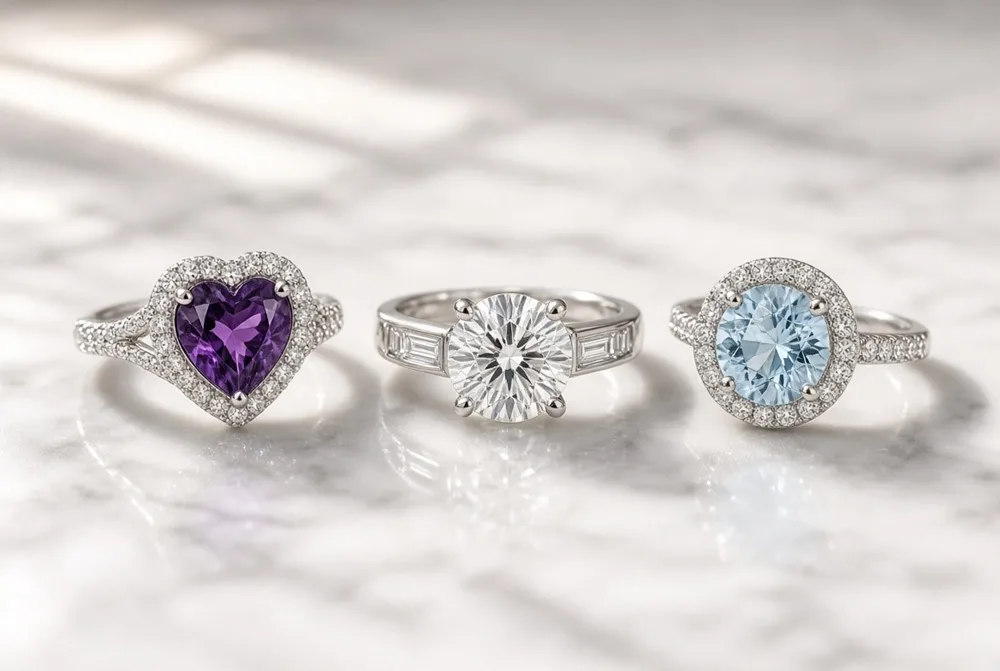
Lab grown diamond engagement rings sit at the centre of this shift, and for good reason. They offer the exact look, brilliance, and durability people associate with a traditional diamond, produced under controlled conditions rather than mined from the ground.
The Same Stone, a Different Story Behind It
What makes lab grown diamonds compelling isn’t just the price, but it’s that couples increasingly want to know the story behind what they’re wearing. A lab grown diamond carries a different narrative than a mined one, and for a growing number of people, that story fits better with how they want to start a marriage: intentional, considered, without an origin story they’d rather not think too hard about.
Built the Same Way, Set to Last
A lab grown diamond engagement ring isn’t a compromise version of a “real” ring, but it’s set, sized, and finished with the same craftsmanship as any other fine jewellery piece, available across the same range of gold and platinum settings that people expect from a traditional engagement ring. That consistency is precisely why the category has moved from a niche alternative to a mainstream first choice for so many couples.
Amethyst Engagement Rings: The Case for Choosing a Colour You’ll Never Get Tired Of
Not every regret-proof ring is centred on a diamond. Amethyst engagement rings represent an entirely different but equally durable answer to the same underlying question, which is, “How do you choose something you’ll still love decades from now?”

A Stone With History, Not Just Colour
Amethyst has a way of catching light that genuinely feels different from the usual engagement ring options. It is rich, a little unexpected, and carries a colour and history that people tend to remember rather than overlook. For someone who’s always found traditional white diamond rings a little predictable, amethyst offers real presence without needing to explain the choice to anyone.
What to Actually Know Before Choosing One
Amethyst sits at 7 on the Mohs hardness scale, which means it is durable enough to hold up to genuine daily wear, though it does ask for slightly more care than a diamond or sapphire would, particularly around harsh knocks or exposure to certain chemicals. That’s a fair trade for most people once they understand it upfront, rather than discovering it by accident. Colour is worth thinking through carefully too: amethyst ranges from a pale lilac to a deep, saturated purple, and the shade someone chooses says as much about personal taste as the cut or setting does. Available across a full range of cuts, styles, shapes, and sizes, in both gold and platinum, amethyst engagement rings genuinely reward the same care in choosing as a diamond ring would as they’re not a lesser decision, just a different one.
Why Purple Doesn’t Mean Compromise
There’s an old assumption that choosing a coloured stone for an engagement ring is somehow settling for less than a “real” diamond. That framing doesn’t hold up once you actually see a well-set amethyst ring in person. Purple engagement rings, made to the same standard as any fine jewellery piece, aren’t a downgrade but simply a different, equally serious choice for someone who knows exactly what they want.
What Ties These Choices Together
Lab grown diamonds and amethyst don’t have much in common on the surface. Among them, one is colourless and traditional in shape; the other is boldly coloured and historically unconventional. But the underlying reasoning behind choosing either one is remarkably similar: both represent a deliberate move away from choosing a ring purely because it’s expected toward choosing one because it genuinely fits.
Custom Work Extends This Same Logic
This same principle naturally extends to custom design work too. Experienced jewellers translate simple ideas into a finished piece that aligns exactly with what someone envisioned, producing results people stay attached to for the same reason: nothing about the design was left to chance. A stunning custom designed set built entirely from a client’s own ideas isn’t a rare outcome in this kind of work but something that happens when the process starts with intention rather than convention.
Choosing a Ring You Won’t Reconsider Later
If there’s one honest test worth applying before choosing an engagement ring, it’s this: imagine explaining the choice to someone in fifteen years. “I chose it because everyone does” rarely ages well. “I chose it because the value made sense”, “I chose it because the colour meant something to me”, or “I chose it because we designed it around exactly what we wanted” tend to hold up considerably better. Lab grown rings will hold more importance not because they’re trendy right now, but because the reasoning behind choosing any such ring has very little to do with trends at all.
Summing Up
To sum up, it is crucial to choose a ring based on your personal preferences and choices, rather than solely for the sake of appearances or to create attractive photographs on your wedding day. This decision will help you choose a ring that will last for a long time, ensuring you never get bored of it and always have a story that takes you back in time.