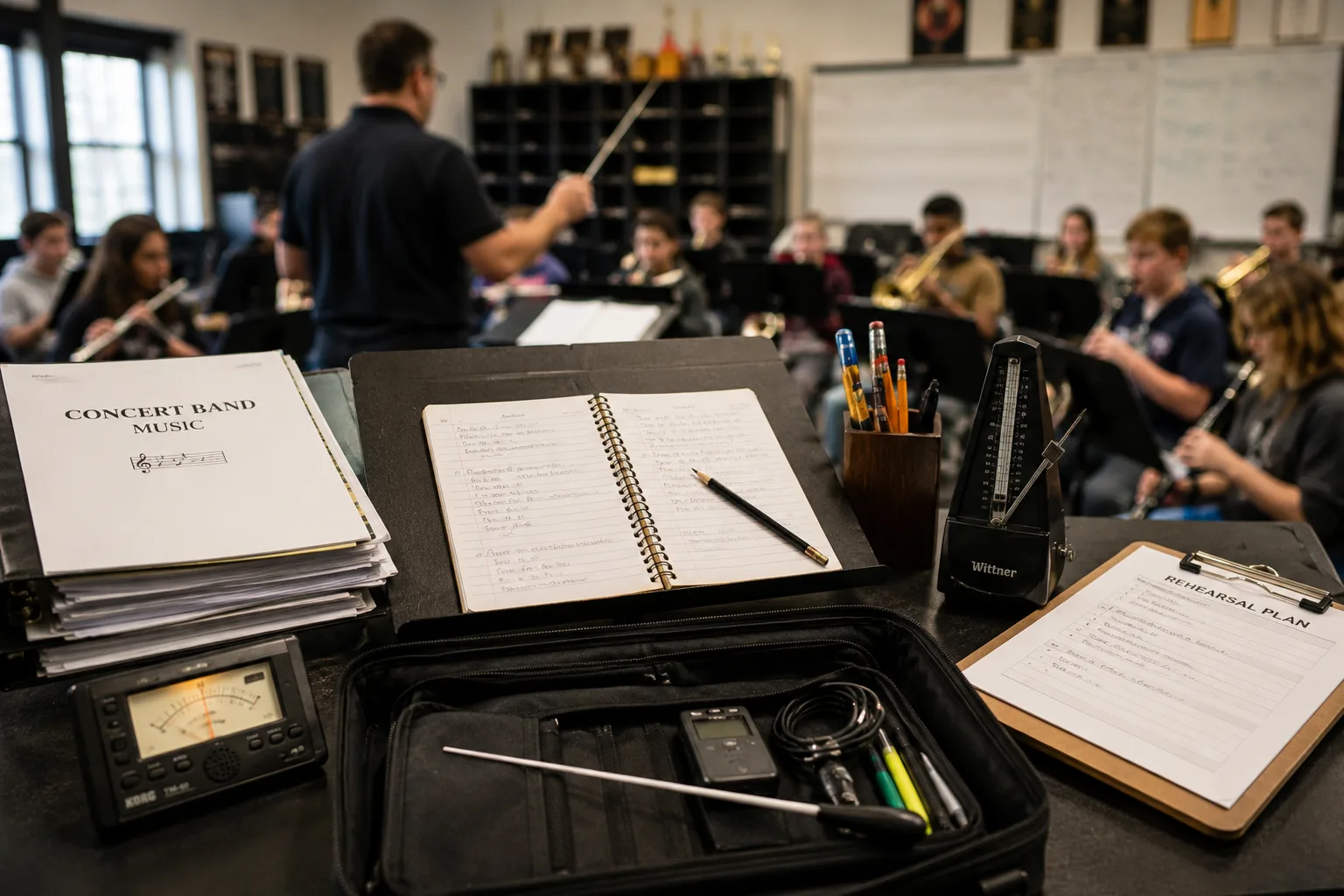
Walk into any band director's office and you'll see something interesting: a complete mess. Or at least, that's how mine looks. There's sheet music everywhere, a binder that fell apart three years ago, some kind of stand that I'm not even sure what it's for anymore, and probably a half-eaten sandwich from last week.
But underneath that chaos? There's actually a pretty specific set of tools that make the whole thing work.
When I started directing, I thought I needed everything. I bought fancy conducting batons with special grips, expensive music stands for every single person, software that was supposed to revolutionize how I ran rehearsals. Some of it helped. Most of it just collected dust.
After more than a decade of figuring out what actually matters, I've narrowed it down to what really makes a difference. Here's what's actually sitting in my bag and on my desk right now.
The Essentials You Can't Skip
A decent conducting baton. Honestly, you don't need anything fancy. I've got a $12 baton from a music store that's been through probably two hundred rehearsals. It's lightweight, the grip is comfortable, and it works. What matters is that you're comfortable holding it and that your students can see your beat clearly. That's it. Everything else is just noise.
A metronome. Not the one on your phone, unless you really have to. Get an actual metronome—the kind that sits on your stand and keeps time audibly. Kids need to hear it, especially when they're struggling with rhythm. I use a pretty standard one, nothing special. The physical one teaches better than the digital version tucked in your pocket.
A quality music stand. Just one to start. You're going to spend a lot of rehearsal time at that stand. If it's wobbly or adjusts weird, you're going to hate it. Get one that actually stands stable and adjusts to where you need it. Your rehearsals will feel less frustrating when you're not fighting with your equipment.
A pencil. Seriously. A regular wooden pencil. Not a pen, not a mechanical pencil. A wooden pencil that you can erase with. You're going to be marking things, making notes, circling measures, and writing reminders. Having a tool you can actually erase with is essential.
The Organizational Stuff That Actually Works
I used to have a color-coded system with tabs and labels. It looked amazing. I used it for about two weeks.
What actually works for me is simpler than that. I've got binders for each ensemble—one for concert band, one for jazz, one for marching band. Inside each one, I keep the parts organized by order of performance and date. That's it. No fancy filing system. When I need something, I know which binder to grab and roughly where it is.
A clipboard. Get a solid plastic clipboard. You're going to use it to take attendance, make quick notes during rehearsals, and mark down who wasn't here so you remember who needs extra help. It's one of those things that sounds simple but completely changes how you function.
A notebook that lives on your stand. This is where you write what you're working on that day, what needs fixing, what's actually improving, and what you want to focus on tomorrow. You'd be amazed how many times you'll think "I'm going to remember that needs work" and completely forget by the next rehearsal. Write it down.
The Tech Stuff (But Only What You'll Actually Use)
Here's where people get lost. There's about a million apps and programs claiming to make your life easier. Most of them will frustrate you.
What I actually use: Google Drive for storing arrangements and notes. That's it. It's free, it works, and I can access it from anywhere. I've got folders for each ensemble and each year. Simple.
A recording app on your phone. Just the basic voice memos or whatever comes with your phone. Record a few minutes of rehearsal now and then. Play it back and listen for the things you might miss while you're conducting. It's eye-opening. Your ears get so focused on certain things that you miss what's actually happening in other sections.
Honestly? Most band directors are spending too much time trying to find the perfect app instead of just using what's available. Your phone probably has everything you need.
The Things That Actually Make Your Rehearsals Better
A good tuner. Not for you—for your students. They need to see what being in tune actually looks like. A visual tuner helps them understand what you're talking about when you say "flat" or "sharp." I bought a reasonably priced one that sits on my stand, and it's probably used more than anything else in my kit.
Quality ear training. This isn't really a tool you buy, but it's something you develop. Listen to a lot of music. Listen to your band. Listen when you're driving. Listen to recordings of professional ensembles playing the same pieces you're working on. Your ear is your most important tool, and you have to develop it intentionally.
Actual, printed arrangements that you've marked up. Yes, you might have PDFs on your iPad. But have at least one full set of printed music with all your notes, boxes around sections you're drilling, tempo markings, dynamics you want emphasized—all of it marked in. When you look at it during rehearsal, everything you've prepared is right there. You don't have to flip screens or wonder what you were thinking.
Time. This isn't something you buy, but you have to protect it like crazy. Have a block of time on your calendar that's sacred—where you're not teaching, not at a meeting, not in your office answering emails. You're just listening to arrangements, thinking about what works, sketching out rehearsal plans, or dealing with administrative stuff that actually matters.
The One Thing Everyone Overlooks
This is going to sound weird, but get comfortable shoes. Seriously. You're going to spend four, five, maybe six hours a day on your feet if you're teaching multiple ensembles. If your feet hurt, everything about your day gets worse. You get irritable, you stand in weird ways because you're trying to relieve pain, and your teaching suffers.
I spent years in dress shoes because I thought that's what a director was supposed to wear. Then I switched to actually comfortable shoes, and my rehearsals got better because I was in a better mood.
What You Don't Need
Save your money on fancy conducting mirrors. You don't need ten different types of batons. Don't buy expensive software that promises to do your planning for you. Don't get a music library management system unless you've got hundreds of pieces to track.
The stuff that matters is simple and affordable. The expensive stuff usually just makes you feel like you're more prepared than you actually are.
The Real Toolkit
Honestly, the actual toolkit comes down to this: clarity about what you're trying to accomplish, organized space to work in, and tools that don't get in your way. Everything else is optional.
If you're feeling overwhelmed by all the options out there, start with the basics. Get a pencil, a notebook, a decent stand, and a metronome. Figure out how you actually work best. Talk to other directors about what they use. Borrow ideas, but don't feel like you have to have everything someone else has.
And if you're really wanting to level up your approach to how you run rehearsals, structure your program, or design your ensembles, that's where getting actual guidance helps. There are music education resources and consultants who can help you figure out what's going to work best for your specific situation. Dr. Ward Miller's band directing consultation services can help you think through the bigger picture—not just what tools you need, but how to actually use them effectively with your specific students.
But the basic answer to "what do I actually need?" is a lot less than you probably think. Get good at the fundamentals with simple tools, and everything else follows from there.
Your students don't care about your fancy equipment. They care that you're prepared, you know what you're doing, and you actually listen to them. That's your real toolkit right there.