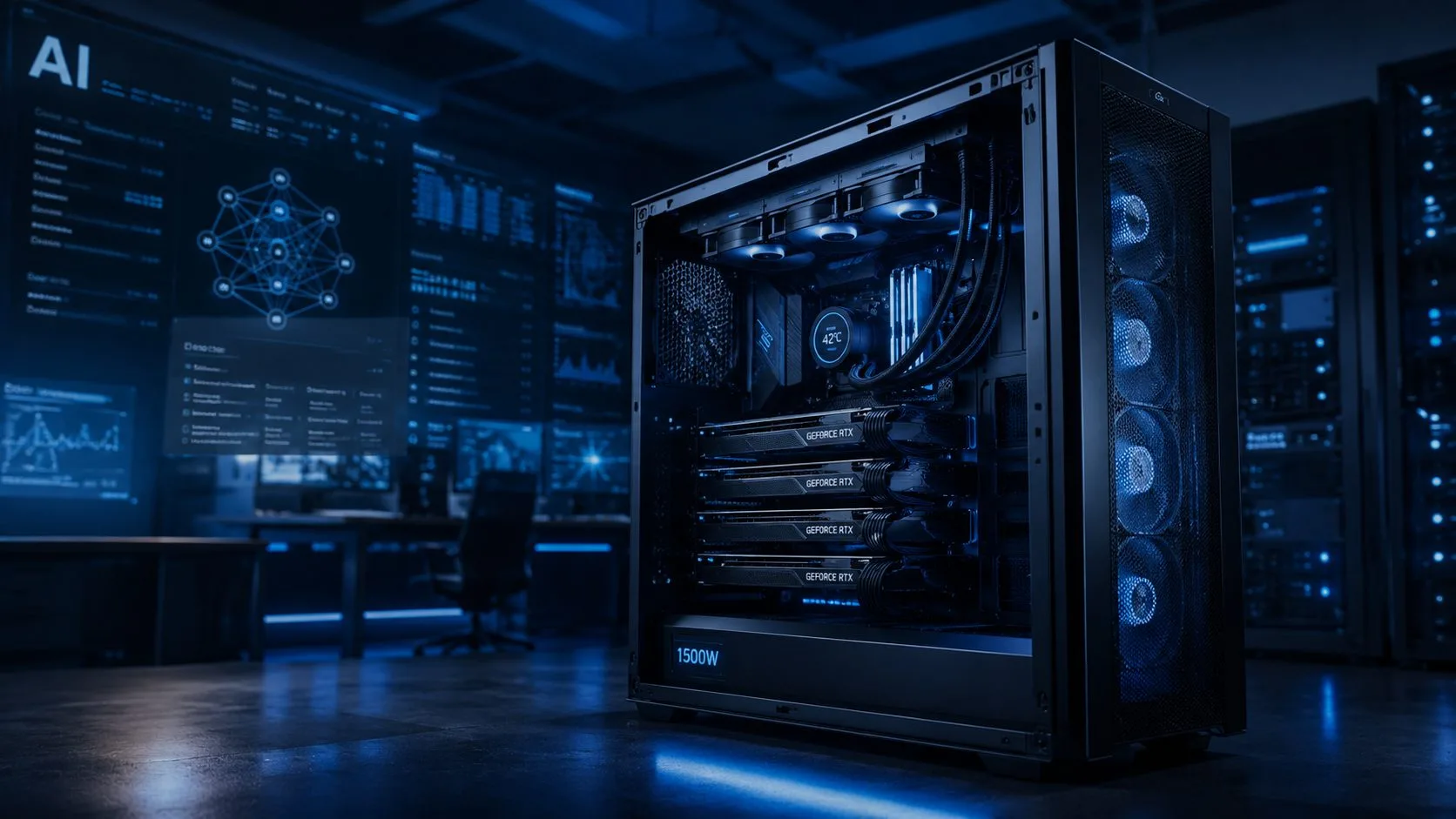

Artificial intelligence has entered a new phase in 2026. For years, the conversation around AI focused heavily on one question: how powerful can the next model become? Bigger systems, larger datasets, longer context windows, and increasingly sophisticated reasoning capabilities dominated headlines. massage tisch
Now, the conversation is changing.
The next major AI trend is not simply about building larger models. It is about making advanced AI faster, more efficient, affordable, and practical for everyday use.
This shift could influence everything from smartphones and personal computers to business software, data centers, robotics, education, healthcare, and scientific research. As AI becomes embedded into more products and services, efficiency is becoming just as important as raw intelligence.
Why AI Efficiency Matters in 2026
Modern AI systems require substantial computing resources. Training sophisticated models can involve enormous amounts of processing power, while serving millions of users requires a huge infrastructure of specialized chips and data centers.
That creates several challenges.
First, companies need to control operating costs. An AI service that requires expensive computing resources for every request can become difficult to scale profitably.
Second, organizations increasingly want AI capabilities on local devices. Businesses and consumers may prefer systems that can perform certain tasks directly on a laptop, smartphone, vehicle, or industrial machine rather than sending every request to a remote server.
Third, energy consumption has become a major consideration. Data centers require electricity not only for computing but also for cooling and supporting the surrounding infrastructure.
These pressures are encouraging researchers and technology companies to focus on doing more with less.
Smaller Models Are Becoming More Capable
One of the most interesting developments is the improvement of smaller AI models.
A few years ago, smaller systems often sacrificed too much capability compared with their larger counterparts. Today, better training techniques, improved datasets, specialized architectures, and more efficient inference methods are helping compact models perform increasingly sophisticated tasks.
This matters because a smaller model can sometimes operate with significantly fewer computing resources.
Instead of relying on a massive cloud-based system for every task, an application might use a compact model for routine requests and reserve larger systems for more complicated problems.
This creates a more flexible approach to AI deployment.
For example, a smartphone could handle simple writing assistance, image organization, translation, or device automation locally while connecting to a larger system only when advanced reasoning is necessary.
AI Is Moving Closer to the Device
Another important trend is the rise of on-device AI.
Modern smartphones and computers increasingly include specialized hardware designed to accelerate machine-learning workloads. These processors can handle certain AI operations without depending entirely on remote infrastructure.
The benefits can be substantial.
Local processing can reduce latency because information does not always have to travel to a distant data center and back. It can also improve privacy for tasks involving sensitive information, because some operations can remain on the user's device.
For manufacturers, on-device AI also creates opportunities to develop new product features.
Cameras can become better at understanding scenes. Computers can organize information more intelligently. Vehicles can process sensor data more rapidly. Smart home systems can respond to commands with less dependence on external servers.
The result is an AI ecosystem that is increasingly distributed rather than concentrated entirely in the cloud.
Smarter Computing Hardware
Software efficiency is only one part of the story. AI hardware is also evolving rapidly.
Traditional processors are not always ideal for the enormous mathematical workloads associated with modern AI. As a result, specialized accelerators have become increasingly important.
Graphics processors remain central to AI infrastructure, while dedicated AI accelerators and neural processing units are becoming more common in consumer devices.
The broader trend is straightforward: hardware is being designed specifically to perform AI workloads more efficiently.
This could eventually make advanced AI capabilities accessible on a wider range of devices.
Instead of requiring a high-end data center for every intelligent feature, more tasks could be handled by specialized hardware inside ordinary computers, phones, vehicles, cameras, and industrial equipment.
Why This Matters for Businesses
Businesses are likely to be among the biggest beneficiaries of the efficiency trend.
Many organizations have experimented with AI but discovered that deploying it at scale involves more than simply choosing a powerful model. Companies also have to consider infrastructure costs, response speed, data management, security, integration, and reliability.
Efficient AI can make these deployments more practical.
A customer-support platform, for instance, could use a smaller model for straightforward questions while sending complicated cases to a more advanced system. A company could therefore reduce unnecessary computing while maintaining higher performance where it matters most.
The same principle can apply to document processing, software development, analytics, marketing, logistics, and internal knowledge systems.
Rather than asking, "What is the largest model we can use?" businesses may increasingly ask, "What is the smallest system that can reliably solve this problem?"
That is a significant change in mindset.
The Rise of Specialized AI
Another major trend is specialization.
Instead of trying to build one system that performs every possible task, developers are increasingly interested in models designed for specific purposes.
A specialized system can often be smaller, faster, and easier to control.
For example, an organization might use one AI system for financial document analysis, another for customer communication, and another for technical research. Each can be optimized for its particular environment.
This approach could lead to a more diverse AI ecosystem.
Large general-purpose systems will remain important, especially for complex reasoning and broad tasks. However, specialized models may become increasingly valuable because they can provide predictable performance at lower operating costs.
Efficiency Could Accelerate AI Adoption
Cost has always influenced technology adoption.
When a technology becomes cheaper and easier to operate, more people and organizations can use it. The same principle applies to artificial intelligence.
If AI systems become significantly more efficient, businesses that previously considered advanced AI too expensive may reconsider.
Small companies could gain access to capabilities that were once available primarily to large technology organizations. Developers could integrate AI into applications without requiring enormous infrastructure budgets. Educational institutions could experiment with intelligent tools on a broader scale.
Efficiency therefore has the potential to expand the overall AI market.
What About Data Centers?
The growth of AI is also reshaping data-center infrastructure.
Large computing facilities are being redesigned around the demands of AI workloads. High-performance accelerators, advanced cooling technologies, networking equipment, and energy management systems are becoming increasingly important.
This creates another technological race: not simply building more computing capacity, but building infrastructure that can support more AI operations with less energy and lower cost.
Liquid cooling, improved chip design, better server utilization, and more efficient data-center layouts are all part of this broader movement.
The future of AI infrastructure may therefore depend as much on engineering efficiency as on model innovation.
A New Definition of AI Progress
The most important change may be philosophical.
For years, progress in AI was often measured by benchmark scores, parameter counts, and demonstrations of increasingly impressive capabilities.
Those measures still matter, but they are no longer the whole story.
In the real world, an AI system needs to be useful. It needs to respond quickly, operate reliably, fit within a reasonable budget, and integrate smoothly into existing products and workflows.
A model that is slightly less capable but dramatically cheaper and faster may create more practical value than a much larger system that is expensive to operate.
That is why efficiency could become one of the defining themes of AI in 2026 and beyond.
What Consumers Can Expect
For everyday users, this trend could lead to quieter but meaningful improvements.
Future phones and computers may perform more intelligent tasks locally. Applications could become more responsive. AI features may work even when connectivity is limited. Battery consumption could improve as hardware and software become better optimized.
Consumers may also encounter more specialized AI features rather than one enormous assistant responsible for everything.
The technology may become less visible while becoming more useful.
That is often how mature technologies evolve: they stop feeling like futuristic experiments and become ordinary parts of everyday products.
Looking Ahead
The next chapter of artificial intelligence will not necessarily be defined by the largest model.
It may be defined by the most efficient one.
As AI capabilities continue to improve, developers are discovering new ways to reduce computing requirements while maintaining strong performance. Smaller models, specialized hardware, on-device processing, improved algorithms, and smarter infrastructure are all contributing to this transition.
For businesses, this could mean lower costs and broader adoption. For consumers, it could mean faster and more capable devices. For the technology industry, it could open an entirely new period of competition centered on efficiency.