
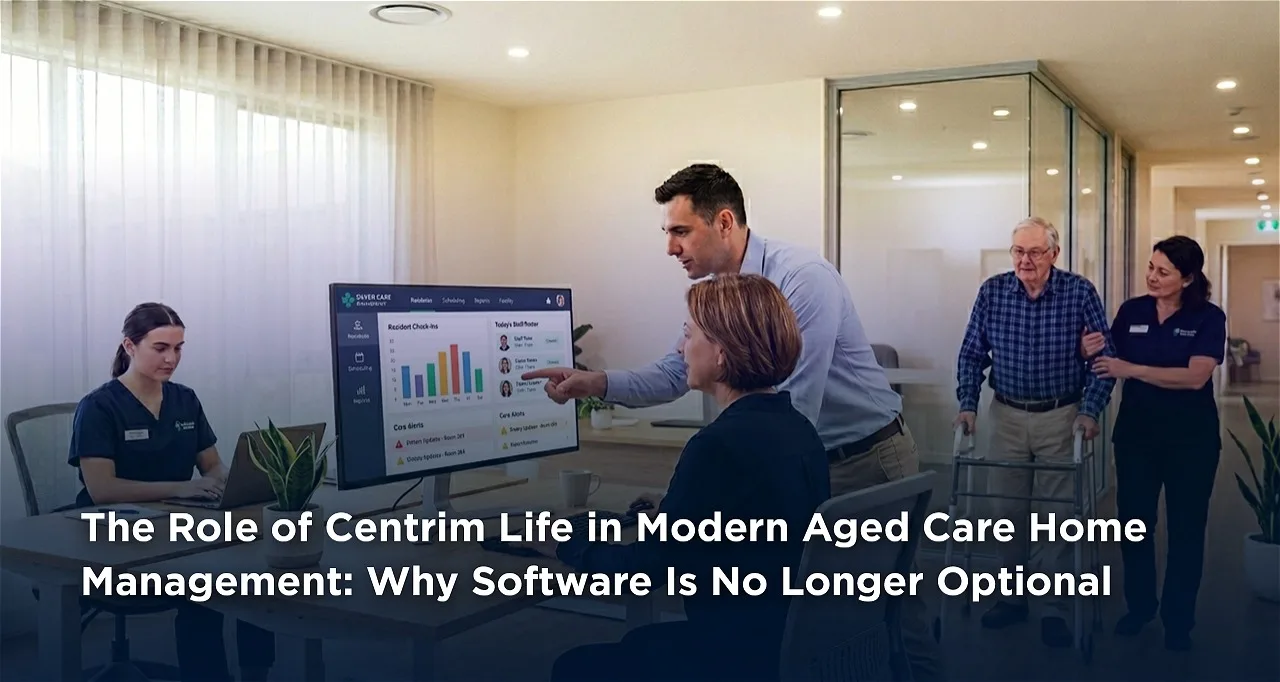
Why software is no longer optional in aged care management
Running a residential aged care facility in 2026 means keeping compliance, dietary safety, maintenance, resident feedback, and family communication moving at the same time, usually across multiple teams. The providers doing this well are not the ones with the longest-serving staff. They are the ones whose systems catch the things people miss.
Aged care management software is what those systems run on. This guide covers why Australian providers are ditching paper, what a connected operational platform actually changes day to day, and how Centrim Life fits into the picture for facility managers working under the strengthened Aged Care Standards.
Paper processes are not just slow. They are a liability.
Nobody set out to build an operation on spreadsheets and whiteboards. It happened one workaround at a time: a roster spreadsheet here, a maintenance log folder there, a dietary alert scrawled on a whiteboard in the kitchen. Each one solved a problem when it was introduced. Together, they create an environment where critical information lives in too many places and reaches the wrong people too late.
The Aged Care Quality and Safety Commission does not audit effort. It audits evidence. Under the strengthened Aged Care Standards (effective 1 November 2025), providers must produce documented, auditable records across clinical care, nutrition, maintenance, and resident experience. Good intentions with disorganised records still generate findings.
That is the practical argument for aged care operational software: the ability to show, on any given day, that what was done matches what was recorded. "Efficiency" is a side effect. Evidence is the point.
What Modern Aged Care Management Actually Involves
Dining and Nutritional Care
Dietary management is one of the highest-risk areas in aged care. Residents have allergies, texture-modified requirements, cultural preferences, and nutritional targets that need to follow them from their care plan to the kitchen to the plate every service, every day, including Thursday night when an agency cook is covering the shift.
Centrim Life's Dining module connects resident dietary profiles to kitchen workflows in real time. When clinical staff update a profile, the kitchen sees it immediately. Temperature logs are captured digitally, menus are built against documented preference data, and meal consumption is recorded to flag residents at nutritional risk before weight loss becomes a clinical problem.
Maintenance and Asset Management
A faulty hoist, a broken call bell, a wheelchair that needs servicing — in a paper-based system, these get reported verbally, written on a request form, and followed up on when someone remembers them. In an aged care software system, they get logged, assigned, tracked, and closed with a digital record that an auditor can retrieve.
Centrim Life's Maintenance module gives facility managers a live view of open jobs, overdue tasks, and asset service histories. For providers managing multiple sites, this removes the need for phone calls to find out what is being done and when.
Housekeeping and Facility Presentation
Housekeeping is rarely the first thing a new software buyer thinks about, but it generates compliance findings more often than most expect. Cleaning schedules, room turnovers, and infection control checks without a documented system – these are hard to verify and easy to miss.
Aged care software solutions that include housekeeping management create a verifiable schedule that staff complete digitally. The record exists whether or not the manager was on site that day.
Lifestyle and Resident Engagement
Standard 1 of the new Aged Care Standards requires providers to demonstrate that residents are supported to pursue their identity, culture, and interests. A lifestyle coordinator running activities from a notebook cannot easily show that individual preferences were considered, that participation was tracked, or that families were kept informed.
Centrim Life's Lifestyle module records individual preferences, schedules activities against them, and gives families visibility into what their relative is doing, creating the documented evidence Standard 1 requires.
Feedback and Quality Management
Complaints and compliments in aged care are not just service data. They are compliance data. Providers must show that feedback was received, acknowledged, and acted on. A feedback register that lives in a folder on someone's desk creates exactly the kind of gap that generates findings.
Residential aged care software that captures and tracks feedback digitally closes that gap. Every piece of feedback has a timestamp, an assigned owner, and a resolution status that an auditor can follow.
Read more about the role of Centrim Life in modern aged care home management here:
https://centrimlife.com.au/blog/the-role-of-centrim-life-in-modern-aged-care-home-management-why-software-is-no-longer-optional/