
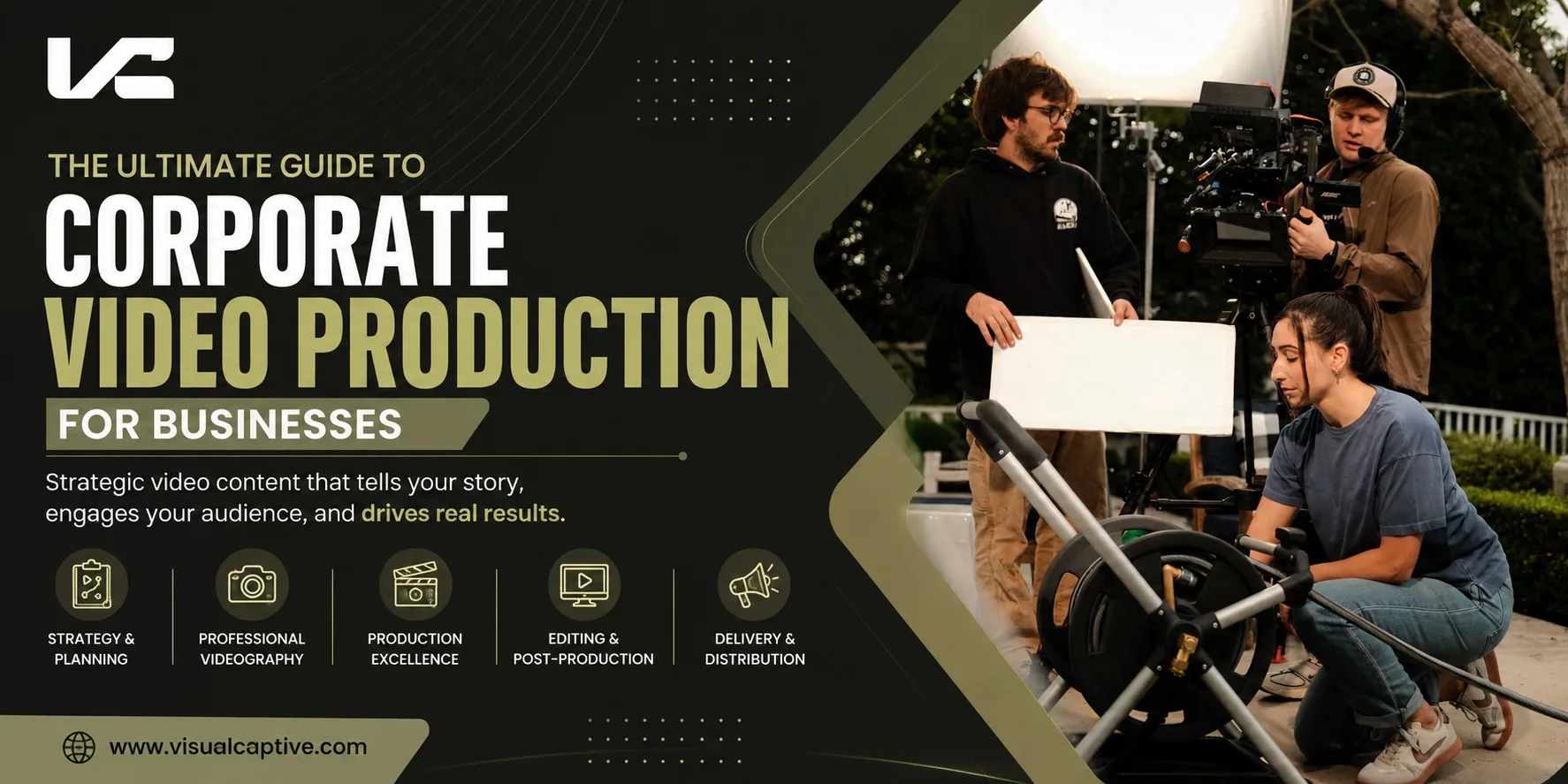
Every business has a story to tell, but not every story captures attention. Whether you are launching a product, recruiting employees, explaining a service, or building customer trust, video has become one of the most effective ways to communicate your message.
Corporate video production goes beyond creating polished visuals. It is a strategic process that turns business goals into compelling video content for marketing, sales, recruitment, training, and internal communications. When planned correctly, one production can create assets for your website, social media, email campaigns, presentations, and more.
This guide explains what corporate video production involves, the types of videos businesses can create, how the production process works, what affects costs, and how to choose the right production partner.
What Is Corporate Video Production?
Corporate video production is the process of planning, filming, editing, and delivering professional video content designed to help businesses communicate with customers, employees, investors, or other stakeholders.
Unlike traditional commercials that primarily focus on advertising, corporate videos can serve a wide range of business objectives. They can educate an audience, explain complex services, introduce a company, showcase employees, support sales conversations, or strengthen brand credibility.
The most effective projects begin with a clear understanding of the business goal and target audience rather than simply starting with a camera.
Types of Corporate Videos for Businesses
Businesses can use different types of video content depending on their goals, audience, and distribution channels.
Brand Story Videos
Brand videos introduce a company's mission, values, people, and personality. They can help potential customers understand what makes a business different while creating a more personal connection with the brand.
Customer Testimonial Videos
Customer testimonials provide social proof by allowing real customers to share their experiences. These videos can be particularly useful for building trust and supporting sales efforts.
Product Demonstration Videos
Product videos show audiences how a product works, what problems it solves, and how it can be used. They are useful for websites, sales presentations, social media, and product launches.
Recruitment and Employer Branding Videos
Recruitment videos give potential employees a look at company culture, workplace environments, and the people behind the organization. This can help businesses attract candidates who are a strong cultural fit.
Training and Internal Communication Videos
Businesses can use video for employee onboarding, training, company announcements, executive communications, and other internal initiatives.
Executive and Leadership Videos
Executive interviews and leadership videos allow business leaders to communicate directly with employees, customers, investors, and other stakeholders.
Why Businesses Invest in Corporate Video
Professional video can support multiple stages of the customer and employee journey.
- Build trust: Seeing real people, products, workplaces, and customer experiences can make a business feel more credible and approachable.
- Increase engagement: Video can communicate information quickly while combining visuals, audio, interviews, and storytelling.
- Support sales: Product demonstrations, testimonials, and case study videos can help sales teams answer common questions before or during conversations with prospects.
- Strengthen recruitment: Authentic workplace and employee content can help prospective employees understand a company's culture.
- Create reusable content: A single production can generate multiple video assets for different channels, increasing the value of the original investment.
The Corporate Video Production Process
A successful project typically moves through three key stages: pre-production, production, and post-production.
Pre-Production
Pre-production establishes the foundation for the entire project. The team defines the objective, target audience, key message, creative direction, script, locations, schedule, and required deliverables.
Depending on the project, this stage may include:
- Audience and goal research
- Creative development
- Scriptwriting
- Storyboarding
- Location planning
- Interview preparation
- Production scheduling
Thorough planning helps reduce delays, unnecessary revisions, and production costs.
Production
Production is where the planned concept becomes visual content. A professional crew manages cameras, lighting, audio, interviews, B-roll, and on-set coordination.
While high-quality cameras can contribute to professional visuals, strong lighting, clean audio, thoughtful composition, and experienced direction are equally important to the finished video.
Post-Production
Post-production transforms the recorded footage into the final business asset. This can include video editing, color correction, sound mixing, music, motion graphics, animation, captions, and other visual elements.
Businesses may also request multiple versions for YouTube, LinkedIn, Instagram, websites, presentations, and email campaigns.
How to Choose a Corporate Video Production Company
Choosing a production partner involves more than comparing portfolios or equipment lists. Look for a company that understands your business objectives and can translate them into an effective visual strategy.
Consider these factors:
- Strategic approach: The production team should ask about your goals, audience, messaging, and intended results.
- Relevant portfolio: Review work that demonstrates experience creating business-focused content, not just attractive cinematography.
- Clear communication: Organized timelines, expectations, deliverables, and feedback processes can make production much easier.
- Creative capabilities: Look for experience with interviews, storytelling, motion graphics, animation, and other formats relevant to your project.
- Long-term thinking: A strong partner should consider how your footage can be repurposed into additional content.
For businesses researching Corporate Video Production in Minneapolis, Visual Captive combines creative strategy, production, and post-production to help businesses create professional visual content for audiences beyond a single market.
What Affects Corporate Video Production Costs?
There is no universal price for a corporate video because every production has different requirements.
Common factors include:
- Video length
- Number of filming days
- Crew size
- Locations
- Equipment requirements
- Travel
- Motion graphics or animation
- Editing complexity
- Number of final deliverables
- Revision requirements
Instead of comparing production costs alone, consider the total value of the project. A production that creates one finished video may provide less long-term value than a project designed to produce a primary video plus multiple short-form assets.
How to Maximize Video Marketing ROI
The best way to increase the value of a production is to plan content distribution before filming begins.
For example, one interview could become:
- A website feature video
- Short social media clips
- A customer testimonial
- Sales presentation content
- Email marketing assets
- YouTube videos
Businesses can also evaluate performance through metrics such as views, watch time, engagement, website activity, leads, conversions, or other objectives connected to the original campaign.
This approach turns video production into a broader content strategy rather than a one-time creative project.
Common Corporate Video Production Mistakes
Even well-planned projects can underperform when businesses overlook the fundamentals.
Common mistakes include:
- Starting without a defined objective
- Trying to speak to everyone at once
- Over-scripting interviews
- Ignoring the target audience
- Forgetting captions and accessibility
- Creating only one version of the video
- Failing to plan distribution
- Prioritizing visuals over the business message
A clear strategy before production can help prevent many of these problems.
Conclusion
Corporate video can be a powerful business asset when strategy and creativity work together. From brand storytelling and customer testimonials to recruitment, training, and product demonstrations, businesses can use video to communicate more effectively across the customer journey.
The goal should not simply be to produce a great-looking video. It should be to create content that supports a specific business objective and continues providing value after the initial production.
With thoughtful planning, professional production, and a clear distribution strategy, one video project can become a valuable collection of marketing, sales, recruitment, and communication assets.
Frequently Asked Questions
What is corporate video production?
Corporate video production is the process of creating professional videos for business goals such as marketing, sales, recruitment, training, and communication. It typically includes planning, filming, editing, and final delivery.
How much does corporate video production cost?
Corporate video production costs vary based on the project scope, including filming days, crew size, locations, equipment, editing, graphics, travel, and the number of final deliverables required for the campaign.
How long does corporate video production take?
Most corporate video projects take several weeks from planning through final delivery. The timeline depends on project complexity, filming requirements, revisions, locations, and the number of videos or formats being produced.
What types of corporate videos can businesses create?
Businesses can create brand story videos, customer testimonials, product demonstrations, recruitment videos, training content, executive interviews, event videos, explainer videos, and internal communication content.
How do I choose a corporate video production company?
Choose a production company with a strong business-focused portfolio, clear communication, strategic planning, professional production capabilities, and experience creating content that supports measurable business objectives.
Can one video shoot create content for multiple platforms?
Yes. A well-planned video shoot can produce a primary website video along with shorter social clips, email assets, sales content, YouTube videos, testimonials, and other reusable marketing materials.