
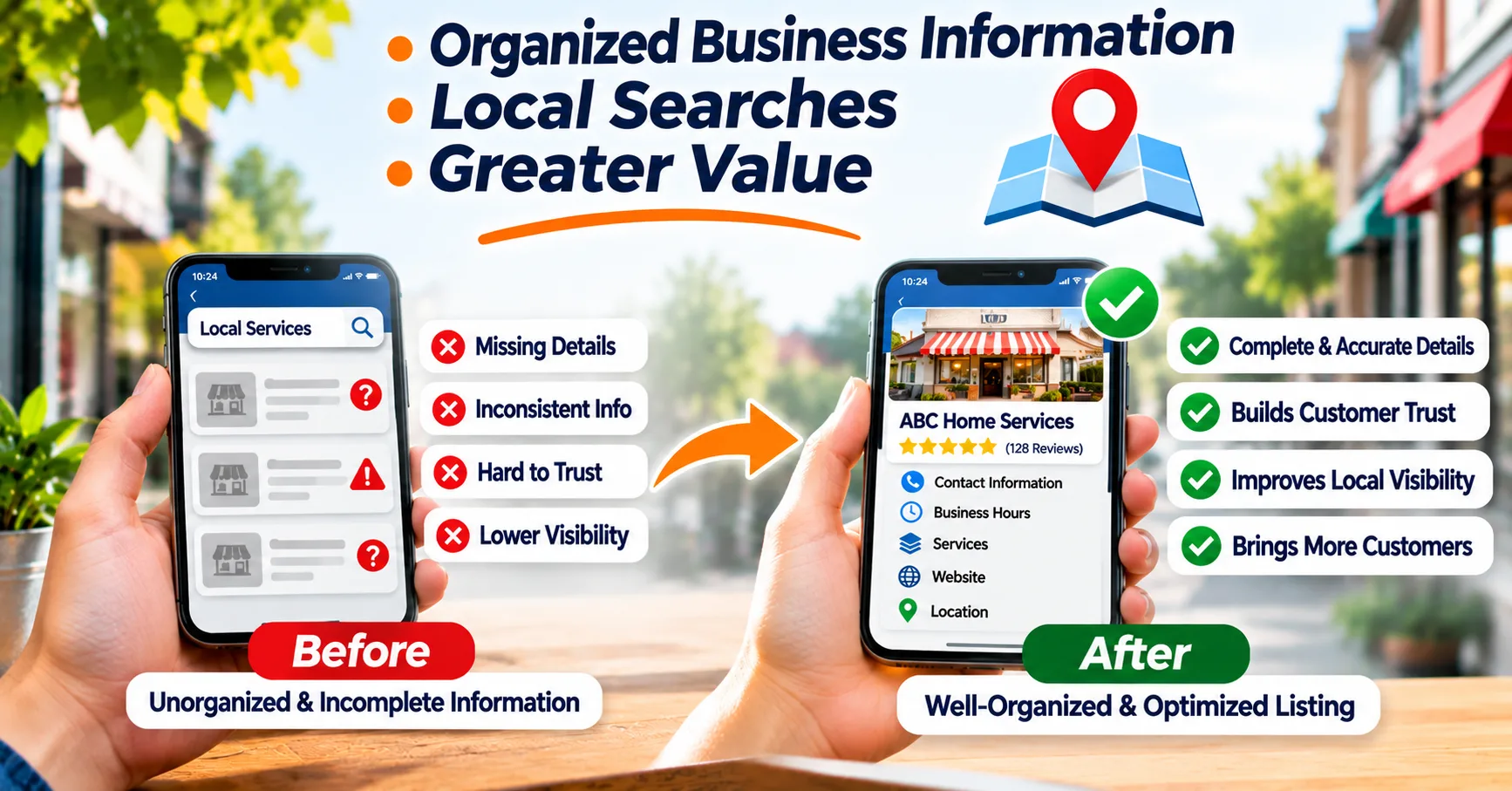
When someone needs a plumber, a dentist, or a café nearby, they rarely start by guessing or asking around. They run a local business search and scan the results that appear in the first few seconds. The name, the distance, the hours, and the first line of description are often enough for them to decide whether to call, visit, or move on to the next option.
That quick decision is the reason organised information matters. It is not about filling in every field for the sake of it. It is about giving a stranger enough clear facts to trust you before they have spoken to you. When those facts are complete and easy to find, the business feels open, active, and ready to help. When they are missing or out of date, the same business can look closed, careless, or hard to reach, even if the work itself is good.
What Organized Business Information Really Means
Organised information starts with the basics, and those basics live in more than one place. Your local business listings should show the same name, address, and phone number everywhere, along with opening hours, the services you offer, and the area you serve. Photos, a short description, and recent reviews complete the picture, because customers read those details together rather than one at a time.
A complete profile answers the questions a customer has before they contact you. What do you do? Where exactly are you? Are you open now? Can you do the job they need? A profile that answers those questions saves the customer a phone call to check, and it saves you a missed enquiry from someone who did not want to guess.
How Customers Use This Information to Decide
Customers do not read a listing the way a business owner does. They scan it. They look for a match with what they need, a distance they are willing to travel, and a sign that the business is currently trading. If those three things line up, they look a little closer at reviews and photos. If they do not, they go back to the results and try the next name.
Reviews and photos carry weight here because they add proof to the facts. A clear photo of the shop, the team, or recent work tells a customer what to expect. A recent review tells them that other people have used the service lately and were happy enough to say so. Neither replaces accurate contact details, but both make those details easier to trust.
- Is it open now?
- Is the phone number correct?
- How far is it?
- Does it offer the service I need?
- What have recent customers said?
That is a short list, and it explains why small errors matter so much. A customer who finds the wrong hours may drive to a closed shop. A customer who calls an old number may assume the business has closed down. Neither customer is likely to try again. They simply choose the next business that looks reliable.
Why Consistency Matters
Consistency is what turns separate profiles into one reliable story. When the same name, address, and phone number appear on your website, on Google, and in a local listing directory, search engines have an easier time trusting that the details are correct. Customers get the same benefit. They see the same facts in different places, and that repetition builds confidence.
Conflicting information has the opposite effect. One site shows the old address, another shows the new one, and a third shows a phone number you stopped using two years ago. A customer has no way to know which one is right, so they pick the business where the answer is clear. The fix is to start with one correct version and use it everywhere, with the same name, address format, phone number, and hours on your website and on every profile you control.
The Role of Directories in Local Discovery
A single profile tells a customer about one business. A business directory brings many profiles together in one place, so a customer can compare them without opening ten different websites. They can look at services, locations, hours, and reviews side by side, and narrow the choice down to two or three names that fit what they need.
That comparison is useful for businesses that are not already well known. A customer who has just moved to an area, or who needs a service for the first time, may not have a name in mind. They start with a category and a place, then work through the options. A clear, complete profile in that setting can put a small business next to larger competitors on equal terms, at least for that first look.
Organized Information and AI Search
AI answers and voice assistants do not invent business details. When they respond to a local business search, they pull from the same public profiles, websites, and reviews that a person would read. If those sources agree, the answer can name the business, give its hours, and explain what it offers. If they disagree, the system has less to work with, and it may leave the business out rather than risk giving wrong information.
This is why the same habits that help in ordinary search also help in AI search. Clear service descriptions, a correct address, accurate hours, and recent reviews give an answer system something solid to use. Vague wording, missing hours, and conflicting addresses give it a reason to choose a competitor whose information is easier to verify. No business can force its way into an AI answer, but it can make its facts easy to find and easy to trust.
What to Keep Updated, and When
Information goes out of date in ordinary ways. A business moves, changes its phone number, adds a service, closes earlier on Sundays, or takes on a new area. Each change is small on its own, but if the profiles are not updated, the old detail stays online and keeps sending customers in the wrong direction. A short check after each change prevents that problem from building up.
- Moved address or changed phone number
- Changed opening hours, including holidays
- Added or removed a service
- Changed service area or delivery area
A regular check is also worth doing even when nothing has changed. Once a month is enough for most small businesses. Look at the main profiles, check the name, address, phone, hours, and services, and fix anything that looks wrong. That habit takes a few minutes, and it keeps the information a customer sees close to the reality of the business.
A Simple Priority Order to Follow
There is no need to list a business everywhere at once. Start with the places people actually use, then widen the net. After the core map profiles are correct, add the business to a trusted local business directory and a few industry or city directories that customers in your area actually use. Those extra profiles help with discovery and give search engines more places to confirm the same facts.
Follow this order: Google Business Profile first, with every field filled in, then Apple and Bing profiles with the same details, then the main review and social profiles your customers use, then industry and city directories that fit your trade and location. That order matters because the first profiles do most of the work. They are the ones customers see in search and on maps. The later ones add support and reach, but they cannot fix a core profile that is wrong or empty.
Conclusion
Organised business information is not a technical extra. It is how a local business is found, understood, and chosen by people who have never met you. When the facts are clear, complete, and the same everywhere, a customer can decide with confidence. When they are scattered or out of date, even a good business can be passed over. Keeping them organised is simple work, and it is work that keeps paying off every time someone searches nearby.