Title plant indexing has moved from manual keying to AI pipelines that classify, extract, and normalize county recordings at scale. Abstractors now work with the exceptions rather than the volume. This guide maps what automates and what stays human.
In everyday terms, title plant indexing is the process of capturing, classifying, and organizing county property recordings into a searchable database. It is arranged by both legal description and party name.
A well-indexed title plant is what makes automated title search possible downstream. When your index is accurate and current, searches that once required an abstractor to walk a chain of title manually can run against structured data instead.
ALTA's Measuring the Complexity of Title Production study 1 found that in more than 80 percent of purchase transactions, title professionals review a minimum of 11 documents per property; in 21 percent, that count exceeds 50 records. Those records need to be in the plant, indexed and current, before a search query runs.
A single normalization error, a trust entity mapped to the wrong index entry, or a mortgage linked to the wrong parcel, can produce underwriting exposure running into six figures.
However, with AI document intelligence pipelines shouldering much of the workload across the full title plant indexing lifecycle, errors have decreased and scaling is possible.
How AI Replaces Manual Work at Each Stage of Title Plant Indexing
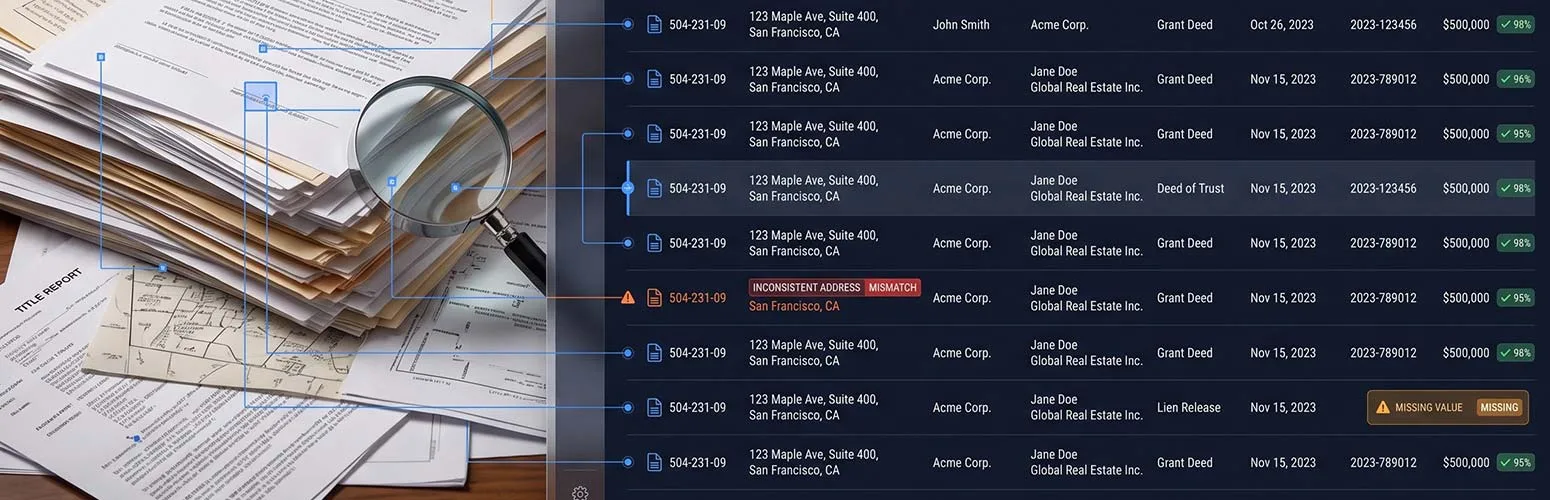
At each stage of title indexing automation, AI can be used with safeguards to maintain accuracy and an audit trail. Each document and extracted field gets its own confidence scoring, and the automated field-level audit trail traces every extracted value back to its source location and document.
Converting legacy records for use in a digital pipeline
Most title plants carry decades of recordings in paper, microfilm, and pre-PRIA formats with handwritten annotations, mixed layouts, and county-specific conventions that change by era.
On the surface, manual title indexing was straightforward. Scan each page, transcribe, sort by instrument type, index names, legal descriptions and other property and transaction identifiers. But the work was grueling, and there was never the number of experts you needed to scale the indexing.
Now OCR engines and vision AI trained on real county recordings, deeds, mortgages, and liens across hundreds of jurisdictions, can convert those pages into searchable, indexable text with supervision. The software is fed county-specific processing rules to handle the format variation and can resolve a 1970s microfilm deed from one county and a 2020 electronic recording from another to the same structured output.
Classifying instruments by type and confidence
A title abstractor's first task on every recording was determining what it is about and the instrument type.
A deed of trust and a mortgage assignment can carry very similar headers, as well as many other property instruments that may have different structures and names while carrying out identical tasks. Determining instrument type required the abstractor to read the body of each instrument, not just the header.
Classification models can now make the same determination by reading body text and scoring classification confidence across hundreds of instrument types. High-confidence classifications are allowed to proceed automatically, while low-confidence recordings are routed to human review with the specific ambiguity flagged.
Extracting data and normalizing to schema
The bulk of a title abstractor's shift went to reading each instrument and keying its data: parties, property identifiers, recording metadata, consideration amounts, lien details. Then normalizing names, compound and multi-part surnames (including paternal-maternal ordering), trust entities, suffixes, and mapping every field to your plant's schema. Consistency degraded after hours of sustained keying.
AI-powered extraction models now extract 100+ data points per instrument, each value mapped back to a specific page and position in the source recording. Normalization maps those fields to a standardized schema (MISMO, PRIA, RESO, or your title plant's custom format) and applies the same naming rules across every instrument.
Legal descriptions present a separate challenge with three incompatible formats (platted subdivisions, government survey sections, metes-and-bounds) each requiring different parsing logic. Parsing those formats into structured fields is largely handled. Interpreting a description that has drifted from prior instruments is not, which is why it routes to a human reviewer.
Cross-referencing and maintaining the plant
An abstractor keying a satisfaction of mortgage earlier had to locate the original mortgage in the plant and link them. The automated pipeline with AI now performs ownership and encumbrance continuity checks, identifying sequencing gaps, open liens, and assignment inconsistencies before a human examiner opens the file.
After initial indexing, newly recorded instruments flow into the plant on a defined schedule, classified and indexed as they arrive, and delivered through API feeds or delta file integration. Your plant stays current, and that currency makes automated title searches possible against live or near-to-live data.
What Stays Human in AI-Assisted Title Abstracting
In a well-tuned AI automated pipeline, 80 to 90 percent of records flow straight through 2. The rest route to human validators: a document the classifier could not confidently type, a field below extraction threshold, a name fitting multiple index entries.
An expert title abstractor usually needs to read a legal description and parse the information to fit the title plant's schema, applying different rules depending on whether the description is platted, sectional, or metes-and-bounds. AI handles much of that extraction and classification now. Human expertise is spent only on the judgment calls flagged by AI including:
- Confidence exceptions: Fields where confidence dropped below threshold, name conflicts the model could not disambiguate.
- Legal description interpretation: Parcels where the recorded text drifts from prior deeds, splits, or lot line adjustments.
- Context-dependent encumbrances: An easement buried in a decades-old survey, an unreleased lien where the payoff occurred but the release was never recorded.
The pipeline performs worst on pre-PRIA handwritten instruments, degraded microfilm, and metes-and-bounds descriptions embedded in narrative legal language. These make up the hardest 15% of a typical document mix and drive the highest exception rates.
Because in AI-powered abstraction the model handles volume and the human validator handles judgment, the combination reaches 99%+ field-level accuracy with human-in-the-loop validation. Quality checks hold every batch to an accuracy threshold before release, with reviewer corrections feeding back into model training.
That feedback loop is where the operational gains compound. Each correction teaches the model to handle a pattern it previously flagged, so the proportion of records requiring human review shrinks over time. Your validators work through the same-sized queue while the total volume processed grows around them.
Texas Abstract Plant Requirements and What They Mean for Indexing
Under TDI Procedural Rule P-12 3, any abstract plant supporting title insurance issuance in Texas must carry fully indexed records covering every recorded instrument in the county from January 1, 1979 forward, kept current to the present date. Insurance Code §2501.004 4 provides the statutory basis: agents may own, lease, or hold interest in a joint plant for each county where they are appointed.
For title agents evaluating how to automate title plant backfile conversion, the regulatory math is straightforward: every year adds another layer of county recordings in formats the pipeline must handle, from pre-PRIA typewritten deeds to modern electronic filings.
P-12 also specifies the indexing standard: geographic order (lot-and-block for subdivisions, survey or section number for acreage tracts), with miscellaneous alphabetical indices maintained by name.
Scaling Title Indexing Automation Across Counties
Pipeline performance varies by county, document era, and recording style. A system tuned on Harris County's platted subdivisions will not perform the same way on a rural New Mexico county's metes-and-bounds recordings or a backfile of faded microfilm spanning three decades of formatting conventions.
In Texas, TDI's Basic Manual 5 requires agents to maintain an abstract plant for every county where they are appointed, with records reaching back to 1979 under P-12, and each decade brings different conventions the pipeline must parse.
Title indexing automation follows a four-step adoption path:
- Scope your plant: Assess the current state, record volumes, source formats, and county-specific instrument types. That assessment shapes the classification schemas, indexing rules, and quality checkpoints configured for each jurisdiction.
- Run a parallel period: Process 30 to 40 files through both the automated pipeline and your manual workflow, logging every divergence: errors, classification disagreements, normalization differences, and legal description parsing.
- Start with standard instruments: Warranty deeds, deeds of trust, lien releases. AI performance on these is well-established. Leave complex instruments (multi-party trust conveyances, mineral rights assignments, deficiency judgments) in the human queue until the model has processed enough volume in that county.
- Monitor the flag rate: The natural tendency is toward over-flagging. Flagging too much is never punished. Missing something is. Without re-tuning, your reviewers end up hand-checking a majority of files.
Now, here is the catch with AI adoption planning for title plants: the labor efficiency gains that make title indexing automation worthwhile depend on keeping the flag rate calibrated. If confidence thresholds climb instead of stabilizing as the pipeline ingests more recordings, check whether the increase reflects genuine issues or threshold drift.
In a manual operation, labor cost scales directly with volume because every additional recording needs an abstractor's time.
With an automated pipeline, the infrastructure handles volume growth and your team has to handle exception volume, not total volume. So as the pipeline matures and the straight-through processing rate stabilizes, your per-record cost drops because the denominator (recordings processed) grows while the numerator (person-hours spent) stays flat or grows more slowly.
Title Plant Indexing After Manual Abstracting
The mechanical layer of title plant indexing, converting, classifying, extracting, normalizing, cross-referencing, and maintaining, now processes through document intelligence pipelines at volumes and consistency no manual team sustained across a full shift.
Abstractors today can concentrate on the exceptions the pipeline routes for human judgment. That combination produces defensible plant data. And because the plant stays both accurate and current, it enables the automated title search operations that manual indexing could never feed fast enough.
Chain-of-title queries that took an abstractor hours of manual instrument review now return from structured, indexed data in seconds.