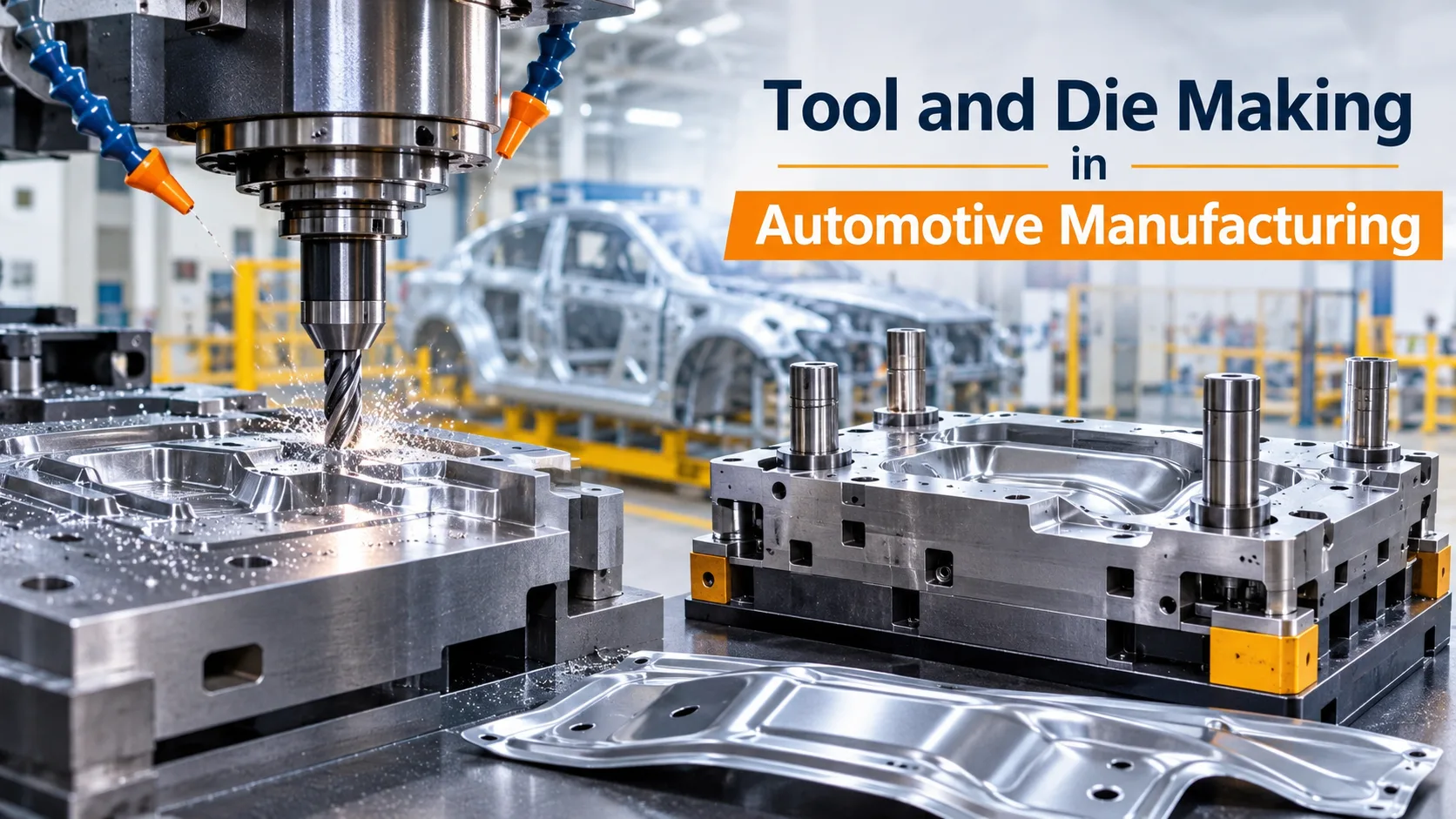
Every vehicle that rolls off a line starts as a stack of flat steel and a set of tools that shape it. Doors, hoods, fenders and the structure underneath them all take their form from dies, and those dies take months of engineering before the first panel is ever pressed. This is the world of automotive tool and die making, and it is where product quality, cost and launch timing are largely decided.
In this guide, we walk through how tooling moves from first prototype to full production, and how a Tier-1 supplier like HIROTEC approaches each stage.
What Is Tool and Die Making in Automotive Manufacturing?
A tool is any custom device used to hold, cut, form or assemble a part. A die is a specialised tool, usually made of hardened steel, that cuts or shapes sheet metal under the force of a press. Tool and die making is the discipline of designing, machining, assembling and tuning these tools so they produce identical parts, millions of times, within tight tolerances.
In automotive, this matters because a single vehicle contains hundreds of stamped and formed components. If the tooling is off by even a small margin, panel gaps, fit and finish and even door-closing sound can suffer.
Stage 1: Prototype and Design Validation
Tooling begins long before steel is cut. Engineers study the part design and ask practical questions: Can this shape be formed without cracking or wrinkling? How many die stations will it need? What material and thickness are specified?
At this stage, suppliers typically:
- Review part geometry for manufacturability
- Run forming simulations to predict problem areas
- Build prototype tools or soft tooling to validate the design quickly
- Feed findings back to the vehicle maker before the design is locked
This early collaboration is where value engineering delivers the most benefit. HIROTEC supports customers across value engineering, prototyping, tool and die, quality iteration and production, so design feedback and tooling decisions stay connected instead of being handed off between separate vendors.
Stage 2: Die Design and Build
Once the design is validated, the production die is engineered in detail. Typical die types include:
Die typeWhat it doesTypical useBlanking dieCuts the flat shape from sheetFirst operation on most panelsDrawing dieForms deep or complex contoursOuter panels, door innersTrimming dieRemoves excess materialEdge finishingPiercing diePunches holes and slotsMounting and fastening pointsProgressive or transfer dieMoves a part through multiple operationsHigh-volume componentsBuilding a die involves precision machining, heat treatment, careful assembly and polishing. Because dies are expensive and long-lived, material selection and surface finish directly affect how many parts they can produce before wear sets in.
Stage 3: Tryout and Quality Iteration
No die is perfect on the first hit. During tryout, the die is installed in a press and the first panels are inspected closely for splits, wrinkles, springback and dimensional drift. Toolmakers then adjust the die, re-test and repeat.
This quality iteration loop is one of the most skilled parts of the process. It rewards experience: a good tryout team can read a panel the way a mechanic reads an engine sound. The goal is a die that holds tolerance consistently, not just once.
Stage 4: Moving Into Production
When the tooling is approved, it moves to the production line. Here, tooling does not work alone. It sits inside a wider system of presses, transfer automation and downstream assembly, including joining steps such as hemming, where panels are folded and bonded to form closures.
HIROTEC is a Tier-1 automotive supplier and systems integrator with facilities across North America, Europe, Asia and Australia, and has worked with robotics for decades, averaging more than 1,000 robots integrated per year since 2010. That integration experience is what links well-made tooling to a stable, repeatable production line.
Stage 5: Maintenance and Continuous Improvement
Production is not the finish line. Dies wear, and regular inspection, sharpening, polishing and part replacement keep output consistent. Many manufacturers follow the Japanese principles of kaizen (steady incremental improvement) and kaikaku (radical change) to decide when to refine existing tooling and when to rethink it.
Common Challenges in Automotive Tooling
- Springback in high-strength steels and aluminium: Newer lightweight materials spring back after forming, so dies must be compensated in advance.
- Tight launch timelines: Tooling is on the critical path of every new model program.
- Cost control: Dies are a major capital investment, so design-for-manufacturing input early on saves expensive changes later.
- Consistency across plants: Global programs need tooling and process standards that hold up in every region.
How to Choose a Tool and Die Partner
When evaluating a supplier, ask:
- Do they cover the full path, from prototype to production, or only one stage?
- Do they have in-house engineering for simulation, design and tryout?
- Can they integrate tooling with automation and downstream assembly?
- Do they have a global footprint to support multi-plant programs?
A partner that handles tooling and automation together reduces handoffs, shortens launch time and makes quality easier to trace.
Key Takeaways
- Tool and die quality shapes the fit, finish and cost of every vehicle.
- The path runs from prototype and design validation to die build, tryout, production and ongoing improvement.
- Early engineering input and a rigorous tryout loop prevent expensive problems downstream.
- Suppliers like HIROTEC, which combine value engineering, tool and die and automation integration, help vehicle makers move from concept to stable production with fewer handoffs.
To learn more about HIROTEC’s capabilities in automotive manufacturing, visit - hirotec.com.