Introduction
Manufacturing businesses across India are embracing digital transformation at an unprecedented pace. From production planning and inventory management to customer service and sales automation, companies are investing in technologies that improve efficiency and profitability.
While many manufacturers already use ERP software to manage operations, customer relationship management often remains fragmented. Sales teams continue to rely on spreadsheets, disconnected applications, emails, and manual follow-ups. As customer expectations rise and competition intensifies, these outdated processes become significant barriers to growth.
This is where a custom CRM makes a real difference.
Unlike generic CRM platforms designed for broad audiences, a custom CRM is tailored to match your unique business processes, sales workflow, dealer network, service operations, and reporting requirements. It integrates seamlessly with your existing ERP, accounting, HRMS, and production systems, creating a unified business ecosystem.
If you're wondering whether it's the right time to invest in custom CRM development services, this guide highlights ten practical signs that indicate your business has outgrown manual processes and off-the-shelf software.
1. Your Sales Team Still Depends on Excel Sheets
Many manufacturing companies begin by managing customer information through spreadsheets.
Initially, this approach seems simple and cost-effective. However, as your customer base grows, Excel quickly becomes difficult to maintain.
Common problems include:
- Duplicate customer records
- Lost quotations
- Missing follow-up reminders
- Version control issues
- No centralized customer history
When multiple sales representatives maintain separate files, management loses complete visibility into sales activities.
A custom CRM software development solution centralizes all customer information in one secure platform, ensuring every department works with accurate and up-to-date data.
2. Leads Frequently Slip Through the Cracks
Generating leads requires significant investments in marketing, exhibitions, referrals, and digital campaigns.
Unfortunately, many manufacturers lose valuable opportunities simply because leads aren't followed up consistently.
Typical warning signs include the following:
- No structured lead assignment
- Delayed responses
- Forgotten follow-ups
- No lead prioritization
- Poor conversion tracking
A modern CRM automatically captures leads from websites, emails, social media, and marketing campaigns while assigning them to the right salesperson instantly.
Instead of relying on memory or sticky notes, your team follows automated workflows that improve response time and increase conversion rates.
3. Customer Information Is Scattered Across Multiple Systems
Does your customer information exist in different places?
Perhaps quotations are stored in emails.
Purchase history sits inside ERP.
Support tickets remain with the service department.
Sales notes stay inside WhatsApp conversations.
When data is scattered, employees spend more time searching than serving customers.
A centralized CRM becomes the single source of truth by connecting departments and providing a complete customer profile, including the following:
- Contact details
- Purchase history
- Previous quotations
- Service requests
- Payment status
- Communication timeline
This holistic view enables better customer service and stronger long-term relationships.
4. Your Sales Process Is Different from Standard CRM Workflows
Many businesses purchase ready-made CRM software expecting it to solve every problem.
Instead, they discover the software forces them to change their existing processes.
Manufacturing businesses often require unique workflows, including:
- Dealer management
- Distributor approvals
- Technical consultations
- Product configuration
- RFQ management
- Multi-level quotation approvals
- Custom pricing
- After-sales service tracking
Generic CRMs rarely support these specialized requirements.
This is why many organizations prefer custom CRM solutions that are designed around their existing business processes rather than forcing employees to adapt to rigid software.
5. Managers Lack Real-Time Business Visibility
How many quotations were sent today?
Which salesperson has the highest conversion rate?
Which region generated maximum revenue this month?
How many high-value opportunities remain pending?
Without real-time dashboards, managers often wait until month-end reports to identify problems.
By then, valuable opportunities may already be lost.
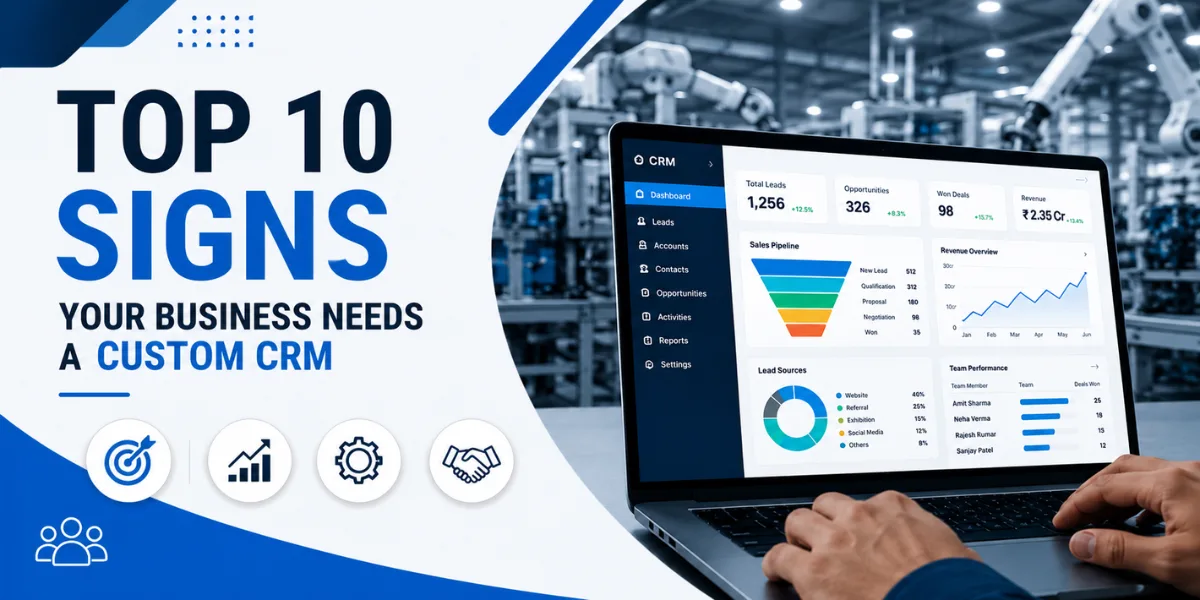
A custom CRM provides live dashboards that display the following:
- Sales pipeline
- Lead sources
- Conversion rates
- Revenue forecasts
- Team performance
- Customer activity
- Pending follow-ups
This enables faster decision-making based on actual business data instead of assumptions.
For organizations seeking the best CRM software development company in Noida, real-time analytics and business intelligence should be among the top priorities when selecting a technology partner.
6. Your CRM Doesn't Integrate with Your ERP and Other Business Systems
Manufacturing businesses rely on multiple software applications to manage operations. ERP handles production and inventory; HRMS manages employees; accounting software tracks finances, while CRM oversees sales and customer relationships.
When these systems operate independently, teams spend valuable time entering the same information repeatedly.
For example, once a sales order is confirmed, the sales team may manually inform production, inventory, and finance departments. This not only slows down operations but also increases the risk of errors.
A modern CRM should seamlessly integrate with:
- ERP software
- Accounting systems
- HRMS
- Inventory management
- Email platforms
- Marketing automation tools
- Customer support software
Well-designed CRM development services help create a connected digital ecosystem where information flows automatically across departments. This reduces manual work, improves accuracy, and accelerates decision-making.
If you're evaluating the Best CRM software development company in India, integration capabilities should be one of the key selection criteria.
7. Customer Retention Is Becoming More Difficult
Winning a new customer costs significantly more than retaining an existing one. Yet many manufacturers unknowingly lose repeat business because they lack structured customer engagement.
Common issues include:
- No reminders for follow-up calls
- Missed Annual Maintenance Contract (AMC) renewals
- Forgotten warranty expirations
- Inconsistent communication
- Delayed service requests
A custom CRM automates these activities by sending reminders, assigning follow-up tasks, and maintaining a complete communication history.
Instead of reacting to customer issues, businesses become proactive in building long-term relationships.
This not only improves customer satisfaction but also increases repeat orders, referrals, and lifetime customer value.
8. Preparing Reports Takes Hours Instead of Minutes
How much time does your management team spend preparing monthly sales reports?
If employees export data from multiple Excel sheets, manually combine information, and create reports every week, productivity suffers.
Manual reporting often leads to the following:
- Data inconsistencies
- Calculation errors
- Outdated information
- Delayed decision-making
A custom CRM generates reports automatically with just a few clicks.
Decision-makers can instantly access insights such as the following:
- Sales performance
- Lead conversion rate
- Revenue by region
- Product-wise sales
- Sales representative performance
- Customer acquisition trends
Real-time reporting empowers leadership teams to respond quickly to market changes rather than waiting for month-end summaries.
9. Your Business Is Growing Faster Than Your Existing Processes
Growth is exciting—but it also exposes weaknesses in outdated systems.
As your business expands into new cities, adds dealers, hires more sales representatives, or launches new product lines, manual processes become increasingly difficult to manage.
Signs include:
- More customer complaints
- Delayed approvals
- Communication gaps
- Duplicate work
- Difficulty managing multiple branches
- Lack of standardized workflows
This is where Custom CRM development services provide long-term value.
Unlike generic software with fixed limitations, a custom CRM grows alongside your business. New modules, workflows, user roles, and integrations can be added as your operational needs evolve.
Instead of replacing software every few years, manufacturers build a scalable digital foundation that supports sustainable growth.
10. You Need Better Data Security and Compliance
Customer information is one of the most valuable assets for any business.
However, storing customer records in Excel files or sharing them through emails and messaging apps increases security risks.
A professionally developed CRM provides features such as the following:
- Role-based access control
- Secure cloud hosting
- Data encryption
- Activity logs
- Automated backups
- Audit trails
- Permission management
These capabilities help protect sensitive business information while ensuring accountability across departments.
Choosing an experienced CRM software development company ensures your CRM follows industry best practices for security, scalability, and future upgrades.
How to Choose the Right CRM Development Partner
Selecting the right technology partner is just as important as choosing the software itself.
Before making a decision, evaluate whether the company:
- Understands manufacturing business workflows
- Offers industry-specific customization
- Provides ERP integration expertise
- Builds scalable solutions
- Delivers post-launch support and maintenance
- Has proven implementation experience
- Focuses on long-term business value rather than just software delivery
Many businesses searching for the best CRM development company prioritize experience, customization capabilities, and industry knowledge over price alone—and for good reason. A CRM is a long-term business investment, and the right partner can significantly influence its success.
Conclusion
Digital transformation is no longer limited to large enterprises. Manufacturing businesses of every size are adopting smarter technologies to improve productivity, strengthen customer relationships, and stay competitive.
If your organization is experiencing several of the signs discussed in this article—such as scattered customer data, missed sales opportunities, manual reporting, poor system integration, or limited visibility—it may be time to move beyond spreadsheets and generic software.
A thoughtfully designed custom CRM doesn't just organize customer information. It streamlines operations, automates repetitive tasks, improves collaboration across departments, and provides the insights needed for confident decision-making.
By working with an experienced partner that specializes in custom CRM solutions, manufacturers can build a platform tailored to their unique processes and future growth plans.
The sooner you identify these challenges, the sooner you can transform them into opportunities for increased efficiency, stronger customer relationships, and sustainable business growth.