Mobile applications have become an essential part of how modern businesses attract customers, streamline operations, and deliver digital services. From healthcare and finance to retail, education, logistics, and professional services, companies increasingly rely on mobile apps to create convenient and personalized user experiences.
Maryland is home to a growing technology ecosystem, with app development companies serving businesses across Baltimore, Rockville, Bethesda, Frederick, Columbia, and other technology hubs. Choosing the right development partner, however, can be challenging. Companies differ in technical expertise, pricing, industry experience, development methodologies, and project sizes.
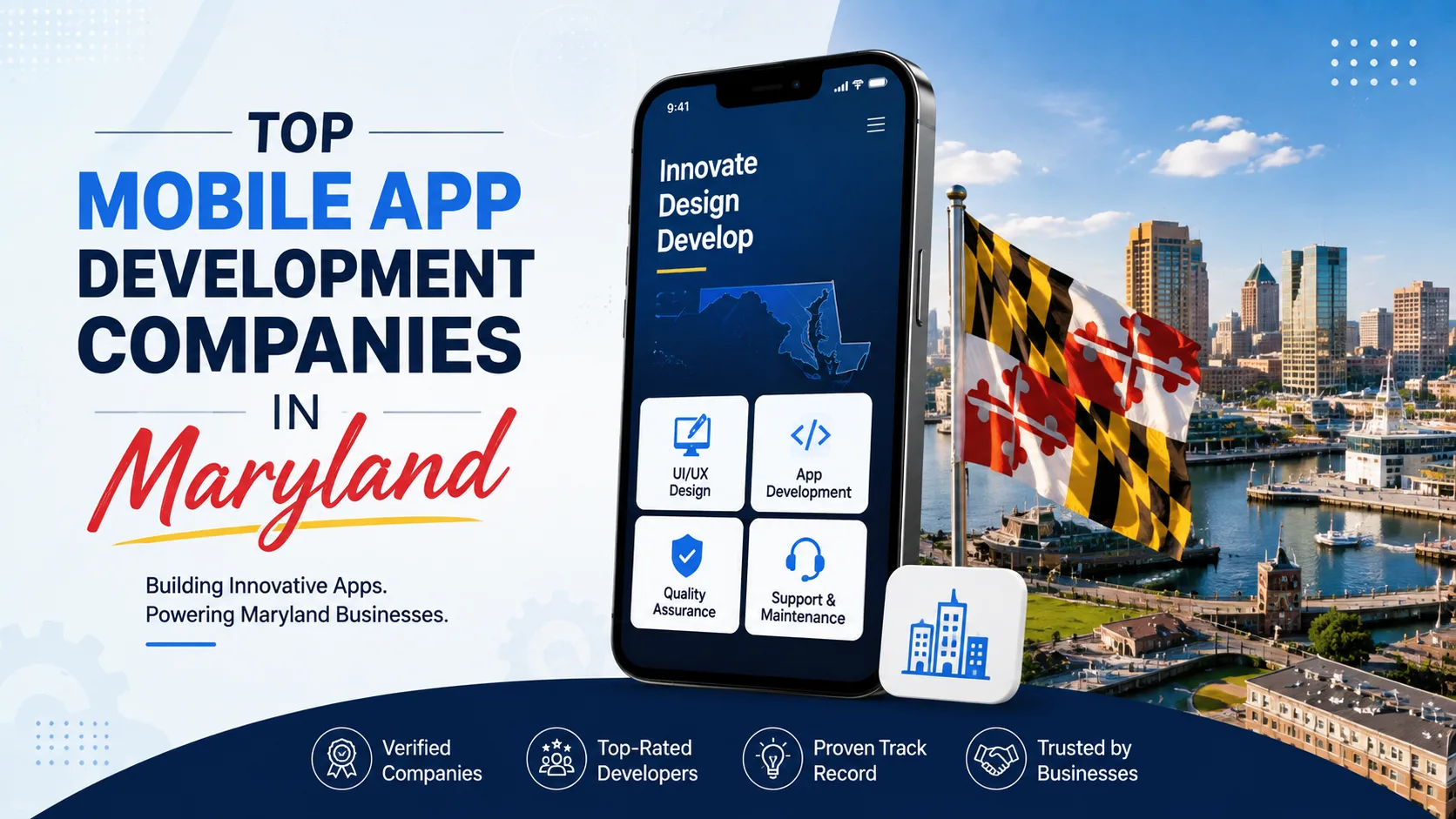
This guide highlights some of the top mobile app development companies in Maryland and explains what businesses should consider before selecting a development partner. The company selection is informed by current 2026 industry listings, client reviews, service offerings, and market presence.
Why Choose a Maryland Mobile App Development Company?
Maryland offers businesses access to a strong technology and innovation ecosystem. Its proximity to Washington, D.C., Baltimore, and major research and healthcare institutions also gives local development companies exposure to complex enterprise and regulated-industry projects.
Working with a Maryland-based or Maryland-serving app development company can provide several advantages:
- Access to experienced developers: Companies can find teams specializing in iOS, Android, cross-platform, cloud, AI, and custom software development.
- Industry expertise: Maryland agencies often work with healthcare, government, financial services, education, and technology businesses.
- Better collaboration: A partner operating in the same or nearby time zone can make meetings, communication, and project management easier.
- End-to-end services: Many firms offer strategy, UX/UI design, development, testing, deployment, and ongoing maintenance.
- Scalable solutions: Established agencies can build applications designed to support future users, features, integrations, and business growth.
Top Mobile App Development Companies in Maryland
1. Apptunix
Based in Rockville, Apptunix is one of the most prominent Maryland app development companies. Current Clutch listings place the company among the leading mobile app developers in the state, with mobile app development accounting for 40% of its listed service focus. Its capabilities include iOS, Android, hybrid and cross-platform development, web development, application management, and UX/UI design.
Apptunix can be a strong choice for businesses looking for a relatively focused development partner that can support an application from initial concept through ongoing management.
2. SoftDoes
Located in Bethesda, SoftDoes offers mobile development alongside AI consulting, AI development, custom software development, enterprise application modernization, UX/UI design, and IT services. Current Clutch data lists both Android and iOS development among its mobile capabilities.
This broader technical portfolio makes SoftDoes worth considering for businesses interested in combining mobile applications with AI, modernization, or enterprise technology initiatives.
3. Kingsmen Digital Ventures
Kingsmen Digital Ventures serves Maryland businesses with a combination of mobile app development, custom software development, UX/UI design, and web development. Clutch currently reports that mobile development represents 35% of its service focus. Its portfolio spans areas such as automotive, fitness, beauty, and sports.
It may be a suitable option for businesses that want a smaller team capable of handling both application development and broader digital product requirements.
4. Tsoftek
Columbia-based Tsoftek is another company to consider, particularly for businesses seeking a firm with a strong mobile development focus. Current Clutch listings show mobile app development as 70% of its service focus, with Android development also representing a significant portion of its capabilities.
Its comparatively focused service profile can make it relevant for organizations where mobile application development is the primary requirement.
5. DMI (Digital Management, Inc.)
Based in Bethesda, DMI is a larger technology organization offering mobile application development as part of a broader portfolio. Current Clutch listings identify mobile development and Android development among its capabilities, alongside enterprise technology services.
Larger organizations with complex requirements, multiple integrations, or enterprise-level digital initiatives may find this type of development partner particularly relevant.
How to Choose the Right Mobile App Development Company
A company appearing on a top list is not automatically the best fit for every project. Before signing a contract, businesses should evaluate several factors.
1. Technical Expertise
Determine whether the agency has experience with the technology your application requires. This could include native iOS development, Android development, Flutter, React Native, cloud infrastructure, APIs, AI, IoT, or third-party integrations.
2. Portfolio and Case Studies
Review previous applications rather than relying solely on marketing claims. Look for projects comparable to yours in terms of industry, functionality, complexity, and target audience.
3. Client Reviews
Independent reviews can reveal how a company handles communication, deadlines, budgets, technical challenges, and post-launch support. Clutch, for example, evaluates providers using client feedback, experience, and market presence.
4. Development Process
Ask how the agency manages discovery, prototyping, design, development, testing, deployment, and maintenance. A transparent process can reduce misunderstandings and help keep the project on track.
5. Security and Compliance
Security should be a priority, particularly for applications handling financial, personal, healthcare, or business-critical information. Ask prospective developers about authentication, encryption, secure APIs, data storage, testing, and relevant regulatory requirements.
6. Cost and Long-Term Support
Don't select a developer based solely on the lowest initial quote. Consider the total cost of ownership, including design, development, testing, cloud services, updates, bug fixes, security patches, and ongoing improvements.
What Should Businesses Expect From the Development Process?
A professional mobile app project generally begins with discovery and strategy, where the development team defines business objectives, users, features, technical requirements, and success metrics.
The next stage is UX/UI design, followed by development of the application's front end, back end, databases, APIs, and integrations. Comprehensive quality assurance and testing should then cover functionality, usability, performance, security, and compatibility.
After launch, the development partner may provide maintenance and optimization, including bug fixes, operating-system updates, performance improvements, analytics, and new features.
For businesses, selecting a partner capable of supporting the entire lifecycle can be more valuable than simply finding a team that can build the initial version.
Conclusion
Maryland offers businesses access to a wide range of mobile app development expertise, from specialized boutique teams to established technology firms. The right development partner should be selected based on your business goals, budget, technical requirements, industry needs, project timeline, and plans for future growth.
Rather than making a decision based solely on rankings or popularity, businesses should carefully evaluate portfolios, client feedback, technical expertise, communication practices, pricing structures, security standards, and post-launch support. A development partner that understands both your technology requirements and business objectives can contribute significantly to the success of the project.
Ultimately, investing in the right mobile app development company can help businesses create a reliable, user-friendly application that strengthens customer engagement, improves operational efficiency, supports innovation, and delivers sustainable long-term value.